 blog
blog
Window Cleaning for Commercial Properties: A Manager's Guide
Table of Contents
- Why Commercial Window Cleaning Matters for Your Facility
- Understanding OSHA Window Cleaning Requirements for Your Team
- High-Rise Window Cleaning: Safety and Operations
- Getting an Accurate Commercial Window Cleaning Estimate
- Building a Window Cleaning Maintenance Schedule
- Hard Water Stains and Environmental Challenges
- What Sets Professional Window Cleaning Apart
- Conclusion
- Frequently Asked Questions
Last Updated: September 19, 2026
Why Commercial Window Cleaning Matters for Your Facility
A facility's exterior is the first thing clients, tenants, and visitors see, making window cleaning commercial properties a critical investment. Dirty windows signal neglect, even if your building is impeccably maintained inside. For property and facilities managers, this visual impression directly affects tenant satisfaction, lease renewals, and your property's market value.
Commercial window cleaning isn't just about aesthetics. Clean windows improve natural light penetration, which boosts employee productivity and reduces lighting costs. They also extend window lifespan by removing corrosive mineral deposits and environmental contaminants. At Clarity Window Cleaning, we work directly with facilities managers across the Wasatch Front to establish professional cleaning schedules.
The challenge isn't knowing you need clean windows, it's managing the logistics without disrupting operations. High-rise buildings, multi-tenant complexes, and industrial properties can't afford downtime or tenant complaints. That's where professional window cleaning becomes a strategic facility decision, not just a maintenance task.
Understanding OSHA Window Cleaning Requirements for Your Team
If your facility has an in-house maintenance team handling window cleaning, you're responsible for ensuring their safety. OSHA regulations govern work at heights, fall protection, and hazard communication. The specific requirements depend on your building height, window accessibility, and the methods your team uses.
Work at heights above 6 feet requires fall protection systems. This means harnesses, anchor points, and rescue procedures, not just ladders leaning against the building. OSHA also requires documented safety training, hazard assessments for each job site, and equipment inspections before use. Many facilities managers discover their current approach doesn't meet these standards only after an incident occurs.
Professional window cleaning companies handle OSHA compliance as part of their service. They maintain certifications, carry liability insurance, and follow documented safety protocols. This transfers both the legal liability and the operational burden away from your facilities team. For most property managers, outsourcing window cleaning to OSHA-compliant professionals reduces risk significantly.
High-Rise Window Cleaning: Safety and Operations
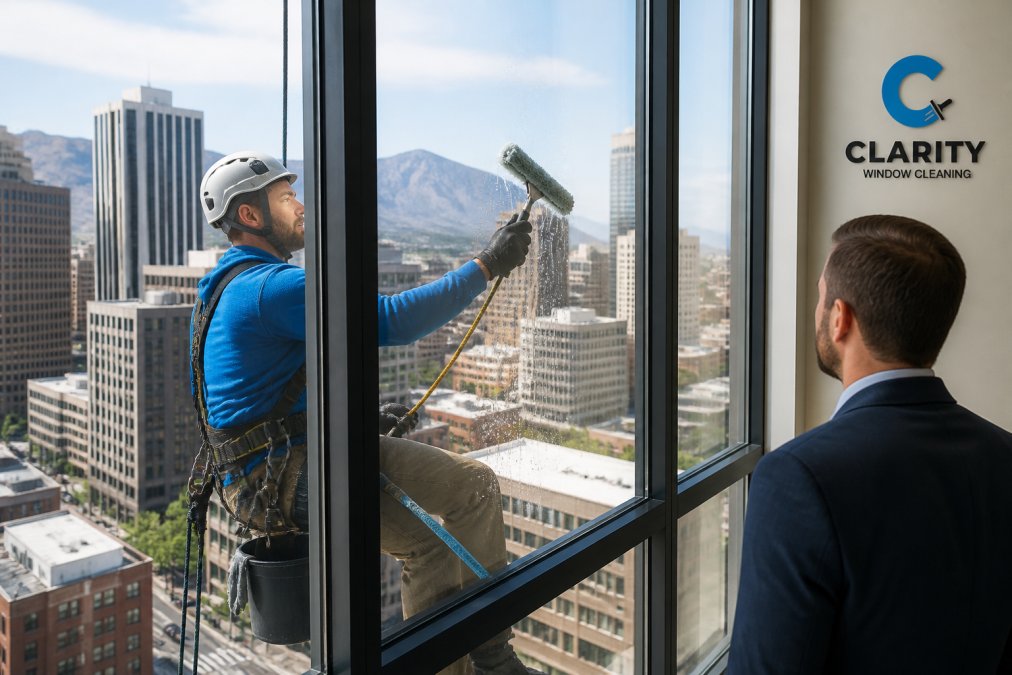
High-rise window cleaning presents unique challenges that differ fundamentally from ground-level work. Buildings over 10 stories require specialized equipment, trained technicians, and detailed safety planning. The methods used, rope access, swing stages, or water-fed poles, depend on building design, window configuration, and safety requirements.

Working Without Disrupting Business Hours
The biggest operational challenge in commercial window cleaning is timing. You can't disrupt tenant operations, block views, or create safety hazards during business hours. Professional window cleaning companies schedule work early morning, evening, or weekends to minimize impact.
Some buildings require work to happen during specific windows: before 7 a.m., after 6 p.m., or on Sundays only. Communicating these constraints upfront prevents scheduling conflicts and tenant complaints. Clarity provides free estimates for all window cleaning needs, and we work directly with facilities managers to build schedules that fit your operational constraints.
Getting an Accurate Commercial Window Cleaning Estimate
A window cleaning estimate should include more than just a price. It should specify the scope of work, frequency, safety methods, and timeline. Vague estimates lead to misunderstandings and disputes later.
When requesting estimates for window cleaning commercial properties, provide this information: building height, total window area, window type (standard glass, skylights, storefronts), current condition (dust, hard water stains, construction debris), and your preferred cleaning frequency. Include any access restrictions, roof access limitations, tenant notification requirements, or time-of-day constraints.
The estimate should break down costs by service component: exterior cleaning, interior cleaning, screen cleaning, and hard water stain removal. It should also specify whether the company provides detailed post-service reporting, which many facilities managers need for board documentation and insurance purposes.
Building a Window Cleaning Maintenance Schedule
Establishing a regular window cleaning schedule prevents buildup, extends window lifespan, and reduces long-term costs. However, the right frequency depends on your building type, location, and operational model, not a one-size-fits-all formula.
Frequency Guidelines by Building Type and Environment
Most commercial properties benefit from one of these schedules:
- Standard office buildings in low-dust environments: Semi-annual (spring and fall) cleaning. Sufficient for buildings with moderate foot traffic and no nearby highways or construction.
- Multi-tenant complexes with high visibility: Quarterly (every 3 months). Tenants notice dirty windows, and appearance directly affects lease renewals and rental rates.
- Buildings near highways or industrial areas: Quarterly or bi-monthly. Road salt spray, exhaust residue, and dust accumulate faster and require more frequent removal.
- High-altitude properties with hard water exposure: Quarterly minimum, with deionized water rinses.
- Buildings with extensive skylights or shaded glass: Quarterly. Skylights accumulate algae and debris faster; shaded areas retain moisture longer.
Facilities managers should assess their building's specific exposure during the first professional cleaning. Ask the technician which contaminants are present and how quickly they accumulate. This informs whether your building needs the baseline schedule or a more aggressive one.
Vacation Rental Properties: Turnover-Specific Cleaning
Property managers of short-term rental properties face a different challenge: windows must be spotless for guest arrival, but cleaning frequency is driven by turnover rate, not calendar months. A vacation rental with weekly turnover needs window cleaning before each new guest arrives, while a property with monthly bookings needs less frequent service.
Turnover cleaning should include:
- Full exterior and interior glass cleaning
- Window track and frame debris removal (guests notice dust in tracks)
- Screen inspection and cleaning (torn screens are a common guest complaint)
- Hard water stain removal if present (mineral deposits signal poor maintenance)
- Final inspection from guest perspective (standing outside looking in, then inside looking out)
For property managers managing multiple vacation rentals, Clarity provides free estimates for all window cleaning needs and works directly with property managers to build turnover schedules that align with your booking calendar.
Documentation and Accountability
A maintenance schedule also creates accountability. When cleaning happens on predictable dates, tenants adjust expectations, and facilities staff can plan around it. Professional window cleaning companies should provide post-service documentation including:
- Date and time of service
- Scope of work completed (exterior, interior, screens, frames)
- Any issues identified (damaged seals, broken screens, water intrusion signs)
- Photos or written notes for insurance and board records
Adjusting Frequency Based on Seasonal Factors
Seasonality affects window maintenance needs. Spring brings pollen and dust storms; summer brings pollen and industrial haze; fall brings leaf debris and algae growth; winter brings road salt spray and frozen mineral deposits. Some facilities managers benefit from adjusting frequency seasonally rather than maintaining a fixed schedule year-round.
Hard Water Stains and Environmental Challenges
Hard water deposits are among the most stubborn window problems, but the science behind them, and the solutions, varies significantly by elevation and climate. When water evaporates, minerals, primarily calcium and magnesium, remain on the glass. In areas with high mineral content, these deposits build up quickly and become increasingly difficult to remove.
Why High-Altitude Glass Maintenance Is Different
Buildings at elevation face accelerated mineral accumulation due to three factors: lower atmospheric pressure, lower humidity, and faster water evaporation rates. The dry air also means mineral deposits dry in minutes rather than hours, bonding more firmly to the glass.
Mineral Composition and Regional Water Chemistry
The Wasatch Front's water supply contains elevated levels of calcium carbonate and magnesium silicate. When this water is used for window cleaning, irrigation, or HVAC cooling systems, and then evaporates on glass, it leaves behind a white or cloudy residue. The mineral composition varies by neighborhood and water source, which is why some buildings accumulate deposits faster than others.
Environmental Contaminants Beyond Hard Water
Mineral deposits are only part of the challenge. Winter road salt spray affects buildings within 500 feet of major highways, creating a corrosive film that etches glass if left untreated. Spring dust storms deposit fine silica particles that embed in glass pores. Summer pollen and industrial exhaust create sticky residue that bonds to mineral deposits, making removal more difficult.
Professional Treatment Methods for Regional Challenges
Standard soap and water don't dissolve mineral deposits. Professional cleaners use various approaches to address these challenges.
What Sets Professional Window Cleaning Apart
The difference between adequate and excellent window cleaning comes down to technique, equipment, and attention to detail. A competent window cleaner removes visible dirt. An excellent one removes mineral deposits, streak marks, and frame debris, then inspects the work from multiple angles before declaring the job complete.
Conclusion
Commercial window cleaning is a strategic facility decision that affects tenant satisfaction, property value, and operational efficiency. Managing it in-house creates safety and liability risks. Outsourcing to OSHA-compliant professionals transfers that burden and ensures consistent results.
Frequently Asked Questions
How often should commercial windows be professionally cleaned?
Most commercial properties benefit from professional window cleaning every 4-6 weeks, though high-traffic retail, medical facilities, and high-rise office towers may need cleaning every 2-4 weeks. Environmental factors matter: properties near construction sites or in areas with heavy mineral deposits require more frequent service. Facilities managers should establish a window cleaning maintenance schedule based on foot traffic, tenant expectations, and local environmental conditions. Clarity provides free estimates to assess your specific property's needs and recommend an optimal schedule.
What OSHA regulations apply to window cleaning at my facility?
OSHA window cleaning requirements depend on building height and access method. For work above 6 feet, OSHA mandates fall protection systems, safety harnesses, and certified technicians. Workers must complete fall protection training and use equipment rated for their weight and task. High-rise work requires site-specific safety plans, rescue procedures, and documented compliance. As a facilities manager, you're responsible for verifying that your contractor is fully insured, bonded, and maintains current certifications. Professional window cleaning companies provide documentation of their OSHA compliance and insurance coverage.
What should I expect to pay for a commercial window cleaning estimate?
A commercial window cleaning estimate depends on building size, window count, height, access difficulty, and cleaning frequency. Rather than comparing quoted numbers, evaluate what's included: safety certifications, insurance coverage, detailed reporting, and service guarantees. Clarity provides free estimates for all window cleaning needs, allowing you to compare service scope and quality assurance alongside pricing. Request estimates from multiple providers and ask specifically about OSHA compliance documentation and post-service reporting.
Can professional cleaners work on my building without disrupting tenants?
Yes. Professional window cleaning companies schedule work during off-peak hours, use non-intrusive access methods, and coordinate with your facilities team to minimize disruption. High-rise cleaning can occur early morning, evening, or weekends. Rope access and water-fed pole systems allow technicians to work without blocking views or access. Communicate your operational constraints when requesting a commercial window cleaning estimate, and professional providers will design a schedule that fits your property's needs.