 ultimate-guide
High Rise Window Cleaning Pricing Factors Explained
Table of Contents
- What Actually Drives High Rise Window Cleaning Pricing
- Equipment Requirements: Rope Access vs. Swing Stage vs. Water-Fed Pole
- Commercial Window Cleaning Cost Per Square Foot: How Contractors Calculate It
- OSHA Window Cleaning Safety Requirements and Their Cost Impact
- Liability Insurance, Workers' Compensation, and Overhead Costs
- Frequency of Service, Contract Types, and Regional Market Conditions
- How to Bid Commercial Window Cleaning Jobs: A Structured Framework
- Conclusion
Last Updated: August 11, 2026
What Actually Drives High Rise Window Cleaning Pricing
High rise window cleaning pricing is more complex than most property managers expect. Two buildings of identical height can carry dramatically different price tags because cost depends on physical building characteristics, equipment and access requirements, and compliance overhead, not just height alone.
Building Height and Facade Complexity
Height determines which access method is feasible, rope access, swing stage, or water-fed pole systems, but access method is where the real cost differential lives. A 15-story building with complex facade geometry often costs more than a straightforward 30-story glass curtain wall. Facade complexity includes recessed windows, decorative mullions, irregular setbacks, and architectural features that interrupt a clean vertical drop. Each interruption requires technicians to re-rig or reposition, adding time and labor cost directly to the project scope.
Window Configuration and Glass Surface Area
Total glass surface area is the most reliable predictor of cleaning time. Window configuration matters equally: small, individually framed windows require far more setup per square foot than large curtain wall panels. Operable windows add complexity because each needs addressing from both interior and exterior. Contractors factor in the number of panes, average pane size, frame type, and specialty coatings requiring specific cleaning chemistry.
Site Accessibility and Anchor Point Infrastructure
Buildings without permanent anchor points or davit systems require contractors to engineer temporary rigging solutions, adding equipment cost and engineering review time. Roof conditions matter too: cluttered mechanical equipment, HVAC units, or low parapets limit where swing stages or rope access systems can safely deploy. Parking and staging access for equipment vehicles also affects cost through logistical overhead.
Equipment Requirements: Rope Access vs. Swing Stage vs. Water-Fed Pole
The equipment deployed is the single largest driver of cost variation in high rise window cleaning.
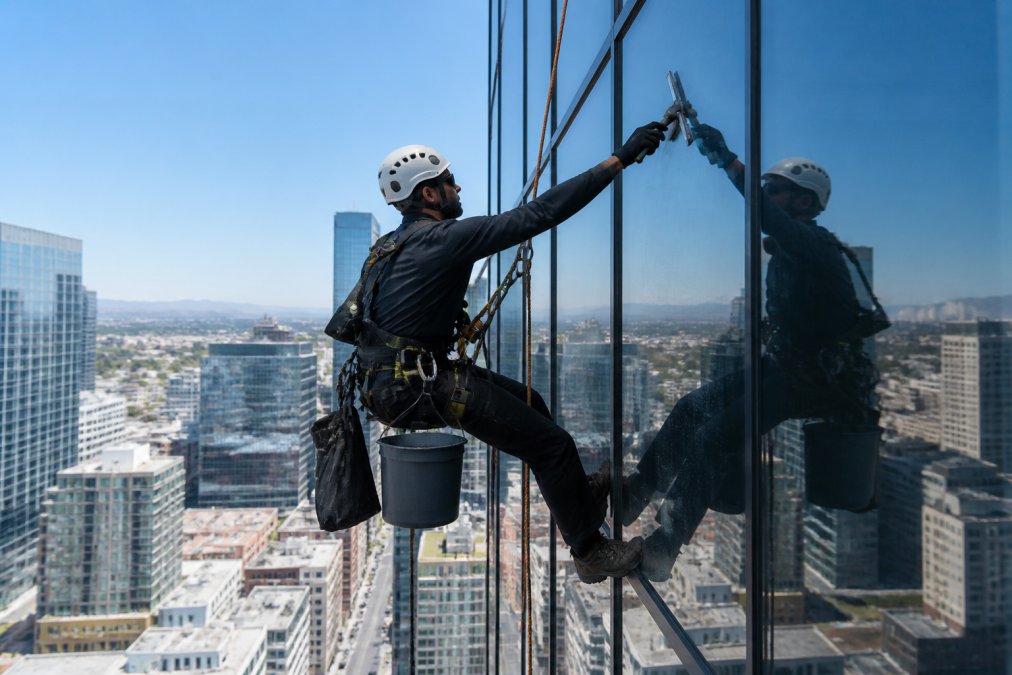
Rope access uses trained technicians descending on industrial ropes anchored to certified roof points. It requires a minimum two-person crew per OSHA standards. Rope access is highly maneuverable for complex facades but covers less glass per day than motorized platforms.
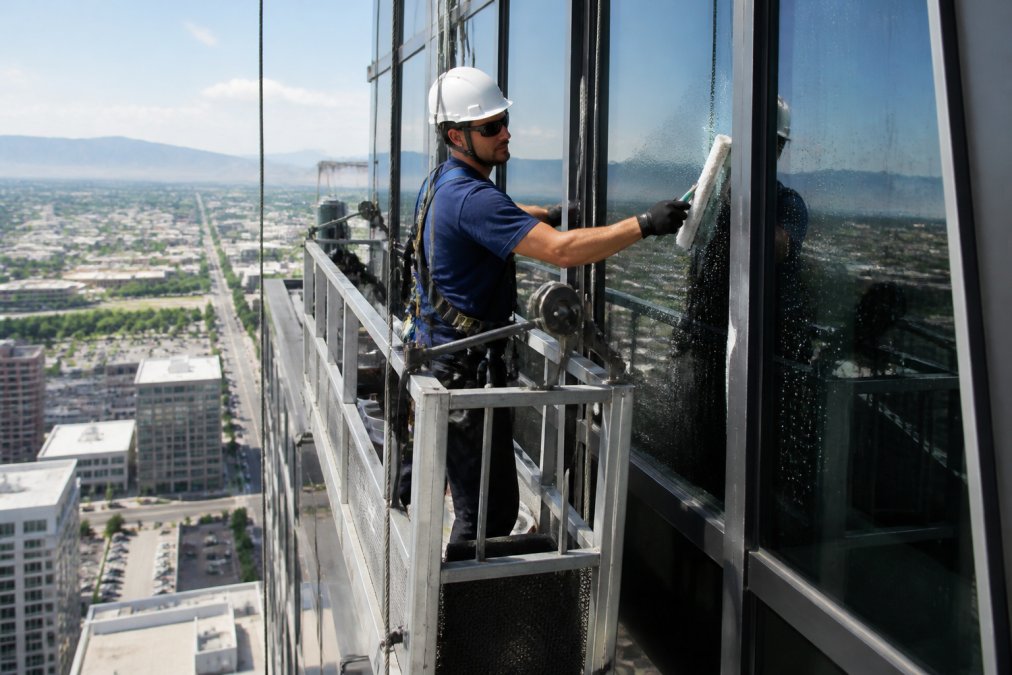
Swing stages (suspended scaffolding) offer higher daily output for large, flat glass surfaces. They require more setup time, a larger crew, and roof structure capable of supporting the load. For straightforward curtain wall buildings above 15 stories, swing stages typically deliver the best cost-per-pane efficiency.
Water-fed pole systems are ground-based and work well for buildings up to around six or seven stories. They use purified water fed through telescoping carbon fiber poles, leaving glass streak-free without squeegees. For mid-rise sections of taller buildings, water-fed poles can supplement rope access or swing stage work on lower floors, reducing overall labor hours billed at higher access rates.
| Access Method | Best For | Relative Cost | Key Limitation |
|---|---|---|---|
| Rope Access | Complex facades, irregular geometry | Higher per-day crew cost | Lower daily glass output |
| Swing Stage | Large flat curtain wall, 15+ stories | High setup cost, efficient output | Requires roof load capacity |
| Water-Fed Pole | Up to ~6-7 stories, ground access | Lowest equipment cost | Height limited by pole reach |
Many large buildings use a combination of all three methods.
Commercial Window Cleaning Cost Per Square Foot: How Contractors Calculate It
Commercial window cleaning cost per square foot is the standard bidding framework, but the number means little without context. It doesn't capture access complexity, glass configuration, or compliance costs that determine actual execution cost.
Per-Drop Pricing vs. Square Footage Models
Per-drop pricing charges based on the number of vertical drops a rope access or swing stage crew must make. It rewards clean, uninterrupted facades and penalizes complex geometry requiring frequent re-rigging.
Square footage pricing calculates a rate per square foot of glass surface area. This works cleanly for curtain wall buildings with dense, consistent glass coverage but becomes less accurate for buildings with high framing-to-glass ratios or varying window configuration by floor.
Many contractors blend both approaches: a base square footage rate adjusted by a complexity multiplier derived from per-drop estimates. Understanding which model a contractor uses is one of the most useful questions during bid review.
Post-Construction vs. Routine Maintenance Cleaning
Post-construction cleaning is a distinct service category. Construction debris, silicone overspray, mortar haze, paint splatter, and adhesive residue require chemical treatment and mechanical removal beyond standard window washing. Labor hours per square foot are significantly higher, and glass damage risk is real. Contractors specializing in post-construction restoration use specific abrasives, chemical cleaners, and inspection protocols differing entirely from maintenance washing.
For general contractors finishing new buildings, post-construction window scope should be a separate line item from ongoing maintenance contracts, with its own site-specific assessment.
OSHA Window Cleaning Safety Requirements and Their Cost Impact
OSHA window cleaning safety requirements are baseline standards separating professional contractors from liability exposure. The OSHA standards for window cleaning and suspended scaffolding fall primarily under 29 CFR 1926 Subpart R and 29 CFR 1910.28, covering anchor points, personal fall arrest systems, and competent person supervision.

Every rope access or swing stage operation requires a documented site-specific safety plan covering anchor point load ratings, rescue procedures, equipment inspection records, and crew training certifications. This documentation takes several hours of pre-job planning per building, per visit.
Cost impact appears in three places: compliant contractors carry certified equipment and trained personnel; pre-job safety reviews and anchor point inspections add non-billable hours absorbed into overhead rates; and OSHA-compliant contractors carry insurance coverage that non-compliant ones skip, where the real cost differential usually lives.
Building owners accepting low bids from contractors without verifiable OSHA compliance accept liability exposure far exceeding any cleaning contract savings.
Liability Insurance, Workers' Compensation, and Overhead Costs
The gap between low bids and professional bids is almost always explained by insurance and compliance overhead. A properly insured high rise window cleaning contractor carries general liability coverage, workers' compensation, and often umbrella coverage extending protection to the building owner as additional insured. According to Insurance Information Institute guidance on contractor liability coverage, workers' compensation rates for high-risk trades like window cleaning are among the highest in construction and services, reflecting elevated injury risk.
Workers' compensation alone can represent a substantial portion of total labor cost. When it doesn't appear in a bid, the contractor is likely uninsured, misclassifying employees as subcontractors, or shifting risk to the building owner.
Overhead costs include equipment maintenance and certification, vehicle and fuel costs, administrative labor for documentation and reporting, and ongoing training for OSHA compliance. Professional contractors providing detailed post-service reporting build that administrative capacity into operations, and it shows in pricing.
Frequency of Service, Contract Types, and Regional Market Conditions
Service frequency directly affects per-visit pricing. Annual maintenance contracts typically see lower per-visit rates than one-off calls because contractors can plan crew scheduling and equipment deployment more efficiently. Common commercial window cleaning contract structures are:
- Annual contracts covering a set number of visits per year, often two to four
- Quarterly maintenance schedules for high-visibility buildings with strict appearance standards
- Monthly service agreements for retail or hospitality properties where glass cleanliness affects customer experience
- As-needed or one-time service at the highest per-visit rate
Regional market conditions affect pricing through labor costs, insurance rate variations by state, and local demand. According to Bureau of Labor Statistics occupational employment data for building cleaning workers, wage rates for cleaning and maintenance workers vary significantly by metropolitan area. Seasonal demand also shapes pricing in climates with significant weather variation.
How to Bid Commercial Window Cleaning Jobs: A Structured Framework
Understanding how to bid commercial window cleaning jobs helps facilities managers evaluate what they're receiving. The structured approach to bid development follows a site assessment framework rather than rule-of-thumb estimates.
Step 1: Site Assessment and Measurements Measure total glass surface area by floor and facade section. Identify window configuration, frame type, and specialty glass coatings. Document anchor point locations, roof access conditions, and obstructions affecting equipment deployment.
Step 2: Access Method Selection Determine the appropriate access method or combination for each facade section. Calculate estimated crew size and daily output. Factor in setup and breakdown time.
Step 3: Compliance and Safety Plan Scope Identify any anchor point engineering reviews needed. Estimate hours for site-specific safety plan preparation. Confirm insurance requirements with the building owner.
Step 4: Labor and Equipment Costing Calculate total labor hours at applicable wage and workers' compensation rates. Add equipment rental or amortized ownership cost. Include overhead allocation for insurance, administration, and reporting.
Step 5: Frequency and Contract Structure Price the per-visit scope, then apply appropriate discount structure for multi-visit contracts. Clearly separate post-construction cleaning scope from routine maintenance if both apply.
Environmental and Site-Specific Variables That Affect Your Bid
Environmental variables are commonly underestimated in commercial window cleaning bids. Buildings near industrial corridors, highways, or construction zones accumulate contamination faster and require more aggressive cleaning chemistry. Prevailing wind direction affects working days per year for high rise work. Hard water deposits, bird activity, and salt air in coastal markets all affect cleaning chemistry and labor intensity.
Facade orientation affects contamination patterns: north-facing glass accumulates biological growth faster than south-facing glass, which dries faster and receives more UV exposure. A thorough site assessment accounts for these variables before pricing.
For facilities managers evaluating bids, the right question is "what assumptions did you make about this building specifically?" A bid built on real site assessment will hold up. A bid built on rule-of-thumb square footage rates probably won't, and the difference usually appears as a change order after work starts.
Managing a high rise building's window maintenance program is genuinely complex. Pricing variables span structural engineering, compliance law, insurance markets, and regional labor economics. Clarity Window Cleaning provides site-specific safety plans, OSHA-compliant operations, and detailed post-service reporting so facilities managers have documentation for board review, insurance records, and ongoing maintenance planning. Our certified technicians handle buildings up to 40 stories with fully insured, bonded crews. Get Clarity on what professional high rise window cleaning actually costs for your building.
Frequently Asked Questions
What factors influence the cost of high rise window cleaning?
High rise window cleaning pricing depends on building height, total glass surface area, facade complexity, the access method required (rope access, swing stage, or water-fed pole), site accessibility, anchor point infrastructure, OSHA compliance requirements, and the frequency of service. Labor costs, liability insurance, workers' compensation, and regional market conditions also factor into every quote. Post-construction cleaning typically costs more than routine maintenance because of debris removal and coating residue work.
How do building height and accessibility affect window cleaning quotes?
Taller buildings require more specialized equipment, longer rigging times, and higher-certified labor, all of which raise the hourly rate and overall project scope. Accessibility issues, such as limited roof anchor points, setbacks, or landscaping that blocks ground-based equipment, add setup time and may require rope access instead of a swing stage. Each additional story increases risk exposure, which is reflected directly in insurance overhead and contractor labor costs.
Are there OSHA regulations that impact the cost of high rise window cleaning?
Yes. OSHA's standards for window cleaning at height, including 29 CFR 1910.28 and 1926 Subpart R, require documented safety plans, certified anchor point inspections, appropriate personal fall arrest systems, and trained personnel. Contractors who meet these requirements invest in professional certification, equipment inspections, and site-specific risk assessments. Those compliance costs are built into their pricing, which is why OSHA-compliant bids are typically higher than those from non-compliant providers.
How often should high rise windows be professionally cleaned?
Most commercial high-rise buildings schedule professional window cleaning two to four times per year. Buildings in areas with heavy air pollution, construction activity, or significant seasonal weather may require more frequent service. Facilities managers who set up annual maintenance contracts often receive better scheduling priority and more predictable operational expenses than those who book one-off jobs. Your building's specific facade complexity and tenant expectations should guide the final maintenance schedule.
This article was written using GrandRanker