 blog
blog
Retail Storefront Window Cleaning Services Cost Guide 2026
Table of Contents
- What Drives Retail Storefront Window Cleaning Services Cost
- Commercial Window Cleaning Frequency and Its Impact on Price
- OSHA Window Cleaning Safety Requirements That Affect Your Quote
- Commercial Window Cleaning Contract Templates: What to Look For
- Hidden Costs and Add-Ons in Storefront Window Cleaning Quotes
- How to Get an Accurate Retail Storefront Window Cleaning Quote
- Frequently Asked Questions
Last Updated: September 18, 2026
What Drives Retail Storefront Window Cleaning Services Cost
Retail storefront window cleaning services cost is driven by variables most property managers never see itemized: glass count, access difficulty, service frequency, and safety obligations.
Pricing Models: Per-Pane, Hourly, and Flat-Rate Visits
Per-pane pricing charges a set rate per pane. Hourly pricing bills for time on site. Flat-rate visits bundle everything into one recurring fee. Most commercial providers mix these models: a small retail storefront with eight panes suits per-pane pricing, while a large commercial building with hundreds of panes, interior partitions, and glass doors usually fits a flat-rate contract.
Per-pane pricing works well when:
- The glass count stays consistent between visits
- Access is straightforward, with no ladder work or lift rental
- You want a simple, auditable invoice
Small Storefront vs. Large Commercial Building Pricing
A single retail storefront and a multi-story commercial property are priced on completely different scales. Storefront maintenance involves ground-level glass, entry doors, and display windows, with cost driven by glass count, frequency, and whether tracks, sills, and screens are included. Large commercial buildings add high-rise access, interior glass, and complex scheduling.
For a large commercial building, expect the quote to reflect:
- Access equipment, such as lifts or water-fed pole systems
- Site-specific safety plans and documentation
- After-hours scheduling to avoid disrupting tenants
- Additional labor for interior glass, atriums, and partitions
| Property Type | Main Cost Drivers | Typical Scope |
|---|---|---|
| Small retail storefront | Glass count, frequency, track and sill cleaning | Ground-level glass, entry doors |
| Large commercial building | Access equipment, safety planning, after-hours labor | High-rise glass, interior partitions, atriums |
Commercial Window Cleaning Frequency and Its Impact on Price
Commercial window cleaning frequency directly affects your price per visit. More frequent service lowers the cost of each visit because the glass stays cleaner and requires less labor to restore. A retail storefront on a weekly or biweekly schedule rarely accumulates heavy buildup, while monthly or quarterly service means longer visits spent removing dirt, hard water stains, and film.
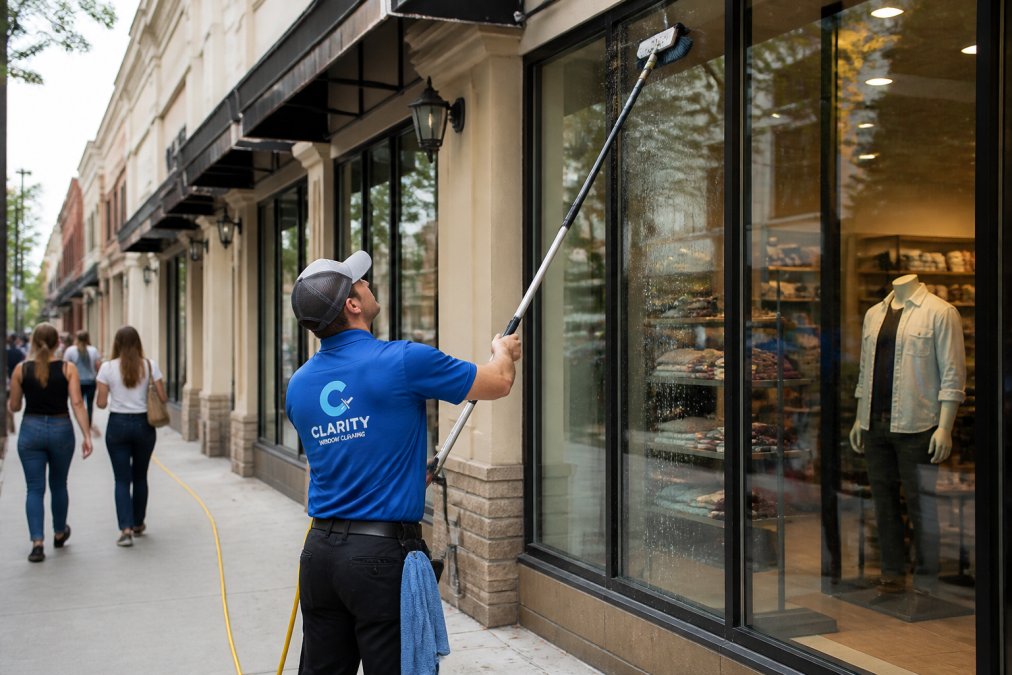
OSHA Window Cleaning Safety Requirements That Affect Your Quote
What a compliant quote should reflect:
- Site-specific safety plans for your building
- Fall protection equipment and inspection records
- Trained, certified technicians
- Liability insurance and bonding
For facilities managers, this is not overhead you can cut. It is the difference between a legitimate contractor and a risk you inherit.
Commercial Window Cleaning Contract Templates: What to Look For
A commercial window cleaning contract template should spell out scope, frequency, pricing, insurance, and termination terms in plain language. But the biggest lever a facilities manager or property manager controls is whether the agreement is structured as a recurring contract or a series of one-time visits.
Why Recurring Contracts Beat One-Time Service on Total Spend
Most quotes are priced per visit, but rarely show the discount structure for a recurring schedule. Monthly or biweekly contracts typically carry a lower per-visit rate than quarterly or on-call service, because the provider routes crews efficiently, forecasts labor, and avoids the deep-cleaning premium. Glass cleaned on a regular cadence never accumulates the heavy mineral film, hard water etching, or construction residue that turns a routine visit into a restoration job, fewer labor hours, less specialized equipment, and a predictable route, with savings passed back as a lower contract rate.
Insurance and Liability Language Every Contract Needs
Professional window cleaning contractors carry general liability insurance, workers' compensation coverage, and often a surety bond. These are not optional, they are why a legitimate quote is higher than a fly-by-night one. If a technician is injured and the contractor lacks workers' compensation, liability can flow back to the property owner; if glass is scratched and the contractor lacks general liability, you negotiate from a weak position.
Your contract should require the provider to:
- Name your property or management company as an additional insured on their liability policy
- Provide a certificate of insurance before the first service date
- Maintain workers' compensation coverage for every technician on site
- Carry a surety bond where required by your ownership or lender
- Notify you in writing if coverage lapses during the contract term
A Practical Contract Checklist
Look for these elements before you sign:
- Exact scope: which glass, which surfaces, interior or exterior, and whether tracks, sills, frames, and screens are included
- Service frequency and scheduling windows, including after-hours or pre-opening access
- Pricing model, the recurring-contract rate, and the specific conditions that trigger a price change
- Insurance, bonding, and additional-insured requirements with certificate deadlines
- Safety plan ownership and documentation responsibilities, including site-specific fall protection plans
- Reporting and quality-check process, with a defined remedy if results fall short
- Termination, renewal, and notice terms, including how rate adjustments are handled at renewal
Clarity Window Cleaning provides free estimates for all window cleaning needs, including commercial and high-rise work, and works directly with facilities managers and property managers to structure contracts that match the building rather than a generic template.
Hidden Costs and Add-Ons in Storefront Window Cleaning Quotes
Hidden costs in storefront window cleaning quotes usually come from scope the initial walkthrough missed, hard water stain removal, glass restoration, and construction cleanup are the most common add-ons. But the deeper reason two quotes for the same storefront differ so widely is equipment: the method used to reach your glass determines labor hours, safety requirements, and the final invoice.
How Equipment Choice Drives the Price
Ground-level storefront glass, display windows, entry doors, and the first row of panes, is cleaned with a squeegee, scrubber, and ladder, so labor is fast and equipment minimal. Above ground level, the method and price change:
- Water-fed pole systems reach two to four stories from the ground using deionized water and a telescoping pole. They eliminate ladder setup time and reduce fall risk, but the system requires a water purification unit, a vehicle-mounted tank, and technicians trained in the technique. That overhead shows up in the quote.
- Ladder and extension pole work handles mid-level glass where a water-fed pole cannot reach or where the glass configuration requires manual detailing. Setup and teardown time per window is higher, and safety planning is more involved.
- Lift or boom access is required for high-rise glass, atriums, and any surface beyond the reach of a pole system. Lift rental, operator certification, and site-specific fall protection plans are all cost lines that a ground-level storefront never carries.
The Add-Ons That Show Up After the First Visit
These items cost more because they require specialized equipment and extra labor:
- Hard water stain removal needs mineral-dissolving treatments, often multiple applications
- Glass restoration addresses scratches and etching with polishing compounds and pads
- Construction cleanup removes coating residue, stickers, and debris left by other trades
- Screen removal and reinstallation adds time per window and requires on-site storage
- Window track and sill cleaning falls outside basic glass work and is commonly omitted
- Awning, sign, and light fixture cleaning is often requested by retail tenants but rarely included in a glass-only quote
Ask upfront whether the quote includes tracks, sills, screens, and frames. Many low quotes exclude them, then bill separately.
A Hidden-Costs Checklist for Facilities Managers
Before you approve any quote, confirm in writing whether each of the following is included or billed separately:
- Exterior glass at all reachable heights
- Interior glass, partitions, and entry doors
- Window tracks, sills, and frames
- Screen removal, cleaning, and reinstallation
- Hard water stain or mineral deposit treatment
- Construction debris and sticker removal
- Awning, sign, and exterior fixture cleaning
- Post-service reporting and quality-check walkthrough
A hidden-costs checklist keeps you honest with your own budget. Request a written scope naming every surface and add-on so the final invoice matches the original number. Facilities managers who require this detail compare quotes on equal footing, and the provider who documents scope most thoroughly usually documents insurance, safety, and results just as well.
How to Get an Accurate Retail Storefront Window Cleaning Quote
An accurate quote starts with a site inspection, not a phone estimate. Providers who quote without seeing the property are guessing, and you will pay for that guess later.
Here is how to get a number you can trust:
- Schedule a walkthrough with the provider
- Walk the full property and count glass panes
- Note access challenges, such as height or obstructions
- Confirm the frequency you actually need
- Ask what the quote excludes
- Request proof of insurance and safety documentation
- Get the scope in writing before work begins
Frequently Asked Questions
How much should I charge for storefront window cleaning?
If you are pricing your own service, base your rate on pane count, access difficulty, and travel time. Most providers use per-pane or hourly pricing rather than flat rates. Account for labor, equipment wear, insurance, and business overhead before quoting. Site inspections help you avoid undercharging on jobs with ladder work, screen removal, or hard water stain removal. Clarity Window Cleaning offers free estimates to help property managers benchmark fair pricing for their specific storefront.
What factors influence the cost of retail storefront window cleaning?
Key cost drivers include the number of panes, window height, access method (ladder work vs. water-fed pole system), and whether interior cleaning is included. Glass condition matters too: construction cleanup, hard water stain removal, and glass restoration take longer than routine squeegee work. Service frequency also changes your price per visit. A site inspection lets providers see window tracks, sill cleaning needs, and any obstacles before quoting.
How often should retail storefront windows be professionally cleaned?
Most retail storefronts benefit from weekly or biweekly service to maintain glass clarity and curb appeal. High-traffic locations near restaurants or construction zones may need more frequent visits. Commercial window cleaning frequency depends on your lease requirements, customer expectations, and local environmental factors like pollen or road dust. Recurring service contracts typically lower your price per visit compared to one-time calls. Clarity Window Cleaning customizes schedules for property and facilities managers.
What safety standards should I look for in a commercial window cleaning provider?
Ask whether the provider follows OSHA window cleaning safety requirements, carries liability insurance, and uses site-specific safety plans. For high-rise or ladder work above certain heights, fall protection and anchor point documentation matter. Request proof of insurance and bonding before work begins. Clarity Window Cleaning is fully insured and bonded, provides OSHA-compliant service, and works directly with facilities managers to document safety protocols for every building.