 blog
blog
Professional Window Cleaners in Utah: A Guide
Table of Contents
- Why Professional Window Cleaners Matter for Facilities Managers
- Commercial Window Cleaning Services for High-Rise Properties
- OSHA Window Cleaning Requirements and Safety Compliance
- Window Cleaning Maintenance Schedules for Different Property Types
- Getting Accurate Window Cleaning Service Estimates
- Residential and Post-Construction Window Cleaning
- What to Expect From Quality Window Cleaning Results
- Conclusion
- Frequently Asked Questions
Last Updated: September 25, 2026
Why Professional Window Cleaners Matter for Facilities Managers
For facilities managers overseeing high-rise office towers, shopping centers, or industrial complexes, clean windows directly impact tenant satisfaction, operational efficiency, and property value. When windows accumulate hard water deposits, construction debris, or seasonal grime, the problem compounds quickly. In-house staff lack the specialized equipment and safety training required for high-rise work, making professional window cleaners utah essential.
Clarity Window Cleaning works directly with facilities managers and property managers, bringing certified expertise, OSHA-compliant safety protocols, and equipment designed for high-rise applications. The result is consistent quality, reduced liability, and maintenance schedules tailored to your property's specific needs.
Commercial Window Cleaning Services for High-Rise Properties
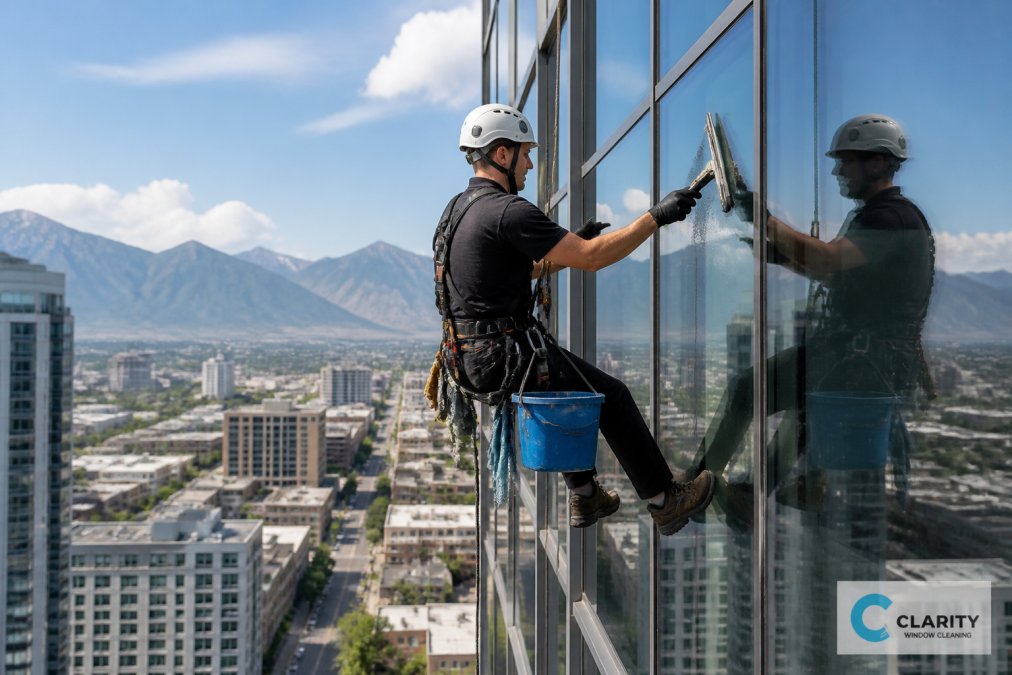
High-rise window cleaning requires specialized training, equipment, and safety protocols. Buildings over 4 stories tall demand rope access systems, water-fed poles extending 40+ feet, or suspended platform systems, all requiring technicians certified in vertical rescue and fall protection.
Commercial window cleaners must operate under OSHA fall protection standards for workers at heights above 6 feet. Verify that contractors maintain current rope access certifications and carry comprehensive liability insurance covering work at elevation.
For properties with 10+ stories, professional window cleaners use water-fed pole systems (minimal disruption, no roof access), rope access systems (flexible for complex shapes), or suspended platforms (efficient for large facades).
Window cleaners Utah schedule work during off-hours or in phases to avoid disrupting tenant operations. Clarity Window Cleaning provides detailed scheduling plans that account for your property's operational needs.
OSHA Window Cleaning Requirements and Safety Compliance
Window cleaning at height falls under OSHA's fall protection standards (29 CFR 1926.500). Facilities managers are responsible for ensuring contractors meet these requirements to protect liability exposure.
Any worker exposed to a fall of 6 feet or more must use personal fall arrest systems, harnesses connected to anchor points that arrest a fall before impact.
OSHA mandates site-specific, documented fall protection plans. Contractors must provide written safety plans outlining fall hazards, rescue procedures, and equipment specifications before work begins.
Request proof of OSHA certification, fall protection plans, workers' compensation insurance, and general liability coverage before signing. Clarity Window Cleaning provides these documents as standard practice.
Window Cleaning Maintenance Schedules for Different Property Types
Cleaning frequency depends on property type, location, and local climate. The region's hard water, seasonal pollen, and winter weather require customized maintenance schedules to prevent costly buildup.
High-Rise Office Towers
High-rise office towers typically require cleaning every 3-4 months due to air pollution, dust, and hard water spray. Regular maintenance is essential for tenant retention.
Hard water deposits accumulate faster in this region on south- and west-facing facades. Professional window cleaners using deionized water systems prevent mineral buildup.
Retail Shopping Centers
Retail shopping centers benefit from regular cleaning on street-facing windows. Ground-level storefronts show grime faster and directly impact customer perception and sales.
Winter salt spray requires regular cleaning (November-March) for properties near highways or parking areas. Deionized water is essential for removing salt residue without leaving mineral deposits.
Ground-level entry areas benefit from regular spot cleaning, with full facade cleaning, maintaining customer-facing appearance cost-effectively.
Industrial Complexes and Warehouses
Industrial complexes require regular cleaning. Maintenance supports worker safety and facility inspection readiness.
Healthcare Facilities and Educational Institutions
Healthcare facilities should maintain regular cleaning schedules to support infection control standards and professional appearance in patient-facing areas.
Educational institutions benefit from regular cleaning, with deep cleaning before academic terms.
Seasonal Adjustments for Local Climate
The region's winter weather and spring pollen patterns warrant specific scheduling considerations:
- Winter (November-March): Snow, ice, and road salt increase window soiling. Properties near highways or with heavy parking lot traffic should increase frequency. Salt residue requires deionized water removal. Schedule cleaning before major snowstorms to maximize the benefit of the cleaning.
- Spring (March-May): Pollen season creates a visible haze on windows, particularly on south- and west-facing facades. A post-pollen-season deep clean (late May) removes accumulated particles and resets the window clarity.
- Summer (June-August): Dust and construction activity may increase soiling. Standard quarterly schedules typically suffice unless nearby construction is active.
- Fall (September-October): Leaf debris and dust accumulate before winter. A pre-winter cleaning ensures windows are clear and prevents debris from being trapped under snow.
Hard Water Buildup and Deionized Water Systems
Hard water deposits are the most important local factor affecting maintenance schedules. The region's mineral-rich water leaves visible calcium and magnesium deposits that standard tap water cleaning cannot prevent.
Deionized water systems eliminate mineral deposits, the water is mineral-free and evaporates without residue.
Customized Maintenance Schedules
Clarity Window Cleaning provides customized maintenance schedules based on property type, building height, environmental exposure, and local water chemistry. We coordinate schedules around tenant operations and building events to minimize disruption.
| Property Type | Recommended Frequency | Seasonal Adjustments | Key Considerations |
|---|---|---|---|
| High-rise office towers | Every 3-4 months | Spring pollen deep clean; quarterly in winter | Hard water deposits, tenant satisfaction |
| Retail shopping centers | Monthly to bi-monthly | Monthly during winter (salt spray); bi-monthly other seasons | Customer perception, street-facing impact |
| Industrial complexes | Every 6 months | Quarterly if near highways or construction | Worker safety, inspection readiness |
| Healthcare facilities | Monthly | Consistent year-round | Infection control, professional standards |
| Educational institutions | Every 3-4 months | Before academic terms; spring and fall deep cleans | Student/parent experience, campus appearance |
Getting Accurate Window Cleaning Service Estimates
Pricing varies widely based on building size, window count, access difficulty, and frequency. Understanding cost drivers helps you evaluate proposals fairly.
Professional window cleaners should provide free estimates accounting for building height, window accessibility, hard water severity, and access difficulty. Clarity provides free estimates for all window cleaning needs.
What Affects Your Estimate
Building height is a primary cost driver. High-rise work requires rope access certification and rescue equipment, increasing labor and insurance costs. Buildings above 10 stories typically require specialized equipment and certified technicians.
Window condition impacts scope and pricing. Hard water deposits require additional treatment time and chemical solvents. Post-construction residue requires restoration-grade cleaning with specialized tools.
Access difficulty affects methodology and crew size. Interior vs. exterior cleaning and frame condition factor into estimates.
Properties committing to regular maintenance may receive favorable per-visit pricing. Ask contractors about rate reductions for annual contracts or standing schedules.
How to Request and Compare Estimates
Provide detailed information: building height, window count, current condition, preferred frequency, and access constraints. Ask contractors to specify their method and explain why it's appropriate for your building.
Clarity provides free estimates for all window cleaning needs, including site assessment of building specifications, access points, surface conditions, and hard water severity, documented in writing for comparison.
Compare estimates on scope, frequency, method, and included services. Ask about post-cleaning inspection and touch-ups. Request proof of OSHA certification, liability insurance, and workers' compensation coverage, standard inclusions, not add-ons.
Red Flags in Low Estimates
If an estimate is substantially lower, ask why. Concerning reasons include lack of insurance documentation, no mention of safety protocols, or vague descriptions.
Ask each contractor how they handle hard water deposits specific to the region.
Residential and Post-Construction Window Cleaning
While this guide focuses on commercial properties, residential window cleaning and post-construction restoration deserve mention because many facilities managers oversee mixed-use developments or condo buildings.
What to Expect From Quality Window Cleaning Results
Professional window cleaning should deliver streak-free, spotless results that improve your property's appearance noticeably. Understanding quality standards helps you evaluate whether a contractor is meeting expectations.
Conclusion
Selecting professional window cleaners requires evaluating safety compliance, maintenance schedules, service reliability, and quality standards. For facilities managers overseeing high-rise office towers, shopping centers, or industrial properties, the decision directly impacts tenant satisfaction, operational efficiency, and property value.
Frequently Asked Questions
How often should high-rise office windows be professionally cleaned?
High-rise office windows require professional cleaning regularly, depending on weather, dust exposure, and building location. Properties in areas with hard water deposits or industrial fallout may need more frequent service. A professional window cleaner can assess your specific building conditions and recommend a maintenance schedule that keeps windows streak-free while minimizing operational disruption. Clarity provides free estimates and can help determine the ideal frequency for your property.
What safety certifications should commercial window cleaners hold?
Commercial window cleaners should hold OSHA-compliant certifications, particularly for high-rise work. Key qualifications include fall protection training, rope access certification, and site-specific safety plans. Your technicians should also carry current liability insurance and be bonded. Always verify certifications and insurance coverage before hiring, this protects both your property and your liability. Professional teams like those at Clarity maintain full OSHA compliance and detailed safety documentation for every job.
What factors influence the service schedule for industrial window maintenance?
Industrial properties face unique challenges: chemical exposure, dust accumulation, and environmental debris affect window condition faster than residential settings. Service schedules depend on proximity to manufacturing operations, weather patterns, and hard water deposits. Facilities managers should work with professional cleaners to establish customized maintenance plans that address these factors without disrupting production. Clarity offers free estimates and can create site-specific schedules tailored to your industrial complex's needs.
How do facilities managers verify OSHA compliance for window cleaning contractors?
Request proof of OSHA training certificates, fall protection qualifications, and current insurance documentation before hiring. Ask contractors to provide a site-specific safety plan and describe their fall arrest systems and rescue procedures. Verify they maintain detailed incident reports and safety protocols. Professional contractors should be transparent about their compliance measures and comfortable providing this documentation. Clarity maintains full OSHA compliance with certified technicians and provides comprehensive safety documentation for every project.
Professional window cleaning isn't a luxury, it's essential maintenance that protects your property's value and your tenants' experience. The question isn't whether to clean your windows, but how to do it safely and reliably. Clarity Window Cleaning provides the expertise, safety protocols, and customer service that facilities managers depend on. Contact us today for a free estimate and discover why commercial properties across the region trust us with their window maintenance.