 listicle
5 Essential Fall Protection Systems for Window Washers
Table of Contents
- Why Fall Protection Systems Matter for Window Cleaning Operations
- 1. Personal Fall Arrest Systems (PFAS) for High-Rise Work
- 2. Fall Restraint vs. Fall Arrest: Understanding the Difference
- 3. OSHA Window Cleaning Anchor Requirements and Compliance
- 4. Suspended Access Equipment for Commercial Buildings
- 5. Fall Protection Equipment Inspection Checklist
- Commercial Window Cleaning Maintenance Reporting and Documentation
- Post-Fall Rescue Protocols and Emergency Preparedness
Last Updated: August 24, 2026
Why Fall Protection Systems Matter for Window Cleaning Operations
Window cleaning at height isn't negotiable work. When your team operates on high-rise buildings, a single failure in fall protection becomes a catastrophic liability. OSHA citations for inadequate fall protection can exceed $15,000 per violation (osha.gov). Beyond fines, falls from height remain a leading cause of serious injury in facility maintenance work. For property managers and facilities directors, this is the difference between a smooth cleaning operation and a site shutdown.
This guide covers five essential fall protection systems for window washers on commercial buildings and high-rise work: personal fall arrest systems, the critical distinction between fall restraint and fall arrest, OSHA compliance requirements, suspended access equipment, and inspection protocols that keep your team safe.
1. Personal Fall Arrest Systems (PFAS) for High-Rise Work
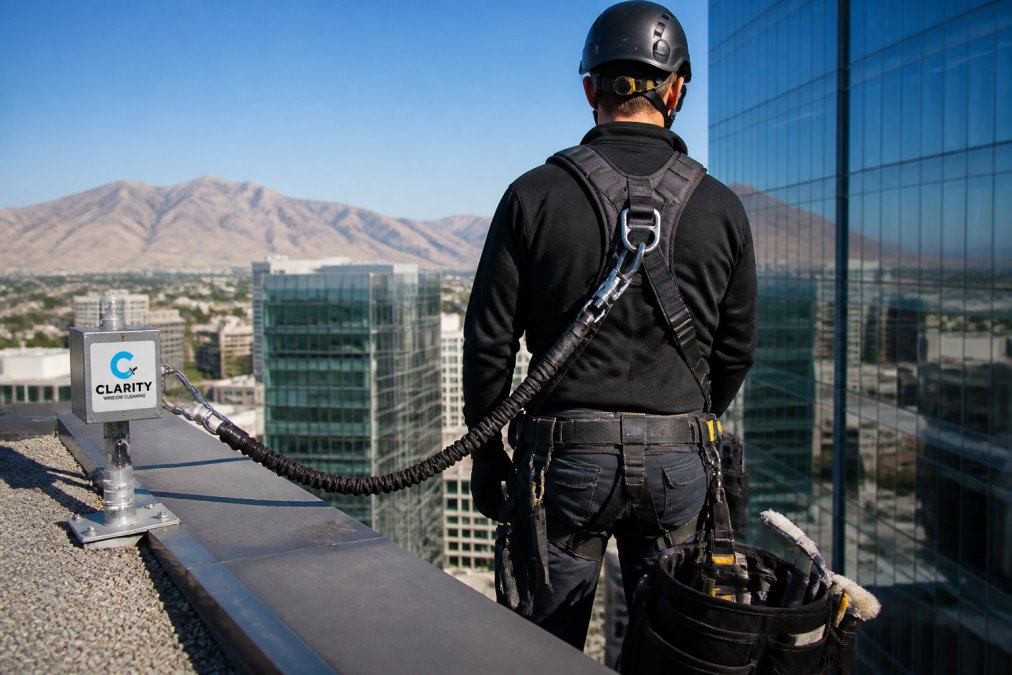
A personal fall arrest system is the backbone of fall protection for window washers working above 6 feet. The PFAS doesn't prevent the fall, it arrests it, catching workers mid-drop and limiting descent distance and force absorption.
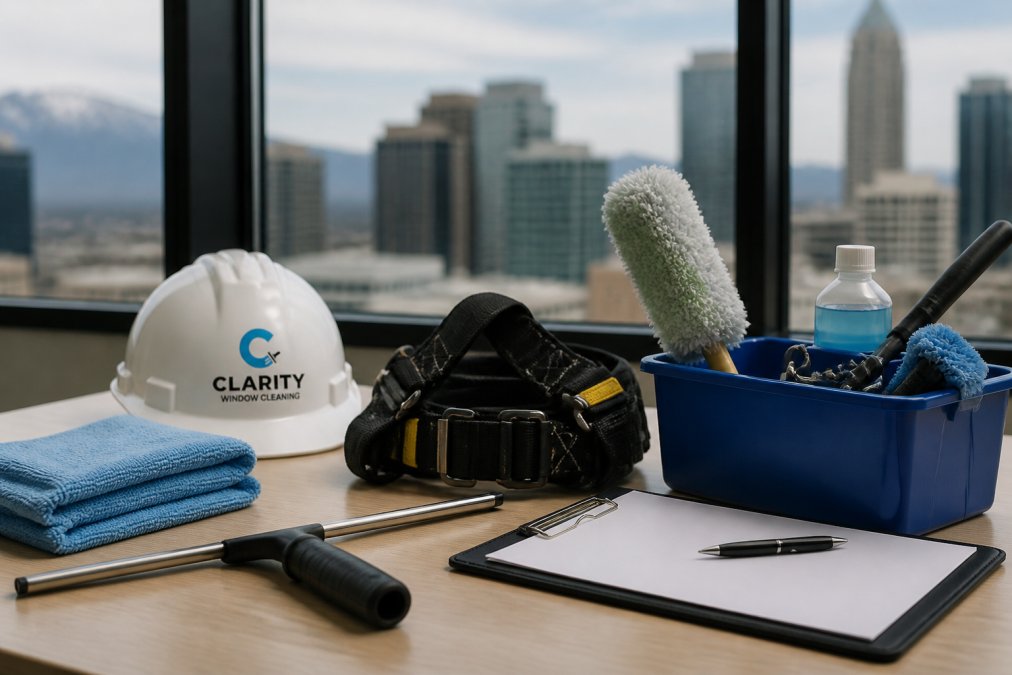
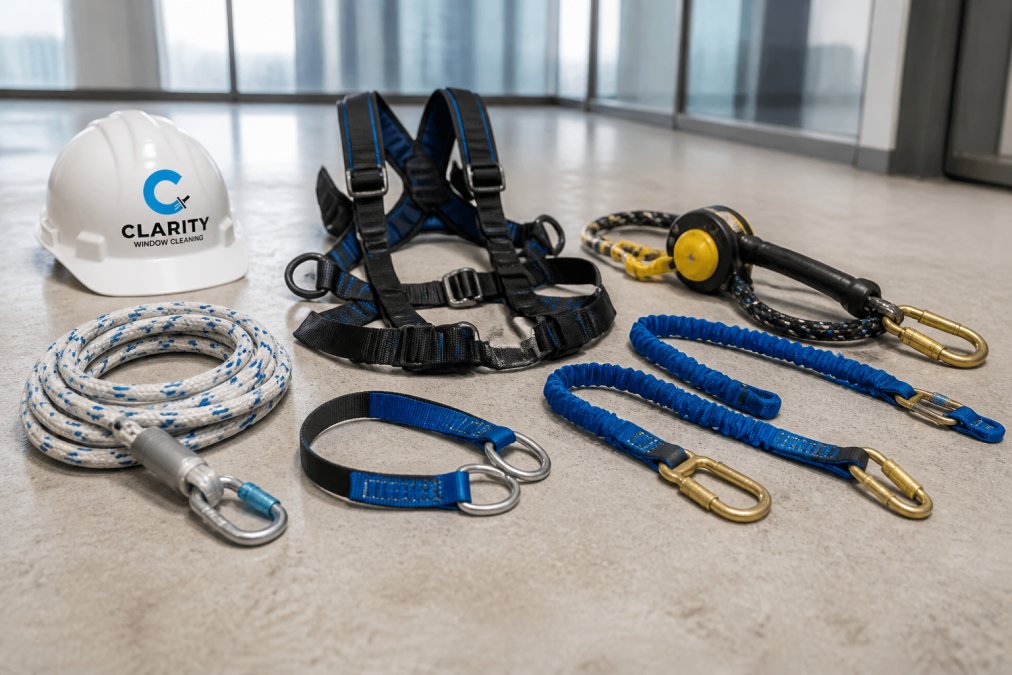
The PFAS has three core components: the full-body harness, the lanyard or lifeline, and the anchorage point. Each piece must work together. A harness alone is useless without a secure connection point. A lanyard without proper shock absorption becomes a liability.
Full-Body Harness and Dorsal D-Ring Attachment
Your harness distributes fall forces across the shoulders, chest, waist, and thighs, never across the neck. Full-body harnesses have been the standard for decades and must meet current ANSI standards.
The dorsal D-ring is the attachment point on the back of the harness where the lanyard connects. For window cleaning work on high-rise buildings, the dorsal D-ring is your primary connection point. When selecting a harness, fit matters, too loose and it shifts during movement; too tight and it restricts movement and fatigues workers faster.
Shock-Absorbing Lanyards and Deceleration Distance
The shock-absorbing lanyard separates a controlled fall arrest from a violent jerk. When a worker falls, the lanyard stretches and the shock absorber dissipates energy, limiting deceleration forces.
Deceleration distance is how far a worker falls before the lanyard fully deploys and stops their descent. A typical shock-absorbing lanyard has a deceleration distance of 3.5 to 4.5 feet (peer-reviewed research). You need at least that much clearance below workers, plus a safety margin.
A 6-foot lanyard is standard for most window cleaning work. Self-retracting lifelines (SRLs) are an alternative that lock automatically when a fall is detected, reducing deceleration distance and giving workers more mobility, though they're more expensive and require regular maintenance.
2. Fall Restraint vs. Fall Arrest: Understanding the Difference
Fall restraint and fall arrest are different systems with different purposes. Fall restraint prevents the worker from reaching an edge where they could fall, using a shorter lanyard to keep workers within a designated safe zone. Fall arrest allows workers to move freely but catches them if they fall.
For window cleaning on high-rise buildings, fall restraint is impractical. Window washers need to move across facades, access different elevations, and position themselves at various points. Fall arrest systems are the standard because they allow the mobility the job requires while protecting against fall hazards.
The choice between restraint and arrest affects your anchor point design, lanyard selection, clearance requirements, and rescue planning. Confirm your contractor is using fall arrest systems appropriate for high-rise work.
3. OSHA Window Cleaning Anchor Requirements and Compliance
OSHA requires that every fall arrest system be anchored to a point capable of supporting at least 5,000 pounds per attached worker, or be designed and certified by a qualified person to support the loads imposed (osha.gov).
For window cleaning on commercial buildings, the anchor point is often a rooftop davit, a structural beam, or a dedicated anchor system. The anchor must be positioned so the lanyard doesn't allow workers to swing into the building or strike obstacles during a fall.
Many facilities managers assume their building's structure is adequate for anchoring. It often isn't, not because the structure is weak, but because the anchor point wasn't designed for fall arrest loads.
Rooftop Davits and Approved Anchorage Points
A rooftop davit is a portable or permanent frame mounted on the building's roof that provides a safe anchor point for window cleaning and maintenance work. Davits are popular for commercial buildings because they're designed specifically for fall protection, keep workers away from the roof edge, and are inspectable and certifiable.
Permanent davits are bolted to the roof structure and remain in place. Portable davits are moved as needed and stored when not in use. Both must be load-tested and certified before use.
For high-rise buildings, the davit's position prevents workers from swinging into the building facade or striking architectural features during a fall. If your building doesn't have a permanent davit, a portable davit can be installed for each cleaning cycle.
Load Testing and Certification Standards
Every anchor point used for fall protection must be load-tested and certified. A structural engineer or qualified person performs the test, typically using a 5,000-pound weight dropped from the anchor point to simulate a fall arrest.
ANSI standards require regular inspection and recertification of anchor points, typically annually or after any incident. For facilities managers, this means budgeting for annual anchor inspections as part of your maintenance program. Clarity Window Cleaning provides free estimates for all window cleaning needs, and professional contractors include anchor inspection and certification as part of their safety protocols.
Documentation of load testing is essential for OSHA compliance. Without documentation, OSHA will assume the anchor was not adequately tested.
4. Suspended Access Equipment for Commercial Buildings
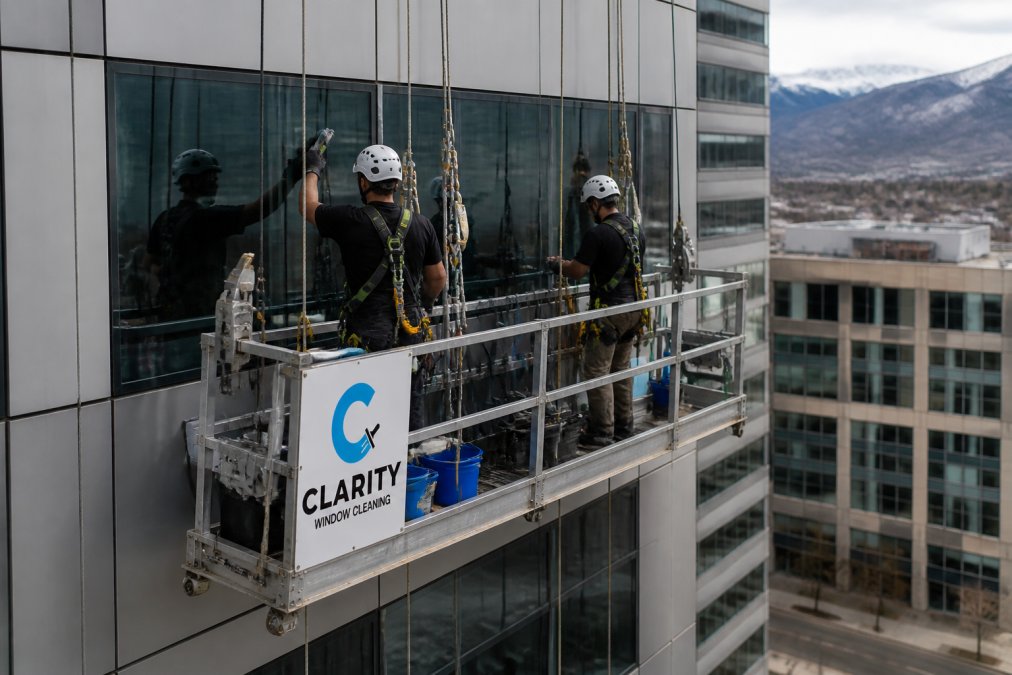
Suspended access equipment, often called swing stages or suspended platforms, is a different approach to fall protection for window cleaning. The worker stands on a suspended platform that's lowered and raised as needed, with the platform itself serving as the primary work surface.
Suspended access equipment is common on high-rise buildings where workers need to access large facade areas and move vertically over distance. A worker on a suspended platform is protected by the platform's redundant rigging, not by a personal harness alone.
The rigging system must have redundancy. If one rope fails, the platform doesn't drop. This is typically achieved through multiple ropes, each capable of supporting the full load. The rigging must be inspected before each use and load-tested regularly.
Vertical Lifelines and Self-Retracting Systems
A vertical lifeline is a rope or cable anchored at the top of the building that runs down the facade. Workers attach their harnesses to the lifeline as they work, and if they fall, the lifeline arrests the fall.
The lifeline must be protected from abrasion and sharp edges. Most vertical lifeline systems include edge protectors or guides that keep the rope away from sharp corners.
Self-retracting lifelines (SRLs) attached to a vertical lifeline give workers more mobility and faster response to falls. An SRL locks automatically when a fall is detected, stopping the worker immediately.
For window cleaning operations on commercial buildings, vertical lifelines are often the most practical fall protection system. They allow workers to move across large facade areas, are inspectable and certifiable, and provide reliable fall arrest.
5. Fall Protection Equipment Inspection Checklist
Equipment failure is often the result of inadequate inspection, not defective manufacturing. A harness that looks fine might have internal damage from a previous fall. Regular, systematic inspection catches these problems before they become failures.
Before every use, perform a visual inspection. Look for tears, fraying, discoloration, or deformation. Check all stitching and attachment points. For shock-absorbing lanyards, look for signs that the shock absorber has been deployed, torn webbing or bunching indicates the lanyard has arrested a fall and should be removed from service.
For harnesses, inspect the webbing for cuts or burns. Check the D-rings for cracks or deformation. Verify that all stitching is intact and that there are no areas where the webbing has separated from the D-ring.
For vertical lifelines and rigging, inspect for corrosion, abrasion, or deformation. Check that all connections are secure. For wire rope, look for broken strands, kinking, or crushing. For synthetic rope, look for melting, fraying, or discoloration.
Documentation of inspections is essential. Create a log for each piece of equipment that records the date of inspection, the inspector's name, any defects found, and actions taken.
Commercial Window Cleaning Maintenance Reporting and Documentation
For facilities managers overseeing high-rise buildings, documentation is your protection. OSHA requires that you maintain records of your fall protection program, including equipment used, inspections performed, and any incidents or near-misses.
A professional window cleaning contractor should provide detailed reporting after each service, including the date of service, areas cleaned, equipment used, equipment inspections performed, and any issues identified. This documentation becomes part of your maintenance record and demonstrates to OSHA that you're maintaining a compliant program.
Clarity Window Cleaning provides free estimates for all window cleaning needs and includes detailed post-service reporting as standard. Your documentation should also include a fall protection plan specific to each building, identifying fall hazards, protection systems, anchor points and their load ratings, rescue procedures, and training requirements.
Post-Fall Rescue Protocols and Emergency Preparedness
A fall protection system that arrests a fall is only half the safety equation. The other half is getting the worker safely to the ground after the fall. A worker suspended from a harness after a fall faces suspension trauma, where prolonged hanging restricts blood flow and can cause loss of consciousness within minutes.
Your rescue plan should identify who performs the rescue, what equipment is needed, and how the rescue will be executed. For high-rise buildings, rescue often requires coordination with emergency services. Some facilities maintain rescue teams trained and equipped to respond immediately.
The rescue plan must account for the building's specific conditions. Before any window cleaning work begins on a high-rise building, confirm that a rescue plan is in place and that rescue personnel are trained and equipped to respond.
Fall protection for window washers is a system that must function reliably under the worst conditions. The five essential systems covered, personal fall arrest systems, the distinction between restraint and arrest, OSHA-compliant anchors, suspended access equipment, and equipment inspection, form the foundation of safe high-rise window cleaning operations. For facilities managers and property managers responsible for building maintenance, working with a professional contractor who understands these systems and maintains rigorous safety protocols is essential. Clarity Window Cleaning provides free estimates for all window cleaning needs and delivers OSHA-compliant service with detailed documentation and post-fall rescue protocols as standard. Get in touch with Clarity to discuss your facility's specific fall protection requirements and how professional window cleaning can be executed safely at any height.
Frequently Asked Questions
What are the five essential fall protection systems for window washers?
The five essential systems are: Personal Fall Arrest Systems (PFAS) with full-body harnesses and shock-absorbing lanyards, Fall Restraint systems that prevent workers from reaching fall hazards, rooftop davits and approved anchor points meeting OSHA standards, Suspended Access Equipment including vertical lifelines and self-retracting systems, and comprehensive inspection and rescue protocols. Each system addresses specific high-rise window cleaning scenarios and OSHA compliance requirements. Facilities managers should ensure their contractors use all applicable systems based on building height and work conditions.
What OSHA standards apply to window washing anchors?
OSHA requires that anchorage points for fall protection systems support at least 5,000 pounds per attached worker, or be designed and certified by a qualified person. Rooftop davits must meet ANSI standards and be properly installed. All anchor points require load testing and certification documentation. Window washing contractors must conduct a fall hazard assessment to identify suitable anchorage locations before work begins. Facilities managers should request proof of compliance and certification from their service provider to ensure regulatory adherence and worker safety.
How often should fall protection equipment be inspected?
Fall protection equipment must be inspected before each use and documented in maintenance records. Full-body harnesses, lanyards, and carabiners should be visually checked for damage, wear, or degradation. Shock-absorbing lanyards must be replaced after any fall event, even if damage is not visible. Self-retracting lifelines require annual professional inspection and certification. Facilities managers should request detailed equipment inspection checklists and maintenance logs from their window cleaning contractor to verify compliance and ensure worker safety on every job.
What is the difference between fall restraint and fall arrest systems?
Fall Restraint systems prevent workers from reaching a fall hazard by limiting their movement with shorter lanyards and body belts. Fall Arrest systems allow workers to move freely but catch them if they fall, using full-body harnesses, shock-absorbing lanyards, and approved anchor points. Fall Arrest systems provide greater mobility for window cleaning work on high-rise buildings, while Fall Restraint is suitable for lower-risk tasks. Understanding when to use each system is critical for OSHA compliance and worker safety during commercial window cleaning operations.
This article was written using GrandRanker