 listicle
Best Window Cleaning for Facilities Managers
Table of Contents
- Why Professional Window Cleaning Matters for Facility Operations
- Commercial Window Cleaning Frequency Guide
- OSHA Window Cleaning Requirements and Compliance Standards
- How to Vet Commercial Window Cleaning Companies
- Non-Disruptive Scheduling Strategies for High-Rise Properties
- Essential Service Level Agreements and Reporting for Facilities Managers
- Post-Construction Window Restoration and Building Envelope Care
- Conclusion
- Frequently Asked Questions
Why Professional Window Cleaning Matters for Facility Operations
Professional window cleaning is a strategic facility maintenance function that directly impacts building performance, tenant satisfaction, and operational costs. For facilities managers overseeing commercial properties, the best window cleaning requires a vendor who understands OSHA compliance, minimizes operational disruption, and delivers measurable results.
Dirty windows reduce natural light penetration by up to 40%, forcing increased reliance on artificial lighting and raising energy costs. Streaked or stained windows damage curb appeal and signal poor facility condition to clients, tenants, and visitors. On high-rise office towers or multi-tenant complexes, one poor cleaning job affects dozens of tenants simultaneously.
At Clarity Window Cleaning, we work directly with facilities and property managers to build cleaning schedules that fit operational realities. This guide covers the key factors that separate professional commercial window cleaning from commodity services: compliance standards, scheduling discipline, vendor vetting, and reporting frameworks that document maintenance for your board and insurance partners.
Commercial Window Cleaning Frequency Guide
How often should your facility's windows be cleaned? The answer depends on building type, location, tenant expectations, and environmental factors.
For standard office towers and commercial complexes, quarterly cleaning (four times per year) is the minimum maintenance threshold. This prevents hard water stains, mineral deposits, and atmospheric grime from accumulating to the point where they become difficult to remove or damage glass integrity. High-traffic retail centers and healthcare facilities often move to bi-monthly (six times per year) because tenant-facing appearance directly impacts customer perception. Industrial properties and facilities in dusty or high-pollution areas may require monthly cleaning.
The real cost driver is consistency. A quarterly schedule executed on a predictable calendar costs less per cleaning than emergency cleanings triggered by complaints. Facilities managers who establish a regular rhythm also catch problems early: a technician on a scheduled visit notices a cracked seal or deteriorating frame before it becomes an expensive repair.
Account for seasonal factors when planning frequency. Post-winter cleaning removes salt spray and road treatment residue. Fall cleaning addresses pollen and leaf debris. High-rise buildings face different challenges than ground-level retail due to wind patterns and atmospheric exposure.
Clarity provides free estimates for all window cleaning needs, and we can help you model the frequency that balances appearance standards with your operational budget.
OSHA Window Cleaning Requirements and Compliance Standards
OSHA compliance is non-negotiable for commercial window cleaning, particularly on high-rise properties. Falls remain one of the leading causes of serious workplace injuries in facility maintenance.
OSHA's standards for fall protection (29 CFR 1926.500) apply to any work performed at heights exceeding six feet. For window cleaning above that threshold, your vendor must implement one of three fall protection systems: personal fall arrest systems (harnesses and lanyards), safety net systems, or warning line systems with guardrails. Most commercial window cleaning uses personal fall arrest systems, with certified technicians wearing full-body harnesses, helmets, and lanyards anchored to secure building points.
OSHA requires documented site-specific safety plans before work begins. A professional vendor should provide this documentation in advance. The plan addresses building-specific hazards: anchor point locations, weather conditions that halt work, communication protocols, and emergency response procedures.
Competent climber certification matters more than most facilities managers realize. A "competent climber" means someone trained in rope access techniques, rescue procedures, and hazard recognition specific to high-rise work. When vetting vendors, ask for proof of certification for every technician who'll work on your property.
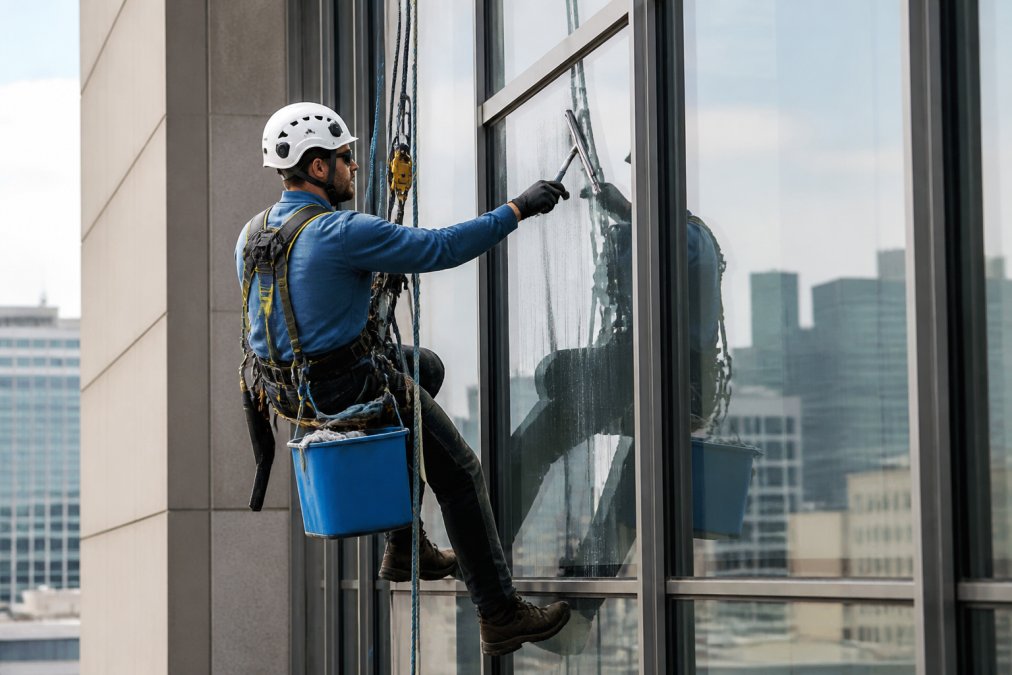
Insurance documentation backs up compliance claims. Your vendor should carry general liability insurance plus workers' compensation coverage. Request certificates of insurance naming your property as additional insured. Weather protocols are part of OSHA compliance too, professional vendors won't work during high winds, lightning storms, or unsafe conditions.
How to Vet Commercial Window Cleaning Companies
Vetting a commercial window cleaning vendor requires more than checking online reviews. You're evaluating a partner who will work at heights on your building and interact with your tenants.
Start with certifications and insurance. Request proof of OSHA training, rope access certification, and current general liability and workers' compensation insurance. Call the insurance carrier directly to verify coverage limits. For high-rise properties, verify that the vendor carries coverage specifically for aerial work.
Reference checks should be specific. Ask the vendor for three facilities with similar building profiles where they've worked in the past 12 months. Contact those facilities directly and ask about consistency, schedule adherence, result uniformity, and complaint handling.
A professional vendor should visit your building before submitting a proposal to assess building-specific hazards, identify anchor points, and account for tenant access requirements. A vendor who quotes over the phone without seeing your property is guessing.

Service Level Agreements (SLAs) separate professional vendors from transactional services. Your contract should specify response times for scheduling, weather-related delays, and complaint resolution. It should define quality standards: stripe-free results, no water damage to building systems, specific handling of delicate surfaces. Include post-service inspection procedures where the vendor walks the building with your team to confirm results before invoicing.
Ask about non-disruptive scheduling approaches. How do they coordinate with building management and tenants? Can they schedule work during off-hours if needed? A vendor experienced with multi-tenant buildings understands that disruption to one tenant affects your reputation across the entire property.
Non-Disruptive Scheduling Strategies for High-Rise Properties
High-rise window cleaning on occupied buildings requires scheduling discipline. A single uncoordinated cleaning can disrupt dozens of tenants simultaneously through blocked views, water spray, noise, and equipment movement.
The best approach is advance notice and tenant communication. Professional vendors should provide your facilities team with a detailed work schedule at least two weeks before service begins, specifying which floors or sections will be worked each day, estimated duration, and access restrictions tenants should expect.
Water-fed pole systems and rope access techniques have different disruption profiles. Water-fed poles (typically used up to 60 feet) use purified water sprayed from the ground with minimal noise. Rope access (used above 60 feet) involves technicians on the building exterior, more visible but still non-disruptive if scheduled during off-hours.
Scheduling around tenant patterns reduces complaints. For office buildings, early morning (before 8 AM) or late afternoon (after 5 PM) work minimizes disruption. A vendor experienced with your building type understands these rhythms.
Weather contingencies matter operationally. Rain, high winds, or temperature extremes can halt work mid-cycle. A professional vendor should have flexible rescheduling built into the contract without additional charges. Communication during service is critical, does the vendor have a point person your facilities team can contact if issues arise?
Essential Service Level Agreements and Reporting for Facilities Managers
Service Level Agreements transform window cleaning from a transactional service into a managed facility function. For facilities managers required to document maintenance to boards, insurance carriers, and auditors, SLAs create the accountability trail.
Your SLA should specify quality standards in measurable terms. "Streak-free, mineral-deposit-free results verified by post-service inspection" is enforceable. Define which surfaces are included, how different glass types are handled, and what constitutes acceptable variance.
Response time commitments prevent scheduling chaos. Your SLA should specify how quickly the vendor responds to scheduling requests, how far in advance they confirm dates, and what happens if they miss a scheduled service. Include weather delay protocols.
Post-service reporting is where many vendors fall short. You need documentation that proves work was completed: date, time, technician names, weather conditions, any issues encountered, before-and-after photos, and sign-off from your facilities team. This documentation supports your maintenance record and protects you if a tenant disputes quality.
Clarity provides free estimates for all window cleaning needs, and our SLAs include detailed post-service reporting that integrates with your facility management system. We document every service with photos and completion certificates so you have a complete maintenance history.
Include escalation procedures in your SLA. If quality falls short, what's the remedy? Define what triggers a formal review of the vendor relationship.
Insurance and liability terms belong in the SLA too. Specify that the vendor maintains current insurance, names your property as additional insured, and indemnifies your facility for injuries or damage caused by their work.
Post-Construction Window Restoration and Building Envelope Care
Post-construction window cleaning is a specialized service distinct from routine maintenance. New construction leaves behind glass contamination, concrete dust, paint overspray, silicone sealant residue, and protective film adhesive that standard cleaning methods won't remove.
The challenge is removing these contaminants without damaging the glass or building systems. Concrete dust and mortar residue require specialized cleaning solutions. Paint overspray demands solvent-based approaches. Silicone and adhesive residue often requires mechanical removal with specialized tools that can scratch glass if done incorrectly. A vendor experienced with post-construction work understands the sequence and which techniques prevent damage.
Building envelope care during construction cleanup extends beyond windows. Frames, seals, and surrounding surfaces accumulate dust and debris. Water runoff from cleaning can damage newly finished facades if not managed carefully. Professional post-construction vendors coordinate with general contractors to schedule cleaning at the right phase and manage water containment.
Protective film removal is part of post-construction work. Many new windows ship with protective plastic film to prevent damage during transport and installation. Improper removal can leave sticky residue or damage glass coatings.
Document post-construction cleaning thoroughly. Before-and-after photos, itemized work lists, and sign-off from the general contractor create the record that work met specifications.
Conclusion
The best window cleaning for facilities managers balances compliance, operational discipline, and measurable results. Professional vendors understand that your building is a working environment where disruption carries real costs. They provide OSHA-compliant safety protocols, detailed SLAs with post-service reporting, and scheduling that respects tenant operations.
When evaluating vendors, prioritize certifications and insurance over price alone. Reference checks from similar properties reveal consistency. SLAs with defined quality standards protect your facility's interests. Clarity provides free estimates for all window cleaning needs and delivers the documentation, scheduling discipline, and safety compliance that facilities managers require. Get started with Clarity and ensure your facility maintains a professional appearance while protecting tenant operations and your compliance record.
Frequently Asked Questions
Q: How often should commercial buildings have professional window cleaning?
A: Commercial window cleaning frequency depends on building type, location, and tenant expectations. Most office towers benefit from quarterly cleaning, while ground-floor retail may need monthly service. Industrial facilities in dusty environments often require more frequent attention. Climate and weather exposure also affect scheduling. Clarity recommends a site inspection to determine the optimal frequency for your specific property and operational needs.
Q: What OSHA compliance standards apply to commercial window cleaning?
A: OSHA regulations require fall protection systems, safety harnesses, and trained personnel for work at heights above 6 feet. Commercial window cleaners must follow OSHA 1926.500 standards for fall arrest systems and 1926.502 for personal protective equipment. Contractors should maintain current certifications, conduct site-specific safety plans, and provide documentation of compliance. Verify your vendor carries liability insurance and can provide proof of OSHA training and certifications.
Q: What questions should I ask when vetting a commercial window cleaning company?
A: Request proof of liability insurance, workers' compensation coverage, and OSHA certifications. Ask about their safety protocols, experience with your building type, and equipment used (water-fed poles, rope access, aerial lifts). Inquire about service level agreements, reporting capabilities, and how they handle disruptions to tenants. Ask for references from similar-sized properties. Clarity provides free estimates and detailed compliance documentation to help you evaluate vendors effectively.
Q: How can I ensure window cleaning doesn't disrupt tenant operations?
A: Professional vendors offer flexible scheduling outside business hours, weekend service, or phased approaches that minimize disruption. Discuss non-disruptive scheduling options upfront and establish clear work windows in your service agreement. High-rise properties benefit from vendors experienced with rope access or aerial lift methods that don't block views or require tenant relocation. Request a detailed site plan and timeline before work begins to coordinate with your building operations.
This article was written using GrandRanker
Frequently Asked Questions
Q: How often should commercial buildings have professional window cleaning?
A: Commercial window cleaning frequency depends on building type, location, and tenant expectations. Most office towers benefit from quarterly cleaning, while ground-floor retail may need monthly service. Industrial facilities in dusty environments often require more frequent attention. Climate and weather exposure also affect scheduling. Clarity recommends a site inspection to determine the optimal frequency for your specific property and operational needs.
Q: What OSHA compliance standards apply to commercial window cleaning?
A: OSHA regulations require fall protection systems, safety harnesses, and trained personnel for work at heights above 6 feet. Commercial window cleaners must follow OSHA 1926.500 standards for fall arrest systems and 1926.502 for personal protective equipment. Contractors should maintain current certifications, conduct site-specific safety plans, and provide documentation of compliance. Verify your vendor carries liability insurance and can provide proof of OSHA training and certifications.
Q: What questions should I ask when vetting a commercial window cleaning company?
A: Request proof of liability insurance, workers' compensation coverage, and OSHA certifications. Ask about their safety protocols, experience with your building type, and equipment used (water-fed poles, rope access, aerial lifts). Inquire about service level agreements, reporting capabilities, and how they handle disruptions to tenants. Ask for references from similar-sized properties. Clarity provides free estimates and detailed compliance documentation to help you evaluate vendors effectively.
Q: How can I ensure window cleaning doesn't disrupt tenant operations?
A: Professional vendors offer flexible scheduling outside business hours, weekend service, or phased approaches that minimize disruption. Discuss non-disruptive scheduling options upfront and establish clear work windows in your service agreement. High-rise properties benefit from vendors experienced with rope access or aerial lift methods that don't block views or require tenant relocation. Request a detailed site plan and timeline before work begins to coordinate with your building operations.