 listicle
Benefits of Professional Hard Water Stain Removal
Table of Contents
- What Hard Water Stains Actually Do to Commercial Glass
- The Benefits of Professional Hard Water Stain Removal
- Commercial Glass Restoration Services: What the Process Involves
- How to Prevent Hard Water Stains on Windows
- OSHA-Compliant Window Cleaning Practices for High-Rise Properties
- The ROI of Professional Maintenance vs. DIY Scrubbing
- Frequently Asked Questions
Last Updated: September 16, 2026
What Hard Water Stains Actually Do to Commercial Glass
Hard water stain removal is not cosmetic upkeep. It is damage control. On commercial buildings, irrigation overspray, cooling tower drift, and rain runoff deposit dissolved calcium and magnesium onto glass, and once the water evaporates, those minerals stay behind. This guide from Clarity Window Cleaning covers what that buildup does to a building's glass over time, what professional removal actually restores, and how facilities managers can keep it from coming back.
Here is the part most property managers learn too late: the damage has two stages, and only one of them is reversible.
Why Water Spots Become Permanent
A fresh water spot is just dried minerals sitting on the surface. It wipes off. The problem starts when new deposits land on old ones, layer after layer, week after week. Glass is slightly porous at the microscopic level, and dissolved minerals work into those pores rather than resting on top of them. Once calcium buildup bonds to the surface, ordinary soap and water stop touching it.
Micro-Etching: The Damage You Cannot Wipe Away
Micro-etching is the physical pitting of a glass surface caused by mineral deposits bonding to it and gradually pulling away microscopic layers of the material. Limescale left in place long enough chemically reacts with the glass itself. The surface becomes permanently textured, which is why etched glass looks hazy even when it is clean. No amount of scrubbing reverses it. That distinction matters because it splits every stain into two categories:
- Surface deposits: minerals sitting on top of the glass, removable with the right process
- Etched damage: minerals fused into the glass, requiring polishing or surface restoration
The Benefits of Professional Hard Water Stain Removal
The benefits of professional hard water stain removal come down to two things: glass that looks right again and glass that lasts longer. Both matter more on a commercial property than most managers expect, because appearance and replacement cost are the two numbers a building owner actually tracks.
Restored Glass Clarity and Aesthetic Appeal
Professional removal restores glass clarity that household methods cannot reach. Technicians match the removal method to the mineral type and the glass, using professional-grade agents that dissolve the bond without attacking the pane. The result is spotless results across an entire facade rather than the patchy, streaky glass that comes from improvised approaches. For a multi-tenant property, that difference is visible to every tenant and every prospective lessee who walks past the lobby.
The mechanism matters here. Hard water deposits are alkaline minerals, and the bond they form with silica is what makes them stubborn. A professional process breaks that bond chemically before any mechanical action begins, which is why it removes the deposit instead of grinding it across the surface. That distinction is the difference between clean glass and glass that looks clean under lobby lighting but hazes over in direct sun.
Pros: Consistent results across large glass areas; no residue or streaking; safe for coated and tinted glass when the agent is matched to the surface. Cons: Requires access equipment and trained technicians, so it is not a one-person weekend job.
Longer Surface Longevity and Fewer Replacements
Stopping mineral accumulation early protects surface integrity and extends the working life of the glazing itself. Replacement glass is a capital expense with long lead times and installation disruption. Ongoing glass maintenance is an operating expense. Facilities directors who treat stain removal as part of a maintenance schedule rather than an emergency repair consistently spend less on glass over the life of the building.
The financial case is easiest to see when you frame it as asset preservation rather than cleaning. A single high-rise elevation can carry dozens of panes, and replacing even a portion of them means crane time, glazier labor, sealant work, and scheduling around tenants. Scheduled removal avoids that entire category of spend by keeping the existing glazing in service. Most facilities managers find that the maintenance line item is a fraction of what a partial reglaze would cost, and it does not interrupt building operations.
There is also a coating-preservation angle that DIY methods miss.
Clarity Window Cleaning provides free estimates for all window cleaning needs, and works directly with facilities managers and property managers to build removal into an existing maintenance calendar rather than treating it as an emergency call.
Commercial Glass Restoration Services: What the Process Involves
Commercial glass restoration services are the structured process of identifying mineral deposits, testing removal agents on an inconspicuous area, and restoring the glass surface without damaging it. The sequence matters as much as the chemicals.
A typical restoration runs through four stages:
- Assessment. Technicians identify the mineral type and test whether the staining is surface-level or etched.
- Pre-treatment. A professional-grade agent is applied to break the bond between mineral and glass.
- Agitation and removal. Controlled mechanical action lifts deposits without scratching the pane.
- Polishing and inspection. The surface is finished and checked for streaks, haze, or missed areas.
How to Prevent Hard Water Stains on Windows
Preventing hard water stains on windows is cheaper than removing them, and on a commercial property most of it comes down to controlling where water lands and how long it sits. The homeowner advice that dominates this topic, squeegee after every rain, wipe with vinegar, does not scale to a facade with hundreds of panes, so the practical approach is a scheduled inspection and correction routine built around the building's water sources.
- Map every water source that reaches glass: irrigation heads, cooling tower drift, condensate lines, roof drainage, and adjacent hard surfaces that splash
- Redirect or reposition irrigation so sprinklers never hit glass or the hard surfaces beside it
- Rinse glass after irrigation cycles and after any cooling tower drift event, before minerals can bond
- Schedule exterior cleaning on a recurring cadence rather than waiting for visible staining
- Inspect frames, seals, and weep holes so runoff does not pool against the pane
- Keep a written log of stain-prone elevations, their water sources, and their cleaning dates
- Review the log seasonally and correct the source, not just the symptom
Building a Maintenance Schedule That Fits the Property
Clarity Window Cleaning provides free estimates for all window cleaning needs and works directly with facilities managers and property managers to set a removal and prevention cadence that matches the building's exposure, access requirements, and high-rise logistics.
OSHA-Compliant Window Cleaning Practices for High-Rise Properties
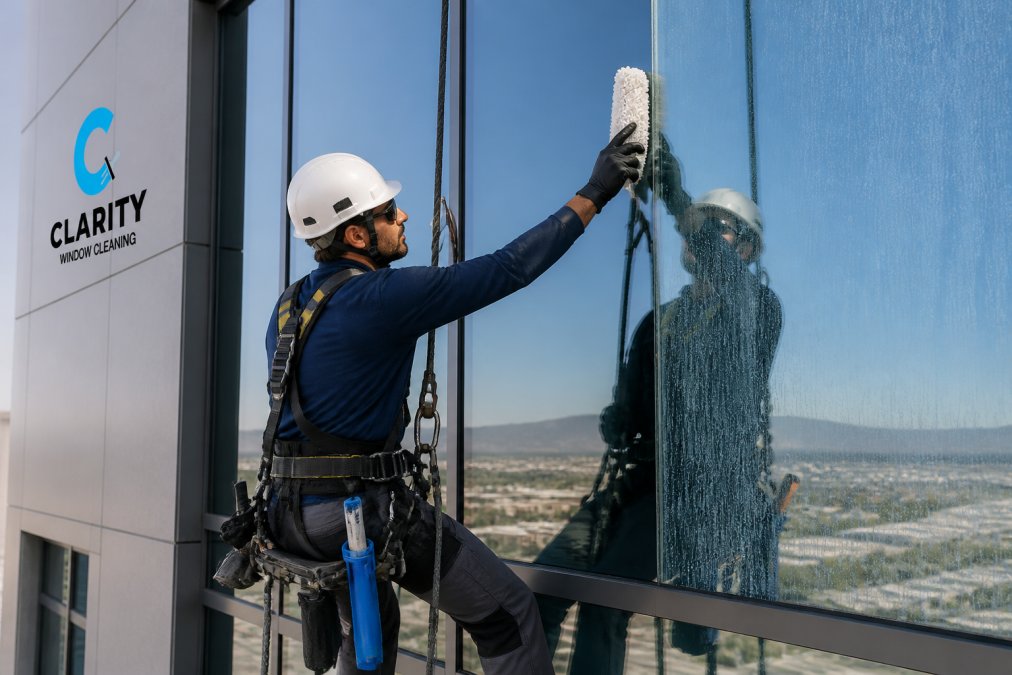
OSHA-compliant window cleaning practices are the safety procedures that govern how technicians work at height on commercial buildings, and they are not optional paperwork. For a high-rise property, the cleaning method and the safety plan are the same conversation.
The ROI of Professional Maintenance vs. DIY Scrubbing
The return on professional maintenance is easiest to see when you compare it against what DIY scrubbing actually costs. Improvised approaches fail for predictable reasons, and the failures are expensive.
| Approach | What It Costs You | Result on Glass |
|---|---|---|
| DIY scrubbing with abrasive cleaners | Labor hours, plus risk of scratched glass | Streaking, scratched panes, etched spots untouched |
| Household acid or vinegar mixes | Minimal materials, high risk | May dull coatings; rarely removes bonded limescale |
| Delayed professional cleaning | Lower short-term spend | Deposits harden into etching; restoration or replacement later |
| Scheduled professional removal | Predictable operating cost | Restored clarity, protected surface longevity |
Frequently Asked Questions
Can hard water stains become permanent if left untreated?
Yes, hard water stains can become permanent. When calcium and magnesium deposits sit on glass, they bond with the silica surface over time. This process, called micro-etching, physically changes the glass and cannot be removed with regular cleaning. Once etching occurs, the damage is irreversible and the glass must be replaced. Professional hard water stain removal performed early prevents this outcome and protects your investment in commercial glass.
How does professional glass restoration differ from DIY cleaning?
DIY cleaning uses household products and abrasive tools that can scratch glass and leave streaks. Professional commercial glass restoration services use specialized compounds and controlled methods to dissolve mineral deposits without damaging the surface. For high-rise buildings, professional teams also follow OSHA-compliant window cleaning practices, which DIY approaches cannot safely replicate. The result is spotless glass with no risk of surface degradation or injury.
How often should commercial properties schedule hard water stain removal?
Most commercial properties benefit from professional hard water stain removal every six to twelve months, depending on local water quality and weather exposure. Buildings in areas with hard water or heavy irrigation runoff may need quarterly service. A preventative maintenance schedule keeps mineral deposits from bonding to the glass and extends the life of your windows. Clarity Window Cleaning provides free estimates and can recommend a schedule tailored to your property.
Why is professional removal safer for high-rise window surfaces?
High-rise glass is exposed to more intense sun, wind, and water runoff, which accelerates mineral accumulation. Reaching these surfaces safely requires trained technicians, proper equipment, and OSHA-compliant window cleaning practices. Professional removal avoids the risk of falls and uses techniques that protect the glass from abrasive damage. Clarity Window Cleaning offers free estimates for all high-rise and commercial window cleaning needs.