 how-to
How to Choose a Commercial Window Cleaning Contractor
Table of Contents
- Key Window Cleaning Contractor Questions to Ask
- Building Your Commercial Window Cleaning Checklist
- What a Commercial Window Cleaning Contract Should Include
- Frequently Asked Questions
Last Updated: October 6, 2026
Key Window Cleaning Contractor Questions to Ask
Choosing the right commercial window cleaning contractor starts with asking better questions before you sign anything. Facilities managers and property managers carry real risk when they hire the wrong crew.
What should you ask a window cleaning contractor before hiring?
Ask about licensing, insurance limits, worker classification, safety training, access equipment, and references.
- Are you insured and bonded, and can you provide a certificate of insurance? Ask for general liability and workers' compensation limits in writing.
- Are your workers employees or independent contractors? Classification affects who carries liability if someone is injured.
- What safety procedures do you follow for elevated work? Ask about fall protection, equipment inspection, and emergency response.
- What access equipment will you use? Lifts, suspended scaffolding, and rope access suit different heights and facades.
- Can you provide references from similar buildings? A contractor experienced with a two-story retail center may not be ready for a 30-story tower.
- How do you handle scheduling around tenant operations? Ask how the crew avoids blocking views, entrances, or business hours.
Building Your Commercial Window Cleaning Checklist
A commercial window cleaning checklist turns a vague vendor comparison into an objective evaluation, so you compare equivalent bids instead of sales pitches.
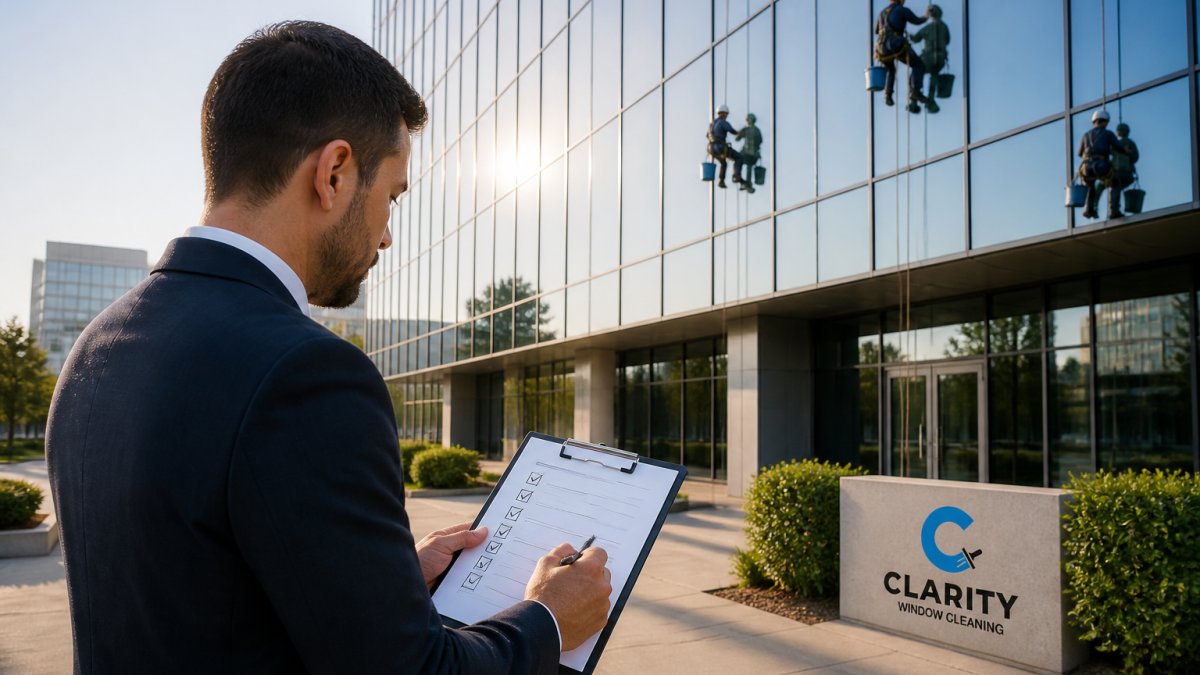
The commercial window cleaning checklist
- Written estimate with defined scope of work. Which glass surfaces, frames, sills, and interior areas are included.
- Insurance verification. General liability and workers' compensation certificates, with limits stated.
- Worker classification confirmed. Employees versus independent contractors, in writing.
- Site-specific safety plan. A generic safety manual is not the same as a plan written for your building.
- Access equipment list. Which lifts, scaffolding, or rope systems will be used, and who inspects them.
- Service-level agreement and quality control. How problems are reported, corrected, and documented.
- References from comparable buildings. At least two, ideally in your market and building type.
- Post-service reporting. Written confirmation of what was cleaned, when, and by whom.
Commercial versus residential window cleaning
Commercial window cleaning differs from residential in scope, access, insurance, and scheduling. Commercial buildings often require elevated access equipment, formal safety documentation, and work scheduled around tenant operations, so confirm the contractor regularly handles commercial-scale jobs before comparing pricing.
How to compare bids on an equivalent scope
Comparing bids only works when every contractor prices the same scope. Ask each to quote against an identical written scope listing building height, glass surfaces, interior and exterior areas, access method, service frequency, and reporting requirements. A lower bid on a narrower scope is a different job, not a lower price.
What a Commercial Window Cleaning Contract Should Include
A commercial window cleaning contract should document scope, schedule, insurance requirements, safety responsibilities, quality standards, and payment terms in writing.
Essential contract terms
- Scope of work: Which glass surfaces, frames, sills, interior partitions, and architectural glass are included, and which are excluded.
- Service frequency and scheduling: A defined commercial window cleaning schedule, plus the process for rescheduling due to weather or building events.
- Insurance and liability: Required coverage types and limits, plus a requirement to notify you if coverage lapses.
- Safety procedures: Who owns the site-specific safety plan, and how incidents are reported.
- Quality control and service-level agreement: Response times for callbacks, re-cleaning terms, and how quality is measured.
- Reporting: What documentation you receive after each service visit.
- Payment terms: Milestones, invoicing schedule, and any conditions tied to completion.
Service-level agreements and quality control
A service-level agreement sets the standard your contractor is measured against. Define what "clean" means for your building, how quickly the contractor must respond to a complaint, and what happens if a window is missed or streaked.
Site-specific safety and compliance review
Site-specific safety planning means the contractor reviews your building's actual conditions before work begins. Building height, facade type, roof anchor points, pedestrian traffic, and tenant schedules all shape how the job should be run.
Clarity Window Cleaning works directly with facilities managers and property managers, provides free estimates for all window cleaning needs, and builds site-specific safety plans and detailed post-service reporting into every commercial and high-rise job.
Hiring a commercial window cleaning contractor comes down to verification: insurance, safety planning, worker classification, and a contract that holds up when something goes wrong. Clarity Window Cleaning supports facilities managers and property managers with certified commercial technicians, high-rise window cleaning up to 40 stories, customized service schedules that avoid operational disruption, and detailed post-service reporting. Get started with Clarity Window Cleaning and keep your building's glass clean without adding risk to your plate.
Frequently Asked Questions
What should I look for in a commercial window cleaning contractor?
Look for proof of insurance, a written safety plan, and experience with buildings similar to yours. Ask for references from comparable properties and confirm the crew is trained for high-rise work. A detailed written estimate and a clear scope of work are also essential. Clarity Window Cleaning provides free estimates and works directly with facilities and property managers to build a plan that fits your building.
How do I compare commercial window cleaning proposals?
Start by making sure every bid covers the same scope: number of panes, interior and exterior, frequency, and access method. Then compare insurance coverage, safety documentation, and what reporting you will receive after each visit. A lower bid that skips insurance verification or post-service reporting is not a real savings. Ask each contractor to walk you through their proposal line by line so you can spot gaps.
How often should commercial windows be cleaned?
Most commercial buildings need exterior cleaning two to four times per year, depending on foot traffic, weather, and nearby construction. High-rise office towers in busy areas often benefit from quarterly service, while retail centers may need more frequent touch-ups on ground-level glass. Your contractor should help you set a commercial window cleaning schedule that matches your building's exposure and tenant expectations without disrupting daily operations.