 how-to
How to Verify Window Cleaner Insurance: A Step-by-Step Guide
Table of Contents
- Why Verifying Window Cleaner Insurance Matters
- Understanding Commercial Window Cleaning Insurance Requirements
- How to Request a Certificate of Insurance From Vendors
- Step-by-Step: Verifying Window Cleaner Insurance
- Red Flags in Insurance Documents
- OSHA Window Cleaning Safety Standards and Insurance Compliance
- Verifying Insurance for Sub-Contractors
- Conclusion
Why Verifying Window Cleaner Insurance Matters
When you hire a window cleaning contractor for high-rise commercial properties, you're assuming significant risk. If a technician falls, damages your building, or injures a tenant, your facility becomes liable unless the contractor carries proper coverage. Verifying window cleaner insurance protects both parties and documents your due diligence if something goes wrong.
At Clarity Window Cleaning, we understand that facilities managers and property managers need absolute certainty about contractor credentials before work begins.
This guide walks you through exactly how to verify window cleaner insurance, what documents to request, how to read them, and what red flags signal problems. You'll learn the specific steps to confirm active policy status, understand the difference between general liability and workers compensation, and recognize when documentation doesn't add up.
Understanding Commercial Window Cleaning Insurance Requirements
Commercial window cleaning operates in a high-risk environment. Workers access elevated surfaces, use specialized equipment, and work around occupied buildings. A legitimate commercial window cleaning contractor must carry two primary types of coverage: general liability and workers compensation.
General Liability Coverage
General liability insurance protects your facility if a window cleaner damages your property or causes injury to someone on your premises. This coverage pays for medical bills, property repairs, and legal defense if a claim is filed. For window cleaning specifically, general liability should cover incidents like dropped equipment striking a vehicle, water damage from improper technique, or accidental injury to building occupants.
When you request proof of insurance, the general liability section will list coverage limits. Standard limits for commercial contractors typically range from $1 million to $2 million per occurrence (osha.gov). The certificate should clearly name your organization as "additional insured," meaning you're protected under their policy. If your organization isn't listed as additional insured, the contractor's insurance won't cover incidents at your facility.
Workers Compensation Insurance
Workers compensation covers the contractor's own employees if they're injured on the job. This is a state-mandated requirement in most jurisdictions for any contractor with employees (dol.gov). If a window cleaner is injured while working at your facility and the contractor lacks workers compensation, your facility could face a lawsuit from the injured worker.
Verify that the workers compensation policy is active and covers all employees who will be working on your property. Request specific policy details and confirm the coverage includes window cleaning at elevation.
How to Request a Certificate of Insurance From Vendors
The first step in verifying window cleaner insurance is requesting formal documentation. Request a Certificate of Insurance (COI), also called an ACORD 25 form, which is the standard document used across the insurance industry.
When you contact a window cleaning contractor, include this language in your request: "Before we schedule work, please provide a Certificate of Insurance showing general liability and workers compensation coverage. The certificate should name [Your Organization Name] as additional insured for general liability. Please ensure the certificate is dated within the current policy period and signed by the insurance agent or carrier representative."
Most professional contractors respond within 24-48 hours. If a contractor resists, delays, or claims they don't have formal documentation, that's a red flag. Request the certificate at least one week before scheduled work. Never accept a certificate dated more than 30 days in the past, as policies change and outdated certificates don't confirm current coverage.
Step-by-Step: Verifying Window Cleaner Insurance
Once you have the Certificate of Insurance in hand, the verification process follows a clear sequence.
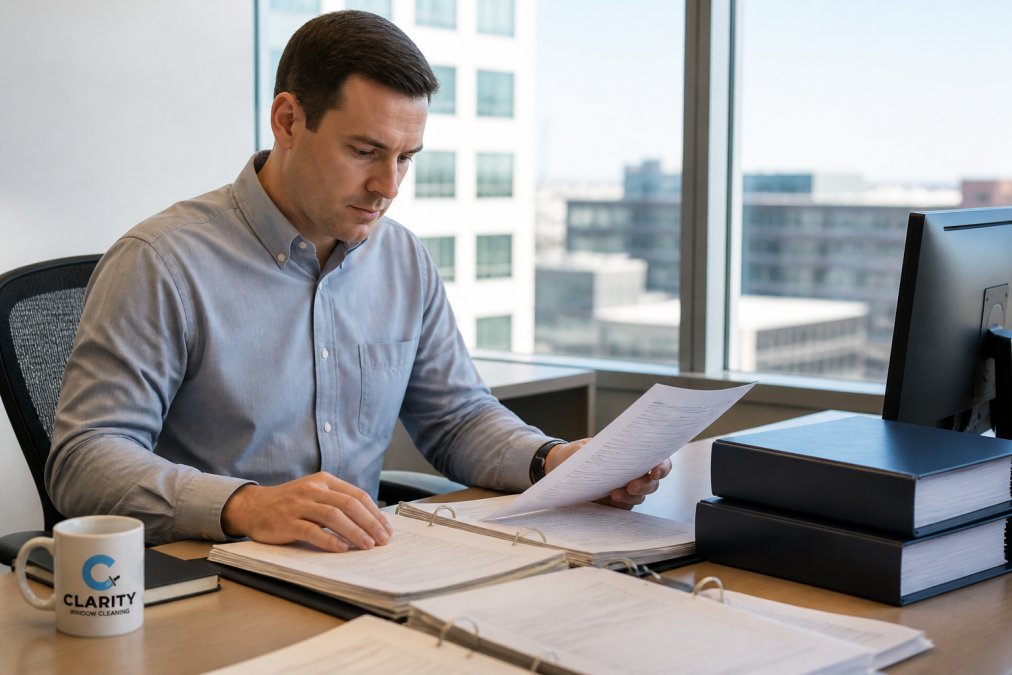
Step 1: Review the ACORD 25 Form
The ACORD 25 is a standardized one-page form that summarizes insurance coverage. When you receive it, review these key sections:
Certificate Holder: This should list your organization's name and address. If it's blank or lists the wrong entity, ask for a corrected certificate.
Insurance Company Name: Verify this is a legitimate, recognizable insurance carrier registered with your state's insurance department.
Policy Numbers: Both general liability and workers compensation should have separate policy numbers. Write these down for verification.
Coverage Limits: General liability limits typically show as "X per occurrence / Y aggregate." Standard commercial limits are $1M/$2M or higher. Workers compensation shows as "Statutory Limits" for most states.
Additional Insured: This section should list your organization. If it's blank or says "Not Applicable," the contractor's insurance won't cover your facility. Request an updated certificate with your organization added as additional insured.
Certificate Expiration Date: This date is critical. If it expires before the scheduled work, request a renewal.
Step 2: Check Policy Expiration Dates
The expiration date on the ACORD 25 form tells you when coverage ends. However, a certificate might show future expiration while the underlying policy could be cancelled if the contractor stopped paying premiums.
To verify that the policy is genuinely active, contact the insurance carrier directly using the phone number listed on the certificate. Confirm:
- The policy is active and in force
- The coverage limits match what's shown on the certificate
- Your organization is listed as additional insured
- The policy hasn't been cancelled or modified
Many insurance carriers have automated verification lines where you can enter the policy number and get instant confirmation.
Step 3: Verify Active Policy Status
Beyond the expiration date, you need to confirm the policy hasn't been cancelled or suspended. Policies can be cancelled for non-payment or other reasons. A contractor might have a valid certificate but an inactive policy underneath it.
Call the insurance carrier's verification line or speak with a representative. State that you need to verify coverage for a contractor performing work at your facility. Provide the policy number and ask specifically: "Is this policy currently active and in force?"
Document the verification in writing. Many carriers will email you a verification letter confirming active status. This documentation protects you if a claim arises later.
If the carrier cannot confirm active status, do not proceed with the work.
Step 4: Confirm Your Organization as Named Insured
The final verification step confirms that your organization is protected under the contractor's policy. On the ACORD 25 form, look for the "Additional Insured" section. Your organization's name should appear there. If it doesn't, contact the contractor and request an updated certificate with your organization added as additional insured.
When you call the insurance carrier to verify active policy status, also confirm: "Is [Your Organization Name] listed as additional insured on this policy?"
If the contractor refuses to add your organization as additional insured, or if the insurance carrier says it's not possible under their policy, do not proceed with the work.
Red Flags in Insurance Documents
Legitimate insurance documents follow standard formats and include specific information. These red flags signal the need for closer investigation.

Missing or Blank Sections: If the ACORD 25 has blank lines where information should appear, especially in the Additional Insured, Policy Number, or Expiration Date fields, request a complete, corrected version.
Handwritten Information: Professional insurance certificates are printed or digitally generated. Handwritten entries (especially policy numbers or dates) suggest the document was altered or hastily prepared.
Mismatched Information: If the contractor's name on the certificate doesn't match the company name on your contract, or if the insurance company name is spelled differently than on official documents, investigate.
No Insurance Carrier Contact Information: A legitimate ACORD 25 includes the insurance carrier's phone number and address. If this information is missing or illegible, you can't verify coverage.
Certificate Older Than 30 Days: Insurance policies change. A certificate dated more than 30 days ago may not reflect current coverage. Request a current certificate dated within the last two weeks.
Policy Limits Below Industry Standard: General liability limits below $1 million per occurrence are unusually low for commercial window cleaning. Confirm whether your facility's risk tolerance accepts these limits.
"Not Applicable" for Additional Insured: If the Additional Insured section says "Not Applicable" or is blank, the contractor's insurance won't protect your facility.
OSHA Window Cleaning Safety Standards and Insurance Compliance
Insurance requirements are tied to federal safety standards that govern window cleaning work. The Occupational Safety and Health Administration (OSHA) sets standards for fall protection and working at heights. For window cleaning, the relevant standards are found in OSHA's fall protection regulations, which require fall arrest systems, safety harnesses, and anchor points for workers at heights above 6 feet.
A contractor's general liability insurance should cover work performed in compliance with OSHA standards. When you verify insurance, ask the contractor: "Does your insurance cover window cleaning work performed in compliance with OSHA fall protection standards?"
For high-rise window cleaning specifically, confirm that the contractor's insurance covers work at the heights your building requires. Some policies exclude work above certain elevations.
At Clarity Window Cleaning, we maintain insurance coverage that explicitly includes OSHA-compliant high-rise window cleaning up to 40 stories. We provide detailed documentation of our safety protocols and insurance coverage before any work begins, giving facilities managers the certainty they need.
Verifying Insurance for Sub-Contractors
Many window cleaning contractors use sub-contractors for specific tasks or large projects. If a contractor brings sub-contractors to your facility, you need to verify their insurance separately. A contractor's policy doesn't automatically cover sub-contractors working on your property.
Request Certificates of Insurance for every sub-contractor who will be on-site. Apply the same verification steps: confirm active policy status, verify your organization as additional insured, and check expiration dates.
Some contractors include sub-contractors on their primary policy as "additional insureds." If this is the case, confirm it on the ACORD 25 form. If a sub-contractor is not listed on the primary contractor's policy, they must carry their own insurance. Do not allow uninsured sub-contractors on your property.
Document all sub-contractor insurance in your project file.
Verifying window cleaner insurance is a straightforward process that protects your facility from uninsured liability. The steps are simple: request the ACORD 25 form, review the key sections, verify active policy status with the insurance carrier, and confirm your organization is listed as additional insured. These steps provide definitive protection.
When you're ready to hire a professional window cleaning contractor, Clarity provides free estimates for all window cleaning needs. We maintain full general liability and workers compensation coverage, list your organization as additional insured before work begins, and provide detailed documentation of our OSHA-compliant safety practices. Our certified technicians are experienced in high-rise window cleaning and understand the specific insurance and safety requirements for commercial properties. Contact us to discuss your facility's needs and receive your free estimate today.
Frequently Asked Questions
Q: How do I verify if a window cleaner's insurance is actually active?
A: Contact the insurance carrier directly using the phone number on the ACORD 25 form. Ask the carrier to confirm the policyholder name, policy number, coverage limits, and expiration date. Never rely solely on the document provided, third-party verification ensures the policy is current and active. Check that your organization is listed as additional insured if required by your contract.
Q: What should I look for on an ACORD 25 certificate of insurance?
A: An ACORD 25 form must clearly show the policyholder, insurance carrier, policy numbers for general liability and workers compensation, coverage limits, deductibles, and expiration dates. Verify your organization's name appears in the 'Certificate Holder' field. Confirm the form is signed and dated by an authorized agent, and ensure all coverage types your contract requires are present with adequate limits.
Q: What insurance do window cleaners need for high-rise work?
A: Window cleaners performing high-rise work must carry general liability insurance (typically $1-2 million in coverage) and workers compensation insurance. They should also comply with OSHA window cleaning safety standards, which may require additional documentation and safety certifications. Verify that their insurance specifically covers work at height and the specific building type you operate.
Q: What happens if a window cleaner is uninsured and an accident occurs on my property?
A: If an uninsured window cleaner is injured or causes damage on your property, you could face significant liability. Your own property insurance may deny claims if you hired an uninsured contractor, leaving you personally responsible for medical bills, legal fees, and property damage. Always verify insurance before work begins. Clarity provides free estimates for all window cleaning needs and maintains full insurance coverage to protect your facility.
This article was written using GrandRanker
Frequently Asked Questions
Q: How do I verify if a window cleaner's insurance is actually active?
A: Contact the insurance carrier directly using the phone number on the ACORD 25 form. Ask the carrier to confirm the policyholder name, policy number, coverage limits, and expiration date. Never rely solely on the document provided—third-party verification ensures the policy is current and active. Check that your organization is listed as additional insured if required by your contract.
Q: What should I look for on an ACORD 25 certificate of insurance?
A: An ACORD 25 form must clearly show the policyholder, insurance carrier, policy numbers for general liability and workers compensation, coverage limits, deductibles, and expiration dates. Verify your organization's name appears in the 'Certificate Holder' field. Confirm the form is signed and dated by an authorized agent, and ensure all coverage types your contract requires are present with adequate limits.
Q: What insurance do window cleaners need for high-rise work?
A: Window cleaners performing high-rise work must carry general liability insurance (typically $1–2 million in coverage) and workers compensation insurance. They should also comply with OSHA window cleaning safety standards, which may require additional documentation and safety certifications. Verify that their insurance specifically covers work at height and the specific building type you operate.
Q: What happens if a window cleaner is uninsured and an accident occurs on my property?
A: If an uninsured window cleaner is injured or causes damage on your property, you could face significant liability. Your own property insurance may deny claims if you hired an uninsured contractor, leaving you personally responsible for medical bills, legal fees, and property damage. Always verify insurance before work begins. Clarity provides free estimates for all window cleaning needs and maintains full insurance coverage to protect your facility.