 how-to
Commercial Window Cleaning Safety Protocols: A How-To Guide
Table of Contents
- Understanding Commercial Window Cleaning Safety Protocols
- OSHA Window Cleaning Requirements and Compliance Standards
- Conducting a Window Cleaning Risk Assessment Template
- Equipment Inspection and Maintenance Protocols
- Commercial Window Cleaning Maintenance Reporting and Documentation
- Weather-Specific Safety Protocols and Site-Specific Planning
- Training, Certification, and Emergency Rescue Procedures
- Frequently Asked Questions
Last Updated: September 29, 2026
Understanding Commercial Window Cleaning Safety Protocols
Commercial window cleaning safety protocols are the documented procedures and standards that protect workers, building occupants, and property during window maintenance on commercial structures. At Clarity Window Cleaning, we've built our entire operation around these protocols because one mistake at height can be catastrophic.
The difference between a safe cleaning operation and a dangerous one comes down to preparation. Commercial window cleaning safety involves risk assessment, equipment inspection, regulatory compliance, and detailed documentation.
Clarity provides free estimates for all window cleaning needs, and during that process, we evaluate your building's specific safety requirements. The fundamentals remain the same: identify hazards, eliminate or control them, and document everything.
OSHA Window Cleaning Requirements and Compliance Standards
OSHA regulations set the baseline for workplace safety in the United States. For window cleaning operations, compliance means understanding fall protection standards, equipment requirements, and worker training mandates.
Fall Protection and Anchor Points
Fall protection is non-negotiable. OSHA requires fall protection systems for any work at heights of six feet or more.
The harness must connect to an anchor point rated to hold the worker's weight plus a safety factor. Anchor points must be structurally sound (5,000 pounds per worker minimum), located above waist level when possible, inspected before every use, and documented in your site-specific safety plan.
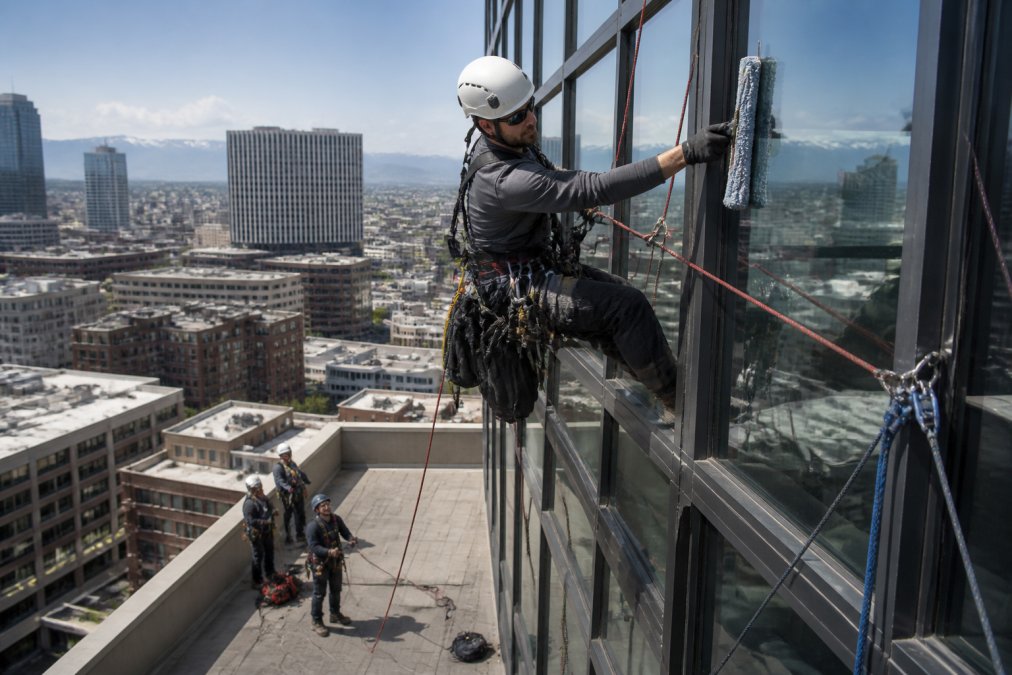
Rope access systems provide flexibility on high-rise buildings where traditional scaffolding isn't practical. These systems use multiple redundant anchor points and require certified technicians trained in rope access rescue procedures.
Anchor point selection determines whether a cleaning operation can proceed safely. A building without suitable anchor points requires temporary rigging, which is why the initial site survey is critical.
Personal Protective Equipment (PPE) Requirements
PPE requirements depend on the specific hazards identified in your risk assessment. At minimum, window cleaning operations require a full-body safety harness, hard hat, safety glasses with side shields, cut-resistant gloves, non-slip footwear, and high-visibility clothing for ground-level workers.
Chemical hazards introduce additional requirements. If your building has window treatments, coatings, or environmental contaminants, workers need chemical-resistant gloves and potentially respiratory protection. UV exposure on high-rise buildings requires long sleeves and sunscreen.
Clarity's certified technicians carry equipment rated for the specific hazards at each location. We don't use generic PPE. Every job gets a customized equipment list based on the site survey findings.
Conducting a Window Cleaning Risk Assessment Template
A risk assessment is the foundation of everything that follows. Identify every hazard present at your facility: fall hazards, chemical hazards, electrical hazards, weather hazards, and operational hazards.
Site Survey and Hazard Identification
The site survey is where you catch problems before they become incidents. Document building height, structural features, window access points, anchor point condition, proximity to electrical lines, environmental factors, tenant occupancy, and previous incidents.
Photograph everything and note dimensions, materials, and condition. Common oversights include missing wind corridors that exceed safe working limits or fragile roof features that could collapse under equipment weight.
Method Statement and Safe Operating Procedures
The method statement translates your risk assessment into specific work procedures. It should address access method, equipment and inspection schedule, PPE requirements, communication protocols, weather limits, emergency procedures, timeline, and contingency plans.
The method statement is the actual procedure your crew will follow. Clarity develops site-specific method statements for every commercial window cleaning job, accounting for your building's unique characteristics, tenant needs, and operational constraints.
Equipment Inspection and Maintenance Protocols
Equipment failure during a cleaning operation puts lives at risk. Safety equipment has non-negotiable service limits that must be tracked and enforced.
Inspection Frequency and Documentation Requirements
Establish a tiered inspection schedule: daily pre-use visual checks of harnesses, carabiners, rope, and anchor connections; weekly professional inspections by trained technicians; monthly third-party certification inspections; and annual recertification with complete equipment replacement for items past service life.
Service Life Limits and Replacement Protocols
Safety equipment has maximum service lives: harnesses 5-7 years (replace after any fall event), ropes 5 years (3-4 years in high-sun locations), carabiners 10 years with annual load testing, and anchor points require annual structural inspection with more frequent checks in corrosive environments.
Failure Mode Documentation and Root Cause Analysis
Create a failure log capturing equipment ID, failure date and location, failure mode, environmental factors, contributing factors, and corrective actions. Common failure patterns reveal systemic issues: UV damage suggests better storage is needed, rapid rope degradation suggests UV-protective storage, and rapid anchor point corrosion suggests more aggressive maintenance.
Equipment Maintenance and Facilities Manager Responsibility
If taking over responsibility for cleaning equipment, identify all equipment and manufacture dates, conduct a full inspection, replace items past service life, establish a documentation system, and schedule professional certification. When contracting with a window cleaning service, require proof of current equipment certification and inspection documentation. Clarity provides free estimates for all window cleaning needs.
Commercial Window Cleaning Maintenance Reporting and Documentation
Documentation proves regulatory compliance, protects your facility legally, creates accountability, and provides the evidence base for continuous improvement.
Daily Operations Logging and Weather Records
Every cleaning operation should generate a daily log capturing date, time, duration, weather conditions, personnel, equipment, access method, building areas cleaned, and any near-misses. Weather documentation establishes whether work proceeded within safe parameters and protects your facility if an incident occurs.
Crew Certification and Training Records
Maintain a personnel file for each crew member including current certifications (rope access, first aid, CPR, fall protection), expiration dates, training records, safety record, and annual refresher training. If an incident occurs and you cannot produce current certification, your facility bears liability. Clarity maintains current certifications for all technicians and provides facilities managers with crew roster documentation before work begins.
Post-Incident Reporting and Root Cause Analysis
Even with perfect safety protocols, incidents can occur. When they do, documentation determines liability and informs future prevention.
Your incident report should capture date, time, location, weather conditions, personnel involved, detailed narrative, contributing factors, immediate actions, witness statements, equipment condition, photographs, method statement review, corrective actions, and follow-up requirements. Root cause analysis asks: Was the hazard identified in the risk assessment? Was it addressed in the method statement? Did the worker follow procedures? Was equipment functioning properly? Was the worker trained? Were environmental conditions acceptable? Most incidents result from multiple contributing factors; identifying all of them prevents recurrence.
Insurance Compliance and Liability Documentation
Your insurance carrier requires proof that you're following industry safety standards. Documentation your insurance carrier will request includes site-specific risk assessment and method statement, equipment inspection and certification records, worker certification and training records, daily operations logs and weather records, and incident reports. If an incident occurs and you can produce a thorough risk assessment, method statement, equipment inspection records, worker certification records, daily logs, and proof the worker followed procedures, you've demonstrated compliance with industry standards. Without this documentation, you're exposed to liability claims.
Creating a Documentation System
For facilities managers, the challenge is managing documentation across multiple cleaning operations, contractors, and time periods. A simple system prevents documents from getting lost:
-
Create a master file for each building or facility containing:
- Site-specific risk assessment (updated annually)
- Method statement (updated as building changes)
- Approved contractor list with certifications
- Equipment inventory and inspection schedule
-
Create an operations folder for each cleaning cycle containing:
- Pre-work meeting notes and crew roster
- Daily operations logs
- Weather records
- Post-work inspection and sign-off
- Any incidents or near-misses
-
Create a compliance folder containing:
- Insurance requirements and coverage documentation
- Regulatory compliance checklist
- Incident history and corrective actions
- Annual review and updates
-
Digitize everything so documents are searchable and backed up. If an incident occurs months later and you need to reference a daily log from the cleaning operation that day, you need to find it quickly.
Clarify provides comprehensive post-service documentation for every commercial window cleaning job. We deliver daily operations logs, weather records, crew certifications, and equipment inspection documentation. This documentation goes directly into your compliance file and is ready if your insurance carrier or a regulator requests it.
Continuous Improvement Through Documentation Review
Documentation isn't just for compliance. It's a tool for continuous improvement. Review your documentation periodically to identify patterns:
- Are certain hazards appearing repeatedly in risk assessments?
- Are certain equipment items failing more frequently than expected?
- Are certain weather conditions causing work stoppages regularly?
- Are certain crew members involved in more near-misses?
- Are certain building areas more hazardous than others?
Patterns reveal opportunities to improve your safety system. If a particular anchor point is causing problems, maybe it needs reinforcement or replacement.
Weather-Specific Safety Protocols and Site-Specific Planning
Weather determines whether work can proceed safely. Different weather conditions create different hazards.
Training, Certification, and Emergency Rescue Procedures
Worker training determines whether safety protocols actually work in practice.
Frequently Asked Questions
What are the primary OSHA regulations for commercial window cleaning?
OSHA requires fall protection systems for work at heights above 6 feet, including safety harnesses, anchor points, and rescue procedures. Employers must conduct risk assessments, provide PPE (safety goggles, gloves, harnesses), ensure equipment inspection before each use, and maintain detailed safety documentation. High-rise window cleaning requires site-specific method statements and trained personnel. Clarity provides OSHA-compliant commercial window cleaning services with free estimates and full documentation for facilities managers.
What documentation should facilities managers require from window cleaning contractors?
Request a site-specific method statement, proof of technician certifications, equipment inspection records, insurance documentation, and post-service maintenance reporting. Contractors should provide hazard identification reports from their risk assessment, emergency rescue procedures, and incident logs (if any). Clarity delivers detailed post-service reporting for board compliance and insurance purposes, ensuring your facility maintains complete maintenance records.
How do safety protocols differ for high-rise versus low-rise commercial buildings?
Low-rise buildings (under 40 feet) may use ladders with stability assessments, while high-rise work requires rope access systems, multiple anchor points, and trained rescue teams. High-rise operations need weather monitoring, building-specific access plans, and coordination with tenants. Risk assessments are more complex for high-rise work due to wind exposure and electrical hazards. Clarity specializes in high-rise window cleaning up to 40 stories with site-specific safety plans tailored to each building's unique requirements.
What is the most common hazard for professional window cleaners?
Falls from height remain the leading hazard, followed by equipment failure and electrical contact. Proper fall protection systems, anchor point verification, and regular equipment inspection prevent most incidents. Weather conditions (wind, rain, ice) increase hazard levels significantly. Comprehensive risk assessments and emergency rescue procedures are essential. Request free estimates from Clarity to discuss how site-specific safety protocols protect your facility and staff.