 ultimate-guide
How Often Should High Rise Windows Be Cleaned? A 2026 Guide
Table of Contents
- The Short Answer: High Rise Window Cleaning Frequency Guidelines
- Key Factors That Change Your Cleaning Schedule
- Why Regular Cleaning Protects Glass Integrity and Saves Money
- Commercial Window Cleaning Frequency by Building Use
- OSHA High Rise Window Cleaning Standards and Safety
- Your High Rise Window Maintenance Checklist for Property Managers
- Modern Methods and Sustainability in High Rise Cleaning
- Conclusion: Building a Schedule With a Professional Partner
- Frequently Asked Questions
Last Updated: September 6, 2026
The Short Answer: High Rise Window Cleaning Frequency Guidelines
Most commercial high rise windows should be cleaned two to four times per year, though many urban property managers opt for quarterly service. Buildings near construction sites, major roadways, or industrial zones may need monthly cleaning to prevent pollutant buildup from etching the glass.
At Clarity Window Cleaning, we work directly with facilities managers and property managers to build schedules that balance appearance, glass longevity, and budget. The right frequency for your specific tower depends on several variables we break down below.
This guide covers recommended cleaning frequencies for commercial high rise windows, factors that accelerate dirt accumulation, and the safety standards governing work at height.
Key Factors That Change Your Cleaning Schedule
No single frequency works for every building. A glass curtain wall tower in a downtown corridor faces different conditions than a suburban low-rise campus.
Location and Environmental Pollutants
Location drives more scheduling decisions than any other factor. Buildings near highways accumulate road film and diesel exhaust rapidly. Coastal properties contend with salt air corrosion, while urban towers face pollutants that bond to glass over time.
Agricultural regions face windblown soil and irrigation overspray that leave mineral deposits becoming hard water stains, so managers in these environments typically shorten cleaning intervals to prevent permanent glass etching.
Building Type and Occupant Expectations
A Class A office tower with premium tenants has different expectations than an industrial facility. Tenant satisfaction surveys consistently show that visible building upkeep influences lease renewal decisions. Lobbies and lower-level glass receive the most scrutiny, but upper-floor streaks become noticeable when the sun hits the glass at certain angles.
Medical buildings and food-service facilities often require more frequent cleaning to meet hygiene expectations. Hospitality properties clean on tighter cycles because guest experience depends on unobstructed views.
Why Regular Cleaning Protects Glass Integrity and Saves Money
The most expensive window cleaning is the one you never schedule. When pollutants and mineral deposits sit on glass for extended periods, they degrade the surface through glass etching, creating permanent cloudy patches that no cleaning can reverse.
High rise windows are a significant capital investment. Replacing a single pane on a multi-story building involves crane work, glazier labor, and material costs that far exceed a decade of professional cleaning. Preventative maintenance removes corrosive materials before they bond to the glass.
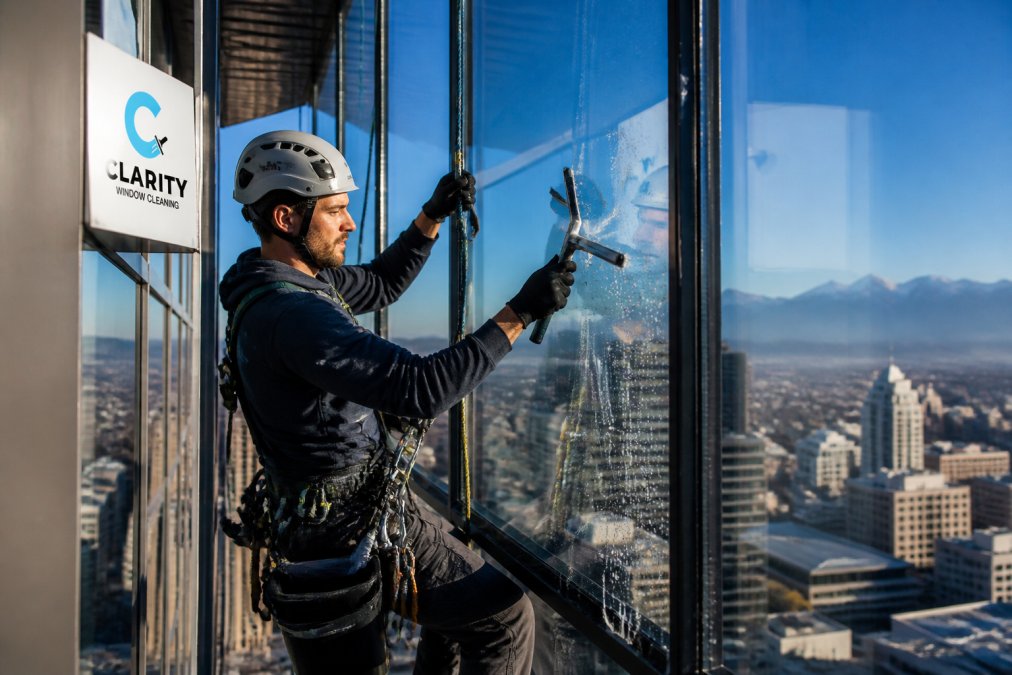
Regular cleaning also lets technicians spot failing seals, cracked frames, and deteriorating caulking before they become expensive repairs. A quarterly cleaning crew becomes an early warning system for your building envelope.
Commercial Window Cleaning Frequency by Building Use
Commercial window cleaning frequency varies meaningfully by how the building is used and who occupies it. Here is a practical starting point for most properties:
| Building Type | Recommended Frequency | Primary Drivers |
|---|---|---|
| Class A office towers | Quarterly | Tenant expectations, aesthetics, glass longevity |
| Medical facilities | Quarterly or more | Hygiene standards, patient perception |
| Retail centers | Monthly to quarterly | Curb appeal, storefront visibility |
| Industrial complexes | Semi-annually to quarterly | Pollutant exposure, safety inspection access |
| Hospitality properties | Monthly to quarterly | Guest experience, unobstructed views |
| Mixed-use developments | Quarterly | Multiple stakeholder expectations |
Buildings under construction nearby should move to the shorter end of these ranges, as construction dust and debris are highly abrasive and can scratch glass during wind events. Post-construction restoration removes cement splatter, paint overspray, and adhesive residue that standard cleaning cannot handle.
OSHA High Rise Window Cleaning Standards and Safety
Property managers need to understand the regulatory framework governing every rope access and suspended platform operation on their building. This section covers the specific standards, liability exposure, and documentation you should demand from any contractor.
The Regulatory Framework: 29 CFR Part 1910 and 29 CFR Part 1926
OSHA regulates high rise window cleaning under two distinct code sets, and knowing the difference matters when reviewing a contractor's compliance paperwork.
General Industry Standards (29 CFR Part 1910): This is the primary framework for window cleaning on existing commercial buildings. The most relevant subpart is 1910.28, covering fall protection. Any worker on a suspended platform or using rope access must be protected by a personal fall arrest system (PFAS) meeting 1910.140 requirements, a full-body harness, connecting lanyard or lifeline, and an anchor point capable of supporting 5,000 pounds per worker.
Construction Standards (29 CFR Part 1926): If your building is under construction or major renovation, different rules apply. Subpart M (1926.500-503) governs fall protection in construction, and Subpart U (1926.950-960) covers rope access. A contractor compliant under 1910 may not be compliant under 1926, and vice versa.
Powered Platforms: The Specific Standard Most Managers Overlook
For buildings with permanent building maintenance units (BMUs), the motorized cradles that hang from roof tracks, OSHA has a dedicated standard: 29 CFR 1910.66. This standard exists because powered platform failures have historically been catastrophic.
Key requirements under 1910.66 that your contractor must verify:
- Daily visual inspections: The operator must inspect the platform, hoist, and suspension system before each use.
- Monthly inspections: A competent person must perform a more detailed inspection monthly, with written records kept.
- Annual load testing: The platform must be load-tested at 125% of its rated capacity annually.
- Emergency descent capability: Every powered platform must have a manual means of descent in case of power failure.
- Suspension wire rope inspection: Wire ropes must be inspected for corrosion, kinks, and broken wires, with specific discard criteria based on wire count.
If your building has a BMU, the property manager is responsible for ensuring this equipment is maintained and inspected, even if a contractor operates it. Failure to maintain the BMU can create liability for the building owner independent of the contractor's actions.
Rope Access: The IRATA and SPRAT Certification Question
Many high rise cleaning contractors now use rope access techniques rather than powered platforms. This approach is often faster and less disruptive, but it carries its own regulatory expectations.
OSHA does not have a dedicated rope access standard for general industry, creating a regulatory gray area. In practice, OSHA inspectors defer to certification standards set by IRATA International and the Society of Professional Rope Access Technicians (SPRAT) , which certify technicians at three levels:
- Level 1: Can perform work under direct supervision
- Level 2: Can perform work independently and assist with rescue
- Level 3: Can plan, supervise, and manage rope access operations, including rescue procedures
A compliant contractor should have at least one Level 3 technician on site for every high rise project, and all technicians should carry current certification cards. Ask to see them before work begins.
The Liability Triangle: Building Owner, Property Manager, and Contractor
OSHA violations are cited against the employer of the workers, not the building owner, but that does not mean you are insulated from liability.
If a worker is injured on your building, the injured worker's attorney will almost certainly name the building owner and property manager in a lawsuit, arguing that you failed to:
- Verify the contractor's safety record before hiring
- Require proof of adequate insurance coverage
- Ensure a site-specific safety plan was in place
- Report known hazards on the building exterior
This is called vicarious liability or negligent hiring, and it is a real exposure. The defense is documentation. Every time a contractor works on your building, receive and retain:
- Certificate of insurance showing general liability and workers' compensation coverage, with your building named as an additional insured
- Site-specific safety plan that addresses the unique features of your building
- Technician certifications for all personnel on site
- Daily log of work performed and any incidents or near-misses
What to Ask Before Signing a Service Agreement
Before you sign a high rise window cleaning contract, request the following documentation and review it with your building's risk manager or legal counsel:
- Current OSHA 300 logs (injury and illness records) for the contractor
- Written fall protection program that meets 1910.140 requirements
- Proof of annual BMU load testing if your building has a powered platform
- IRATA or SPRAT certification rosters for the crew assigned to your building
- Emergency rescue plan that addresses how a worker would be rescued from height on your specific building
A reputable contractor will provide all of this without hesitation. Clarity Window Cleaning operates under OSHA-compliant practices with site-specific safety plans and full insurance coverage for every project. We work directly with facilities managers and property managers to ensure all documentation is in place before work begins, and we provide free estimates for all window cleaning needs.
Your High Rise Window Maintenance Checklist for Property Managers
Building a maintenance schedule requires coordination between your cleaning provider, your building engineer, and your tenants. Use this checklist to keep the process organized:
- Audit your building's location for pollutant exposure and adjust frequency accordingly
- Review tenant expectations and lease language regarding exterior appearance
- Verify contractor OSHA compliance, insurance, and bonding before scheduling
- Request a site-specific safety plan for each cleaning visit
- Coordinate cleaning schedules around tenant operations to minimize disruption
- Schedule interior and exterior cleaning to align where possible
- Document each service visit with photos and a written report
- Inspect window seals, frames, and caulking during each cleaning cycle
- Track glass condition over time to identify etching or corrosion early
- Review your schedule annually and adjust based on changing conditions
Detailed post-service reporting matters more than most property managers realize. Documentation of cleaning frequency and glass condition supports warranty claims, insurance discussions, and board presentations. Clarity provides this reporting as part of every service.
Modern Methods and Sustainability in High Rise Cleaning
The window cleaning industry has undergone a quiet technological revolution over the past decade. Harsh chemicals and manual scraping are being replaced by systems that are safer for technicians, gentler on glass, and better for the environment.
The Chemistry of Pure Water Cleaning
The most significant advancement is the widespread adoption of deionized (DI) water systems, often called pure water cleaning.
Standard tap water contains dissolved minerals, calcium, magnesium, iron, and silica, that leave visible spots when the water evaporates. Traditional cleaning used detergents followed by a squeegee pass, introducing chemicals into the environment.
Deionized water passes through ion-exchange resin tanks that remove virtually all dissolved minerals. The result is water that is chemically "hungry", it actively pulls contaminants from the glass as it flows. When it evaporates, it leaves nothing behind.
The practical implications for high rise buildings:
- Chemical-free cleaning: DI water systems eliminate the need for detergents in most routine cleaning applications. This means no chemical runoff entering storm drains, no residue on landscaping, and no concerns about chemical exposure for building occupants.
- One-pass efficiency: Technicians can rinse and clean in a single pass without needing a separate squeegee stroke. This reduces the time each window takes, which translates to lower labor costs over the life of a contract.
- Superior results on modern glass: Low-E coated glass and tinted glass are sensitive to harsh chemicals and abrasive tools. DI water cleaning is gentle enough to protect these specialized coatings while still achieving a spot-free finish.
Water-Fed Pole Systems: Extending Reach Without Suspended Access
Water-fed pole systems pair DI water with telescoping carbon fiber poles that reach windows up to 60 or even 70 feet from the ground or rooftop. A brush head agitates dirt while DI water flushes it away, with no ladders, scaffolding, or suspended platform required.
For high rise buildings, water-fed poles are most useful for:
- Lower-level glass (first 3-5 stories) that would otherwise require awkward scaffold positioning
- Atrium and lobby glass where interior access is limited
- Rooftop applications where the building has a setback design that allows pole access to upper floors
The limitation is height. Beyond roughly 70 feet, the pole becomes unwieldy and wind affects the brush head's contact with the glass. For upper reaches of a high rise tower, suspended access remains necessary.
Automated Cleaning Technology: The Future Is Already Here
While human technicians remain essential for high rise work, automated systems are increasingly handling specific tasks.
Building Maintenance Units (BMUs) with automated controls: Modern BMUs feature computerized positioning systems that allow a single operator to guide the platform with joystick precision. Some include pre-programmed cleaning patterns that reduce the skill required for consistent coverage.
Rope access with mechanized descent: Rope access technicians now use mechanical descenders that provide smoother, more controlled descent than traditional friction devices. This reduces fatigue and improves safety.
Drone-assisted inspection: While drones are not yet cleaning windows at scale, they are increasingly used for pre-cleaning inspections. A drone can survey the entire building envelope in hours, identifying cracked seals, damaged frames, and heavy soiling before a crew is dispatched.
Automated cleaning robots: Several manufacturers are developing robotic systems that adhere to glass and traverse building facades autonomously. These systems are still in early adoption for high rise applications but are already used for lower-level and atrium glass in some commercial properties.
The Sustainability Case for Regular Cleaning
There is a sustainability argument for regular window cleaning most property managers do not consider: frequent cleaning with gentle methods is more environmentally responsible than infrequent cleaning with aggressive chemicals.
When glass accumulates heavy soiling, technicians must use stronger detergents, more aggressive scraping, and additional passes. Conversely, a building cleaned quarterly with DI water systems uses fewer chemicals and less water per square foot of glass over a year.
Additionally, regular cleaning extends the life of the glass itself. Glass that is maintained properly does not need replacement as frequently, and glass manufacturing is energy-intensive with a significant carbon footprint. Every year you extend your glazing's life avoids the environmental cost of manufacturing and transporting replacement glass.
What to Look for in an Eco-Conscious Contractor
When evaluating window cleaning contractors for your high rise property, ask these specific questions:
- Do you use deionized water systems? If the answer is no, ask why. For most applications, DI water is now the industry standard.
- What chemicals do you use, and are they environmentally certified? Look for products that carry Green Seal certification or meet EPA Safer Choice standards.
- How do you handle wastewater? On lower levels, runoff should be contained or directed away from storm drains. On upper levels, ask about their protocol for preventing chemical-laden water from drifting onto landscaping or public spaces.
- What is your water usage per cleaning cycle? DI water systems are more water-efficient than traditional methods because they eliminate the need for a separate rinse pass.
- Do you offer a sustainability report? Some contractors now provide documentation of chemical usage, water consumption, and waste diversion as part of their service reporting.
Clarity Window Cleaning provides free estimates for all window cleaning needs and works directly with facilities managers and property managers to develop schedules that align with budget and sustainability goals. Our modern methods, including DI water systems where appropriate, reduce environmental impact while delivering the spot-free results your tenants expect.
Conclusion: Building a Schedule With a Professional Partner
The right cleaning frequency for your high rise windows balances location, building use, tenant expectations, and glass longevity. Most commercial properties settle into a quarterly rhythm, but your specific conditions may require adjustment.
Clarity Window Cleaning provides free estimates for all window cleaning needs and works directly with facilities managers and property managers to build customized schedules. Our certified commercial window cleaning technicians handle high rise projects up to 40 stories, operating under OSHA-compliant practices with site-specific safety plans and full insurance coverage.
Get Clarity and put your high rise window maintenance on a schedule that protects your investment and keeps your building looking its best year-round.
Frequently Asked Questions
What factors influence the frequency of high-rise window cleaning?
Several factors determine your high rise window cleaning schedule. Location is primary: buildings near highways, construction sites, or coastal areas with salt air accumulate pollutants faster. Weather patterns matter too, as heavy rain can leave mineral deposits. Building use also plays a role; medical offices or buildings with atriums visible to the public need more frequent service. Facilities managers should review their building's exposure and tenant expectations to set a schedule, typically ranging from quarterly to bi-annual cleaning.
What are the OSHA safety requirements for high-rise window cleaning?
OSHA requires building owners and employers to protect workers performing high rise window cleaning. This includes providing and ensuring the use of safety harnesses, lifelines, and approved suspended platforms or cradle systems. A site-specific safety plan and fall protection procedures are mandatory. Clarity Window Cleaning operates under OSHA-compliant practices, providing fully insured and bonded technicians with documented safety protocols, giving facilities managers confidence that their building's maintenance meets federal standards.
How do facilities managers determine the optimal cleaning cycle for commercial towers?
The optimal cycle balances aesthetics, glass maintenance, and budget. Start with a bi-annual schedule as a baseline for most commercial towers. If your building is in a dusty area or has high-profile retail space, move to quarterly cleaning. Observe glass conditions after each service; if hard water stains or etching appear, increase frequency. Working directly with a professional cleaning company helps tailor a schedule that protects the curtain wall investment and keeps tenants satisfied.
Does Clarity Window Cleaning provide free estimates for high-rise window maintenance?
Yes, Clarity provides free estimates for all window cleaning needs, including high rise and commercial window cleaning. We work directly with facilities managers and property managers to assess your building's specific requirements. Our team offers customized service schedules and detailed post-service reporting. Contact Clarity to schedule an assessment and receive a tailored plan for your property.
Frequently Asked Questions
What factors influence the frequency of high-rise window cleaning?
Several factors determine your high rise window cleaning schedule. Location is primary: buildings near highways, construction sites, or coastal areas with salt air accumulate pollutants faster. Weather patterns matter too, as heavy rain can leave mineral deposits. Building use also plays a role; medical offices or buildings with atriums visible to the public need more frequent service. Facilities managers should review their building's exposure and tenant expectations to set a schedule, typically ranging from quarterly to bi-annual cleaning.
What are the OSHA safety requirements for high-rise window cleaning?
OSHA requires building owners and employers to protect workers performing high rise window cleaning. This includes providing and ensuring the use of safety harnesses, lifelines, and approved suspended platforms or cradle systems. A site-specific safety plan and fall protection procedures are mandatory. Clarity Window Cleaning operates under OSHA-compliant practices, providing fully insured and bonded technicians with documented safety protocols, giving facilities managers confidence that their building's maintenance meets federal standards.
How do facilities managers determine the optimal cleaning cycle for commercial towers?
The optimal cycle balances aesthetics, glass maintenance, and budget. Start with a bi-annual schedule as a baseline for most commercial towers. If your building is in a dusty area or has high-profile retail space, move to quarterly cleaning. Observe glass conditions after each service; if hard water stains or etching appear, increase frequency. Working directly with a professional cleaning company helps tailor a schedule that protects the curtain wall investment and keeps tenants satisfied.
Does Clarity Window Cleaning provide free estimates for high-rise window maintenance?
Yes, Clarity provides free estimates for all window cleaning needs, including high rise and commercial window cleaning. We work directly with facilities managers and property managers to assess your building's specific requirements. Our team offers customized service schedules and detailed post-service reporting. Contact Clarity to schedule an assessment and receive a tailored plan for your property.