 ultimate-guide
Benefits of Rope Access Window Cleaning for Skyscrapers
Table of Contents
- Why Rope Access Window Cleaning Beats Traditional Methods for Skyscrapers
- OSHA Rope Access Requirements Every Property Manager Should Know
- Rope Access vs Swing Stage: Which Method Fits Your Building?
- High-Rise Window Cleaning Equipment That Makes Rope Access Work
- The Business Case: Cost, Liability, and Minimal Disruption
- Pros and Cons of Rope Access Window Cleaning for Skyscrapers
- Frequently Asked Questions
Last Updated: September 27, 2026
Why Rope Access Window Cleaning Beats Traditional Methods for Skyscrapers
Rope access window cleaning is a method of reaching a building's exterior using technicians suspended on certified ropes and harness systems anchored to the structure itself. For skyscrapers, it has become the preferred approach because it removes the need for ground-based staging that consumes loading zones, sidewalks, and parking areas for days at a time. At Clarity Window Cleaning, we work directly with facilities managers and property managers who need their towers maintained without shutting down the building around the work.
That distinction matters more than most people realize.
Traditional methods require a footprint. A boom lift needs a stable surface to park on. Scaffolding needs to be erected, inspected, and dismantled, and it occupies the same space for the entire duration. On a 30-story tower in a dense commercial district, that footprint is often the single biggest obstacle to getting the glass cleaned on schedule.
Rope access inverts that equation. The building becomes the anchor, not the obstacle.
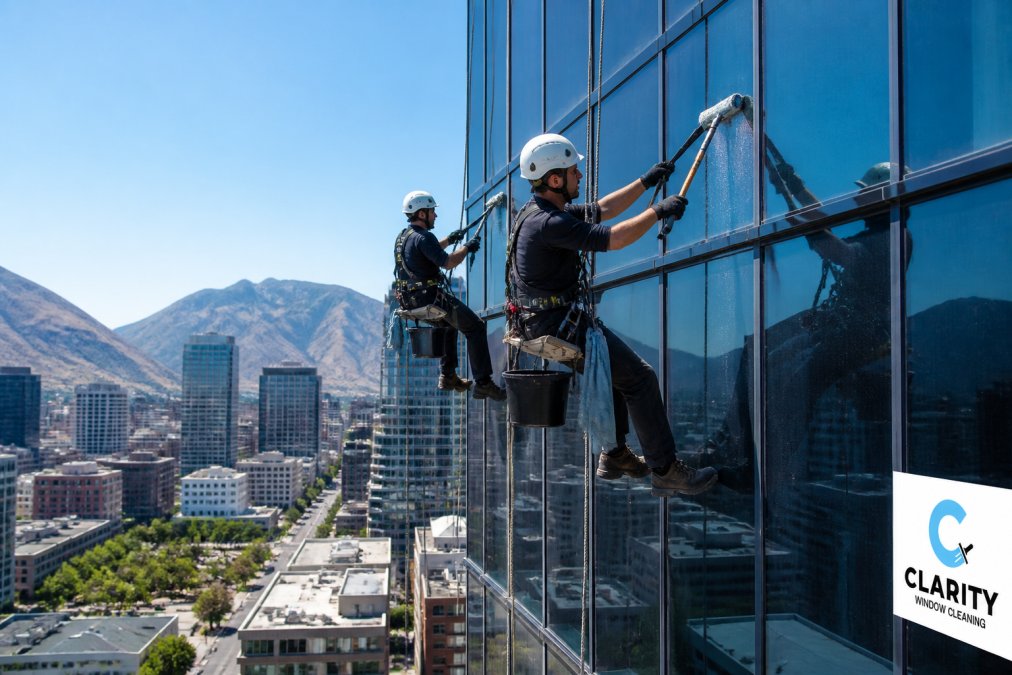
How Rope Access Window Cleaning Works
A certified technician descends from an anchor point on the roof, secured by a primary line and a separate backup line. Both systems are independent, and the technician carries a full fall protection setup. Work proceeds in vertical drops, with the crew repositioning anchors as they move around the building envelope.
The practical result: a two-person crew can cover a large glass facade in a fraction of the time a ground-based crew would need, because there is no setup and teardown cycle between sections.
Traditional Scaffolding vs. Rope Access Window Cleaning
Scaffolding makes sense for construction and heavy facade repair. It is a poor fit for routine cleaning.
| Factor | Scaffolding | Rope Access |
|---|---|---|
| Setup time | Days to weeks | Hours |
| Ground footprint | Large, blocks access | Minimal to none |
| Disruption to occupants | High | Low |
| Best for | Construction, major repair | Routine facade maintenance |
For a property manager, the difference shows up in tenant complaints and loading dock availability, not just in the cleaning itself.
OSHA Rope Access Requirements Every Property Manager Should Know
Rope access work in the United States falls under OSHA's walking-working surfaces and fall protection standards, and the requirements are not optional. Before any technician goes over the edge, the employer must have a written risk assessment, a site-specific safety plan, certified anchor points, and documented fall protection equipment inspections.
What most guides miss is that the property manager carries exposure too. If a contractor works at height on your building without proper documentation, the liability does not stop at the contractor's insurance policy. You want to see certification records, equipment logs, and a rescue plan before work begins.
The OSHA walking-working surfaces standard lays out the fall protection thresholds that govern this work, including the training and equipment requirements employers must meet.
Rope Access vs Swing Stage: Which Method Fits Your Building?
Swing stage and rope access are not interchangeable, and picking the wrong one costs time and money. A swing stage is a suspended platform, typically a few meters wide, that a crew uses for broader work like caulking, sealing, or painting. Rope access is a two-line descent system for targeted work on a vertical face.
Here is the decision framework we use:
- Choose a swing stage when the work covers a wide horizontal band, requires tools and materials on a stable surface, or involves facade repair alongside cleaning.
- Choose rope access when the job is glass and facade cleaning, the building has complex geometry, or you need to avoid blocking a street or loading zone.
- Choose rope access when the schedule is tight and you cannot afford multi-day staging.
For straight cleaning on a high-rise tower, rope access usually wins on speed and disruption.
High-Rise Window Cleaning Equipment That Makes Rope Access Work
The equipment is what separates a safe operation from a risky one, and the logic behind it is simpler than the gear list suggests: every critical function is duplicated. A working rope access setup includes a primary descent line, a separate backup line on an independent anchor, a full-body harness, a descender, an ascending device, and anchor hardware rated for the load. If the primary system fails, the backup system is already loaded and the technician never free-falls.
Here is how the descent actually works. The technician clips into both lines at the roof edge. The descender on the primary line controls the rate of descent through friction; the backup device on the second line is a fall arrester that slides freely during normal movement but locks onto the rope if the descent accelerates or the primary line goes slack. That is the mechanism that makes the two-line system meaningful rather than decorative.
For the glass itself, crews carry water-fed poles and purified water systems. Purified water matters more than people expect. Deionized water dries without spotting, which means no chemical residue and no streaking on the glass. For buildings with coated or tinted glazing, that matters for both appearance and the long-term condition of the glass surface.
Equipment choices also shift with facade material, which is a detail most guides skip:
- Glass curtain wall: Water-fed poles with purified water and soft-bristle brushes. Abrasive pads or aggressive squeegees can scratch low-e coatings.
- Aluminum panels: Mild surfactant solutions and non-scratching pads. Bare aluminum can oxidize if left wet with the wrong chemistry.
- Stone and precast concrete: Low-pressure washing and pH-neutral cleaners. Acidic cleaners can etch limestone and marble over repeated cycles.
- Sealant and gasket joints: Visual inspection during the descent, since rope access puts a technician within arm's reach of joints that a swing stage or BMU may not.
Equipment mobilization for a rope access job is fast.
The Business Case: Cost, Liability, and Minimal Disruption
The cost-benefit analysis for rope access usually comes down to three things: labor hours, liability exposure, and disruption. Most guides stop there. The part they skip is what actually changes on the insurance and compliance side when a building moves from a suspended platform or BMU to rope access.
- A certificate of insurance showing general liability and workers' compensation coverage, with your building named as an additional insured where appropriate.
- Documentation of technician certification and training records.
- A site-specific safety plan and a written rescue plan.
- Equipment inspection logs for ropes, harnesses, descenders, and anchors.
- A fall protection plan that identifies anchor points and confirms they are rated for the load.
Pros and Cons of Rope Access Window Cleaning for Skyscrapers
Rope access is not the right answer for every building, and pretending otherwise does a disservice to the property managers making the call.
Pros:
- Fast deployment with minimal site staging
- No ground footprint, so sidewalks and loading zones stay open
- Lower disruption to building occupants
- Adapts to complex facades and irregular geometry
- Preserves building aesthetics by avoiding heavy equipment against the glass
Cons:
- Requires certified technicians, which narrows the pool of qualified providers
- Not suited to work that needs a stable platform for tools and materials
- Weather-dependent, since wind and precipitation can halt a descent
- Demands rigorous documentation, which some contractors handle poorly
Frequently Asked Questions
How does rope access window cleaning compare to traditional scaffolding for skyscrapers?
Rope access window cleaning uses ropes, harnesses, and anchor points to suspend technicians directly on the building facade. Scaffolding requires assembling platforms that take days to install and block windows. Rope access deploys in hours, costs less, and lets crews reach complex architectural features. For skyscrapers, it is faster, less disruptive, and often the only practical option for cleaning upper floors.
What OSHA rope access requirements must window cleaning companies follow?
OSHA requires rope access window cleaning companies to follow 29 CFR 1910.140 and 1910.28 for fall protection. Technicians must have certified anchor points, independent safety lines, and backup fall arrest systems. Employers must provide documented training, site-specific risk assessments, and rescue plans. Property managers should verify certifications, insurance, and written safety documentation before hiring any rope access window cleaning team.
Is rope access more cost-effective than scaffolding for high-rise window cleaning?
Yes. Rope access eliminates the labor, permits, and equipment costs of scaffolding. Setup takes a fraction of the time, and crews can clean more square footage per day. For skyscrapers, the savings compound because scaffolding on a 40-story tower can take weeks to erect and dismantle.
How does rope access minimize disruption to building occupants?
Rope access window cleaning requires no ground-level staging, no sidewalk closures, and no window blocking. Technicians work from the roof or setback anchor points, so tenants keep their views and daily operations continue uninterrupted. For multi-tenant office towers and healthcare facilities, this means no noise, no restricted access, and no scheduling conflicts with tenants.