 blog
blog
4 Best Practices for Hiring Window Cleaning
Table of Contents
- Verify Licensing, Insurance, and Bonding Before Hiring
- Confirm OSHA Window Cleaning Safety Standards Compliance
- Review Experience, Track Record, and References
- Establish Clear Service Terms with a Commercial Window Cleaning Service Agreement Template
- Request Detailed Commercial Window Cleaning Maintenance Reporting
- Evaluate Equipment, Technology, and Service Quality Standards
- Frequently Asked Questions
Last Updated: September 22, 2026
Verify Licensing, Insurance, and Bonding Before Hiring
When hiring window cleaning company services, confirm they carry proper licensing, insurance, and bonding. Request documentation proving these requirements are met.
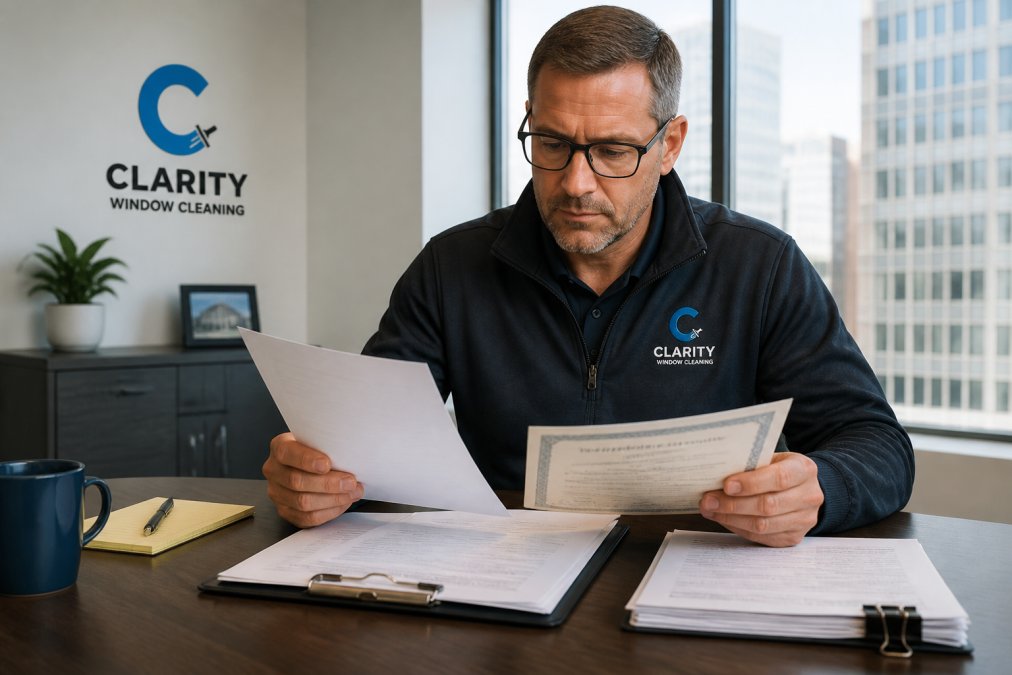
What insurance coverage protects your property
The right insurance protects you from liability if a worker is injured or property damage occurs. General liability insurance covers building damage, workers compensation protects staff, and property damage liability covers accidental breakage during service.
Request proof of general liability and workers compensation coverage with limits matching your property's size and complexity. High-rise buildings require higher coverage limits than single-story commercial spaces.
How to request and review certificates of insurance
Request a Certificate of Insurance (COI) before work begins, listing your property as an additional insured party. Verify policy dates are current, coverage amounts are adequate for your building type, and call the insurance company directly to confirm limits.
Bonding is separate from insurance and guarantees work completion or compensates you for losses. Ask for proof of bonding alongside insurance documentation. Clarity provides free estimates for all window cleaning needs and maintains full bonding and insurance coverage.
Confirm OSHA Window Cleaning Safety Standards Compliance
Your window cleaning company must follow OSHA standards to protect workers and your facility. Confirming compliance prevents accidents, protects you from liability, and demonstrates due diligence to your board and insurance carrier.
Required safety certifications, training documentation, and verification methods
Workers at heights must hold fall protection certification covering fall arrest systems, harnesses, and anchor points. Rope access certification from a recognized body is required for high-rise work and verifies training on equipment use, rescue procedures, and emergency response.
Request copies of worker certifications (not verbal assurance). Verify they are current and issued by recognized organizations. For rope access, different levels indicate varying technical skills.
Request documentation of annual refresher training on fall protection, equipment inspection, and emergency procedures. Ask for the company's training schedule and safety manual to verify their standards.
Ask whether the company conducts background checks and maintains a clean OSHA record. Search the OSHA database for citations and ask how the company corrected any violations.
Fall protection systems, site-specific safety plans, and hazard mitigation
Every job requires a written site-specific safety plan (SSSP) identifying building hazards and mitigation methods, including fall protection, anchor points, rescue procedures, and weather protocols. Develop it before work begins and review with your facilities team.
Request the safety plan one week before service. For high-rise buildings, verify it specifies roof anchors, tie-off methods, and rescue equipment. For occupied buildings, confirm it addresses tenant coordination and disruption minimization.
The company should conduct a site assessment identifying building features, weather exposure, and operational constraints. Ask whether this is included in the proposal or charged separately.
Fall protection methods vary by building height. Taller buildings often use rope access with dynamic ropes and redundant anchors, while very tall buildings may use suspended platforms. Ask the company which method they'll use and why.
Environmental and chemical safety standards
Ask the company what cleaning chemicals they use and whether they follow environmental best practices, as many facilities managers are concerned about impact on occupants, landscaping, and water systems.
Ask whether they use biodegradable, phosphate-free detergents or purified water only. Verify cleaning agents are EPA-certified or meet Green Seal standards.
For high-rise buildings, ask whether the company has runoff containment protocols, especially if your building has green roofs or sensitive plantings.
Ask whether workers receive safety data sheets (SDS) and training on proper handling and PPE for each product. Inform the company of any tenant chemical sensitivities so they can use alternatives or schedule work accordingly.
For buildings in environmentally sensitive areas or with strict regulations, ask whether the company is familiar with local rules regarding cleaning chemicals and permits.
Review Experience, Track Record, and References
A company with years of commercial experience has handled diverse building types and demonstrates consistent results and safety management.
Questions to ask about past commercial projects
Ask how many high-rise projects they've completed, the tallest building cleaned, and whether they've worked on similar properties. Request case studies showing how they solved specific challenges. Ask client retention rates, long-term relationships indicate reliability.
How to evaluate client testimonials and site visits
Request three references from similar commercial properties. Ask about on-time completion, safety incidents, post-service quality, and whether they'd rehire. If possible, visit a recently cleaned building to assess quality firsthand.
Establish Clear Service Terms with a Commercial Window Cleaning Service Agreement Template
A written service agreement defines scope, scheduling, and dispute resolution. Ensure it addresses your specific needs when hiring window cleaning company services.
Essential contract elements and scope of work
Clearly describe what work is included: interior/exterior windows, frames, sills, tracks, screens, debris removal. For multi-tenant buildings, specify common areas vs. tenant spaces. Define "clean", does it include hard water deposits, paint residue, or environmental buildup? Clarity works directly with facilities managers to define exact scope before service begins.
Include performance standards defining acceptable quality (streak-free, dry within timeframe) and safety/insurance compliance requirements.
Service frequency, quality guarantees, and dispute resolution
Specify service frequency (quarterly/semi-annual for high-rise, monthly for retail) with flexibility for seasonal adjustments.
Include a quality guarantee requiring corrections at no cost within 5-10 business days if work doesn't meet standards. Add a dispute resolution process with mediation before legal action.
Request Detailed Commercial Window Cleaning Maintenance Reporting
Documentation of cleaning work is essential for board compliance and insurance records. Your window cleaning company should provide detailed reports after each service. These reports create a maintenance history and prove work was completed.
What documentation to include in post-service reports
Post-service reports should document what was cleaned, when work was completed, and who performed it. Include the date, time, weather conditions, and any challenges encountered. List which windows, frames, and areas were cleaned. Note any damage observed or repairs recommended.
Include photos of completed work. Before-and-after photos provide visual proof of the cleaning quality. Photos also document the condition of your building's exterior. This is valuable if damage claims arise later.
Report any safety incidents or near-misses. If a worker encountered a hazard or had a minor accident, document it immediately. This creates a safety record and helps identify patterns. Regular incident reporting shows your commitment to worker safety and risk management.
Using reports for board compliance and insurance records
Maintain all cleaning reports in a centralized database. This creates a maintenance history that satisfies board requirements and insurance audits. Many commercial properties must document routine maintenance for regulatory compliance.
Insurance companies may request maintenance records if a claim arises. If a window breaks during cleaning, your documentation proves the incident occurred during professional service. This protects you from liability disputes. Reports also show you took reasonable steps to maintain your property.
Share cleaning reports with your board or ownership.
Evaluate Equipment, Technology, and Service Quality Standards
Modern equipment and processes deliver better results and safer work. A professional window cleaning company invests in quality tools and stays current with industry standards. For facilities managers overseeing high-rise or large commercial properties, understanding the equipment and quality assurance methods used is essential to ensuring consistent results and worker safety.
Water-fed pole systems, rope access, and equipment specifications
Water-fed pole systems are a common method for commercial window cleaning, using purified water delivered through telescoping poles, allowing workers to clean from the ground without scaffolding or elevated work platforms. Purified water prevents mineral deposits and streaking that occur with tap water. Ask your window cleaning provider whether they use purified water systems and what filtration method they employ.
Quality assurance processes, inspection protocols, and streak-free guarantees
Professional window cleaning companies should have documented quality assurance (QA) processes that include pre-service assessment, in-progress monitoring, and post-service inspection. During pre-service assessment, a supervisor or lead technician walks the building to identify problem areas, hard water stains, paint residue, environmental buildup, and communicates expectations to the crew. This step prevents surprises and sets a baseline for quality.
Technology-driven communication and real-time reporting
Modern window cleaning companies increasingly use digital tools to improve communication and accountability. Mobile scheduling apps allow facilities managers to book service, receive real-time status updates, and access photos of completed work from a single platform. Automated invoicing and digital payment options streamline billing and reduce administrative overhead. Some companies provide live photo documentation during service, allowing you to see progress without being on-site.
Frequently Asked Questions
What insurance coverage should a professional window cleaning company have?
A reputable window cleaning company must carry general liability insurance (minimum $1 million coverage) and workers compensation insurance. General liability protects your property if equipment damages the building or surrounding areas. Workers compensation covers employee injuries on your site. Always request a Certificate of Insurance naming your property as an additional insured before work begins. Verify the policy is active and covers high-rise window cleaning if applicable.
Why is OSHA compliance critical when hiring window cleaning services?
OSHA standards require fall protection, safety harnesses, and proper training for work at heights. Non-compliant contractors expose your facility to liability if an accident occurs. Ask about OSHA 30-hour certifications, fall protection training, and site-specific safety plans. Ensure technicians use approved equipment like rope access systems or water-fed poles. Compliance documentation protects both your property and the contractor's team.
What should a commercial window cleaning service agreement template include?
A solid service agreement specifies scope of work, service frequency, pricing structure, insurance requirements, safety protocols, and quality guarantees. Include clauses for weather delays, equipment damage liability, and dispute resolution. Define what 'streak-free' means and outline post-service inspection procedures. The agreement should also address background checks, workers compensation verification, and your right to request detailed maintenance reporting after each service.
How often should commercial properties schedule professional window maintenance?
Frequency depends on building type, location, and environmental factors. High-rise office towers typically require quarterly or semi-annual cleaning to maintain professional appearance and tenant satisfaction. Retail properties may need monthly service during peak seasons. Industrial facilities with dust or chemical exposure may require more frequent cleaning. Discuss your specific needs with your contractor; they can recommend a customized schedule and provide documentation in maintenance reports for your records.