 how-to
Window Cleaning Safety Checklist: A How-To Guide
Table of Contents
- Why a Window Cleaning Safety Checklist Matters
- Conducting a High-Rise Window Cleaning Risk Assessment
- OSHA Window Cleaning Safety Standards and Compliance
- Step-by-Step: Building Your Safety Checklist
- Commercial Window Cleaning Maintenance Reporting
- Common Safety Mistakes to Avoid
- Implementing Digital Checklist Integration
- Conclusion
- Frequently Asked Questions
Last Updated: September 3, 2026
Why a Window Cleaning Safety Checklist Matters
A window cleaning safety checklist is a documented set of procedures and inspections designed to identify hazards, verify compliance, and protect workers before they begin work at height. For facilities managers and property managers overseeing high-rise or commercial properties, this checklist becomes the difference between a routine maintenance day and a preventable incident.
Window cleaning involves work at height, suspended platforms, anchor points, and chemical handling, each introduces specific risks. A comprehensive checklist ensures your team catches problems before they escalate. At Clarity Window Cleaning, we've built our entire operation around documented safety procedures because one oversight can cascade into liability, injury, or worse.
This guide walks you through building a practical, OSHA-compliant window cleaning safety checklist tailored to your facility's specific needs.
Conducting a High-Rise Window Cleaning Risk Assessment
Before you write a single checklist item, you need to understand your site's unique hazards. A high-rise window cleaning risk assessment identifies conditions specific to your building that generic checklists will miss.
Identifying Site-Specific Hazards
Start by walking your property with a critical eye. A 28-story office tower in an urban core faces different hazards than a 5-story retail center. Wind exposure, surrounding structures, tenant operations, and building materials all matter.
Document these site-specific hazards:
- Structural elements: Ledges, cornices, setbacks, and architectural features that affect anchor point placement and worker movement
- Environmental factors: Prevailing wind patterns, sun exposure, proximity to traffic or pedestrian areas
- Building materials: Glass type, coating residue, surface condition, presence of asbestos or lead paint on older structures
- Operational constraints: Tenant schedules, HVAC systems, electrical equipment, or security protocols that affect access
- Adjacent hazards: Power lines, nearby construction, neighboring buildings, or rooftop equipment
Write these down. Don't rely on memory.
Documenting Environmental Conditions
Environmental conditions change daily. Your safety checklist must account for weather, temperature, and visibility before work begins.
Create a pre-work environmental log that captures:
- Weather conditions: Wind speed and direction, precipitation, temperature, forecast for the duration of work
- Visibility: Glare from sun position, fog or haze, lighting conditions
- Surface conditions: Wet or icy glass, condensation, residue buildup that affects grip or footing
- Time-of-day factors: Shift changes affecting building operations, rush hour traffic, tenant meeting schedules
Include a decision rule: "If wind exceeds 20 mph at any point during the shift, work stops immediately."
OSHA Window Cleaning Safety Standards and Compliance
Your window cleaning safety checklist must align with OSHA standards for work at height. OSHA regulations are legally binding requirements for any commercial operation.
Fall Protection Requirements
OSHA's fall protection standard applies to any work performed at heights of 6 feet or more. For window cleaning on high-rise buildings, every worker must be protected by a personal fall arrest system, safety net, or warning line with guardrail.
Personal fall arrest systems are the standard for window cleaning. A fall arrest system includes:
- An anchorage point capable of supporting at least 5,000 pounds per worker
- A body harness that distributes fall forces across the torso
- A connector (lanyard or self-retracting lifeline) that limits free fall distance to 6 feet maximum
- Proper inspection and maintenance of all components before each use
Your checklist must verify that all three components meet OSHA standards before workers are deployed.
Personal Protective Equipment (PPE) Standards
OSHA requires specific PPE for window cleaning work. Your checklist should verify that each worker has and is wearing:
- Hard hat: ANSI Z89.1 compliant, properly fitted, chin strap fastened
- Safety glasses or face shield: Impact-resistant, appropriate for chemical splash hazard
- Slip-resistant footwear: Minimum sole rating that prevents slipping on wet or treated glass surfaces
- Gloves: Cut-resistant and chemical-resistant depending on cleaning agents used
- High-visibility clothing: Required if work occurs near traffic or equipment movement
Each worker must understand why each piece of PPE matters. Hard hats prevent head injuries from falling objects. Slip-resistant footwear prevents falls on wet platforms.
Step-by-Step: Building Your Safety Checklist
A practical window cleaning safety checklist follows a logical sequence: pre-shift inspection, equipment verification, chemical review, and site access confirmation.
Pre-Shift Inspection Procedures
Begin every shift with a physical walk-through of the work area. Pre-shift inspection takes 15-20 minutes for a typical commercial building.
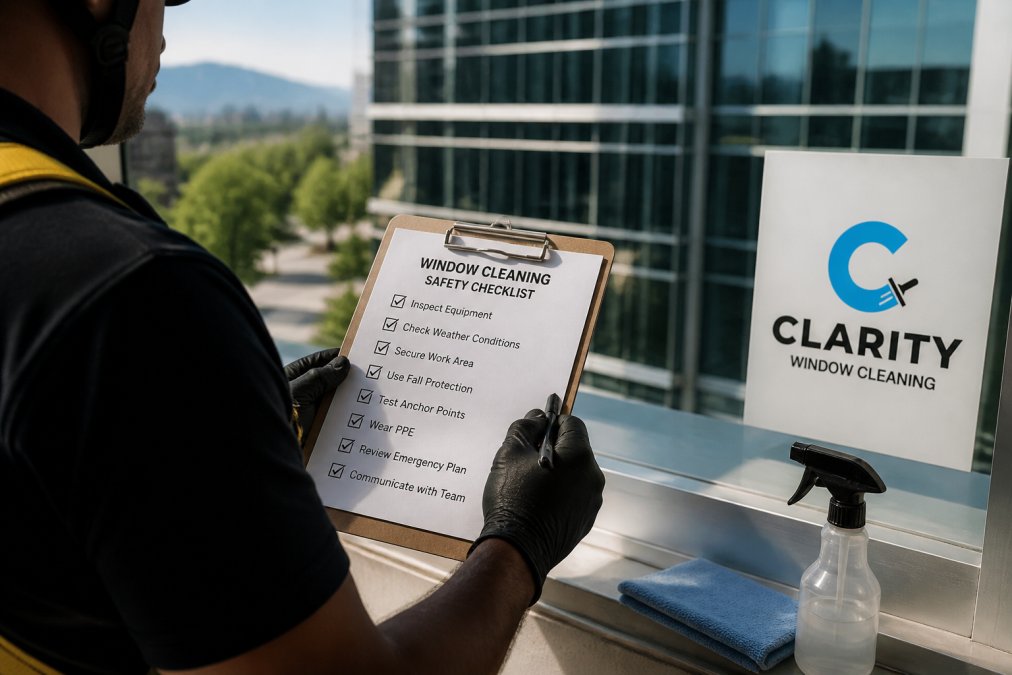
The pre-shift inspection checklist should include:
- Visual scan of work surfaces: Look for loose glass, cracks, sharp edges, or debris
- Anchor point verification: Physically test each anchor point with visual inspection and load testing
- Platform and equipment placement: Confirm suspended platforms are level, secure, and positioned correctly
- Surrounding area assessment: Check for hazards in the vicinity, open windows, active HVAC systems, electrical lines, or construction
- Access route confirmation: Verify the safest path for workers to reach the work area
- Communication system check: Confirm two-way radios, phone signals, or hand signals are functional
Document findings on your checklist. If a problem is found, note it, photograph it, and decide: fix it before work begins, modify the work plan, or postpone.
Equipment Maintenance and Safety Checks
Equipment failures cause incidents. Your checklist must verify that every tool and safety device is in working condition before deployment.
Equipment maintenance checks should cover:
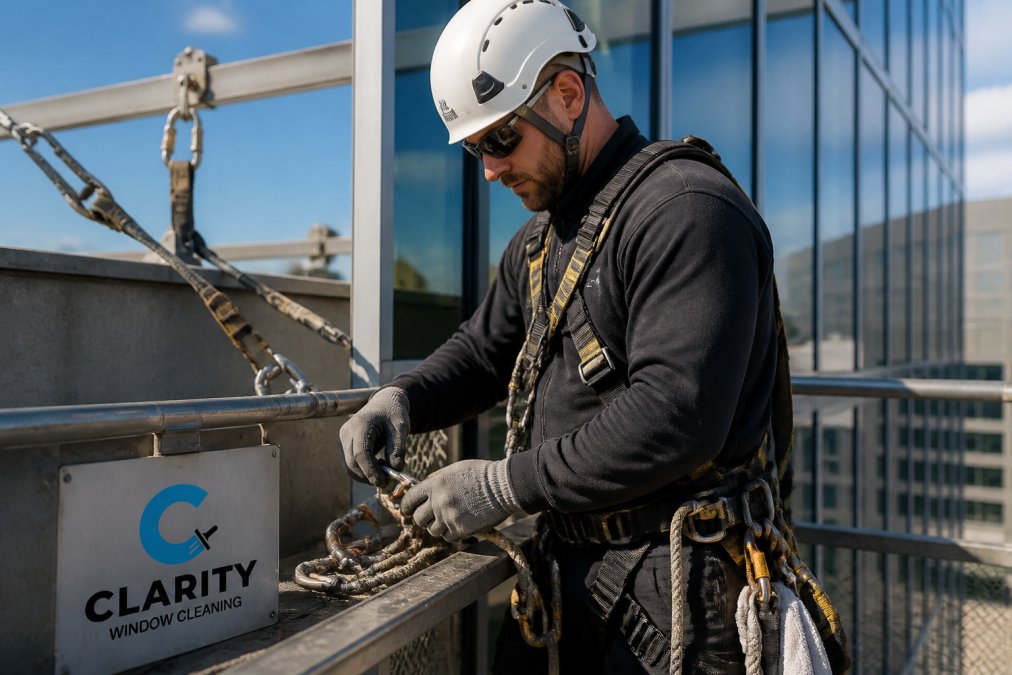
- Suspended platforms: No visible cracks, rust, or damage; all attachment points secure; safety rails intact; weight capacity placard visible
- Ropes and rigging: No fraying, cuts, or chemical damage; proper diameter for the load; stored correctly
- Harnesses and lanyards: No tears, cuts, or deformation; all stitching intact; attachment points functional; hardware not corroded
- Cleaning equipment: Squeegees without cracks, buckets without holes, extension poles without damage
- Power tools or electric equipment: Cords without cuts, grounding intact, GFCI protection functional
- Rescue equipment: Verify rescue harnesses, pulleys, and rigging are in working order
Keep dated maintenance logs showing when each piece of equipment was inspected, by whom, and what condition it was in.
Chemical Handling and Safety Data Sheets
Window cleaning solutions vary widely. Some are mild detergents. Others contain caustic or acidic components that require careful handling.
Your chemical safety checklist must include:
- Safety Data Sheet (SDS) review: Every chemical used on site must have a current SDS available to workers
- Proper storage: Chemicals stored in labeled containers, away from food or drinking water, in conditions that prevent degradation
- Personal protective equipment for chemical use: Gloves, eye protection, and respiratory protection based on hazard classification
- Spill containment: Absorbent materials, spill kits, and disposal procedures available on site
- Ventilation: Adequate air movement to prevent vapor accumulation
- Dilution procedures: If chemicals are mixed on site, verify correct ratios and mixing order
A worker who spends eight hours a day handling window cleaning solution without proper gloves will develop dermatitis. Your checklist prevents these chronic exposures.
Site Access and Perimeter Security
Before work begins, confirm that the work area is secure and that workers won't be interrupted by building occupants or pedestrians.
Site access and security checks include:
- Area isolation: Confirm the work area is cordoned off with warning signs, barriers, or personnel
- Tenant notification: For multi-tenant buildings, verify affected tenants have been notified
- Equipment staging: Confirm all equipment is staged in a location that doesn't block emergency exits or fire lanes
- Security clearance: Verify workers have appropriate building access and security personnel are aware of the work
- Parking and vehicle safety: Confirm vehicles are parked safely and won't interfere with building operations
This step prevents disruptions and protects both your team and building occupants.
Commercial Window Cleaning Maintenance Reporting
Documentation transforms a safety checklist from a daily procedure into a compliance system. Facilities managers and property managers need detailed records for insurance, audits, and liability protection.
Incident Reporting Workflows
An incident doesn't have to mean an injury. Near-misses, equipment failures, and environmental hazards that forced work stoppage are all incidents that should be documented.
Your incident reporting workflow should capture:
- Date, time, and location: Specific building, floor, or area where the incident occurred
- Description of what happened: Factual account without blame or speculation
- Conditions at the time: Weather, equipment in use, number of workers, environmental factors
- Immediate actions taken: First aid administered, work stopped, equipment removed from service
- Root cause analysis: What caused this? Equipment failure, procedural error, environmental condition, or something else?
- Corrective actions: What will be done to prevent recurrence?
- Follow-up verification: Confirmation that corrective actions were completed and effective
Incident reports prove to your carrier and any investigator that you identified problems, took them seriously, and implemented solutions.
Liability and Insurance Documentation
Your window cleaning safety checklist and maintenance records are insurance documents. They prove you operated with reasonable care.
Maintain a file that includes:
- Safety checklist templates with completed checklists from each work day
- Equipment maintenance logs showing inspection dates and findings
- Incident reports for any near-miss or injury
- Training records documenting that workers received safety training
- Site assessments and risk documentation for each property
- Chemical inventory and SDS records showing what was used and proper handling
- Contractor agreements if external services are used, including proof of insurance and safety certifications
If Clarity Window Cleaning handles your commercial window cleaning, we provide detailed post-service reporting that documents what was done, conditions observed, and any issues noted.
Common Safety Mistakes to Avoid
Skipping the site-specific assessment. Teams use a generic checklist without adapting it to the building's unique hazards. Invest time in understanding your site before work begins.
Assuming equipment is fine because it was fine last time. Equipment degrades. Inspect every piece of equipment every shift.
Working in bad weather because "the forecast was clear this morning." Weather changes. Your checklist should include a decision rule: if conditions exceed your safe limits at any point, work stops.
Skipping the pre-shift walk-through to save time. A 15-minute walk-through prevents a two-hour delay caused by discovering a structural problem mid-work.
Not documenting anything. If something happens and you have no records, you have no defense. Document everything: inspections, incidents, maintenance, training, and any decisions to work or not work.
Using contractors without verifying their safety practices. If an external service performs window cleaning, verify their insurance, certifications, and safety procedures. You're liable for their actions on your property.
Implementing Digital Checklist Integration
Paper checklists work. Digital checklists work better because they create automatic records, reduce transcription errors, and allow real-time communication.
A digital checklist system should include:
- Mobile app or web interface: Workers complete checklists on tablets or phones on site
- Photo documentation: Workers can photograph issues directly in the app
- Real-time alerts: If a critical item is marked as failed, the system immediately notifies a supervisor
- Automatic record storage: Completed checklists are timestamped and stored automatically
- Incident tracking: Near-misses and incidents are logged in the same system for pattern analysis
- Compliance reporting: The system generates reports for insurance carriers and regulatory audits
Digital integration removes the friction of paper-based systems. Workers don't lose checklists. Supervisors can review findings in real time. Records are never "somewhere in a filing cabinet."
Conclusion
A window cleaning safety checklist is not a compliance checkbox. It's your operational foundation for protecting workers, managing liability, and maintaining your facility professionally. The checklists that work are the ones that reflect your specific site, are updated regularly, and are actually used before every work session.
If you're managing commercial window cleaning for a high-rise or complex property, building a comprehensive safety checklist is essential. Clarity provides free estimates for all window cleaning needs, and we work directly with facilities managers and property managers to develop site-specific safety plans and documentation. Our OSHA-compliant approach includes detailed post-service reporting so your maintenance records are always current. Get started with Clarity Window Cleaning and eliminate the guesswork from your window cleaning operations.
Frequently Asked Questions
What are the mandatory OSHA requirements for window cleaning safety?
OSHA requires fall protection systems for all work at heights exceeding 6 feet, including safety harnesses, anchor points, and guardrails. Hard hats, slip-resistant footwear, and eye protection are mandatory PPE. All equipment must be inspected before use, and workers must receive training on hazard identification and rescue procedures. Facilities managers should verify that contractors meet these standards and maintain documentation of compliance.
How do I document safety inspections for commercial window cleaning maintenance?
Create a standardized form that records the date, time, inspector name, equipment checked, hazards identified, and corrective actions taken. Include sections for weather conditions, site access verification, and worker certifications. Digital tools can automate this process and generate reports for your records. Clarity provides detailed post-service reporting to help facilities managers maintain compliance documentation for insurance and board reviews.
What should be included in a high-rise window cleaning risk assessment?
A comprehensive risk assessment evaluates building-specific hazards such as wind exposure, anchor point locations, load-bearing capacity, weather patterns, and emergency access routes. Document site-specific conditions including building height, facade materials, and nearby obstacles. Identify potential fall hazards, chemical exposure risks, and weather-related dangers. This assessment forms the foundation of your safety checklist and should be reviewed before each service cycle.
How often should safety equipment be inspected for window cleaning?
Safety harnesses, lanyards, and anchor points must be inspected before every shift and at minimum annually by a qualified technician. Suspended platforms, ropes, and rigging equipment require inspection per OSHA standards, typically monthly or after any incident. Document all inspections in your maintenance log. Facilities managers should request this documentation from contractors to verify ongoing compliance and equipment integrity.
This article was written using GrandRanker
Frequently Asked Questions
What are the mandatory OSHA requirements for window cleaning safety?
OSHA requires fall protection systems for all work at heights exceeding 6 feet, including safety harnesses, anchor points, and guardrails. Hard hats, slip-resistant footwear, and eye protection are mandatory PPE. All equipment must be inspected before use, and workers must receive training on hazard identification and rescue procedures. Facilities managers should verify that contractors meet these standards and maintain documentation of compliance.
How do I document safety inspections for commercial window cleaning maintenance?
Create a standardized form that records the date, time, inspector name, equipment checked, hazards identified, and corrective actions taken. Include sections for weather conditions, site access verification, and worker certifications. Digital tools can automate this process and generate reports for your records. Clarity provides detailed post-service reporting to help facilities managers maintain compliance documentation for insurance and board reviews.
What should be included in a high-rise window cleaning risk assessment?
A comprehensive risk assessment evaluates building-specific hazards such as wind exposure, anchor point locations, load-bearing capacity, weather patterns, and emergency access routes. Document site-specific conditions including building height, facade materials, and nearby obstacles. Identify potential fall hazards, chemical exposure risks, and weather-related dangers. This assessment forms the foundation of your safety checklist and should be reviewed before each service cycle.
How often should safety equipment be inspected for window cleaning?
Safety harnesses, lanyards, and anchor points must be inspected before every shift and at minimum annually by a qualified technician. Suspended platforms, ropes, and rigging equipment require inspection per OSHA standards, typically monthly or after any incident. Document all inspections in your maintenance log. Facilities managers should request this documentation from contractors to verify ongoing compliance and equipment integrity.