 ultimate-guide
Window Cleaning Safety: Best Practices for 2026
Table of Contents
- Why Window Cleaning Safety Is a Business Imperative
- OSHA Window Cleaning Regulations: The Legal Baseline
- Essential High-Rise Window Cleaning Safety Equipment
- PPE and Chemical Handling for Professional Cleaners
- Risk Assessment: The First Step on Every Job
- The Window Cleaning Safety Checklist for Property Managers
- Conclusion: Building a Safety-First Partnership
- Frequently Asked Questions
Last Updated: September 9, 2026
Why Window Cleaning Safety Is a Business Imperative
Window cleaning safety is the systematic application of protocols, equipment standards, and training designed to prevent falls, injuries, and property damage during exterior maintenance. For property and facilities managers, a single incident triggers liability questions, insurance complications, tenant disruption, and reputational damage.
This guide from Clarity Window Cleaning outlines the operational standards that separate professional, OSHA-compliant operations from dangerous improvisation. We work directly with facilities managers and property managers, and the patterns we see repeat are predictable: rushed timelines, inadequate equipment inspection, and weather decisions made on optimism rather than data.
The visible work, gleaming glass on a 20-story tower, is the easy part. The invisible work, anchor point verification, harness inspection, rescue planning, and risk documentation, is where safety is actually won or lost.
OSHA Window Cleaning Regulations: The Legal Baseline
The legal foundation for window cleaning safety rests on federal workplace standards enforced by the Occupational Safety and Health Administration. OSHA window cleaning regulations do not exist as a single dedicated rule; instead, they emerge from the general industry standards for walking-working surfaces, fall protection, and personal protective equipment that apply to all work at height.
Under OSHA's walking-working surfaces standard, employers must assess workplace conditions and provide fall protection when workers are exposed to falls of four feet or more in general industry settings. For window cleaning operations on multi-story buildings, this effectively means every exterior task above the first level requires a written fall protection strategy.
A common mistake is treating OSHA compliance as a checklist exercise rather than an ongoing operational commitment. Compliance demands documented training records, regular equipment inspection logs, and site-specific fall protection plans. Verifying a contractor's compliance starts with requesting those documents before work begins, not after.
Essential High-Rise Window Cleaning Safety Equipment
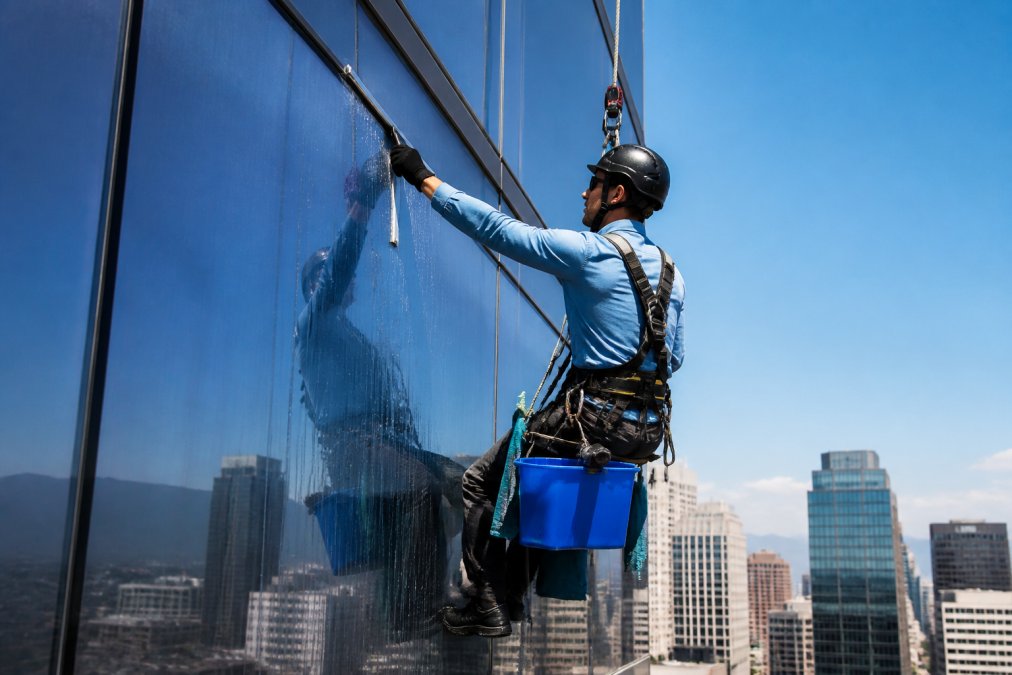
High-rise window cleaning safety equipment is specialized, load-rated, and unforgiving of improvisation. Every component in the system, from the harness on the technician's body to the anchor point embedded in the roof structure, must meet rigorous manufacturing standards and pass inspection before each use.
Fall Protection Systems: Harnesses, Lanyards, and Anchor Points
Full-body harnesses distribute fall forces across the thighs, pelvis, chest, and shoulders, reducing the risk of trauma during a sudden stop. The lanyard connects the harness to the anchor point, and modern systems typically incorporate a shock-absorbing component that limits the force transmitted to the worker's body during a fall event.
Anchor points are the foundation of the entire system, and they demand the most scrutiny. A structural anchor must be rated to support at least 5,000 pounds per worker, according to OSHA's fall protection guidelines. The critical detail that most guides miss is that anchor points must be positioned to minimize free-fall distance and swing hazards. A technically sound anchor that allows a 15-foot pendulum swing can be more dangerous than no anchor at all.
Access Equipment: Scaffolding, Ladders, and Rope Descent Systems
For buildings up to a few stories, ladders and scaffolding remain common access methods. Ladder stability depends on the four-to-one rule: the base should sit one foot away from the wall for every four feet of vertical height. Overreaching is the leading cause of ladder-related falls, and a spotter at the base adds a critical layer of protection.
High-rise structures typically require rope descent systems or powered suspended platforms. These systems demand redundant safety lines, independent of the primary working line, and a documented rescue plan before anyone goes over the edge. Suspension trauma can become fatal within minutes, making rapid rescue capability non-negotiable.
PPE and Chemical Handling for Professional Cleaners
Personal protective equipment for window cleaning extends beyond fall protection into a layered system designed for the specific hazards of exterior maintenance. For facilities managers overseeing commercial contracts, understanding this system is essential for evaluating whether a crew is genuinely prepared or merely equipped.
Head-to-Toe PPE Requirements
Technicians working at height need a complete PPE ensemble, not just a harness. The standard configuration for professional crews includes:
- Slip-resistant footwear rated for wet surfaces, with non-marking soles to protect building interiors and ledges. Most practitioners replace boots when tread depth falls below 1/8 inch, as smooth soles on wet glass ledges are a primary cause of slips.
- Hard hats with chin straps when working below other trades, near overhead crane operations, or on rooftops with HVAC equipment. A falling tool from an upper floor can be fatal, and the chin strap prevents the hat from becoming a projectile itself.
- Safety glasses with side shields or goggles rated ANSI Z87.1 to guard against chemical splash and glass fragments. When using concentrated acids, a full-face shield is the appropriate standard, as splash patterns from pressurized sprayers are unpredictable.
- Cut-resistant gloves for handling glass panes during repair or replacement work, rated at least ANSI A4 for tasks involving raw glass edges.
- High-visibility vests when working near vehicle traffic or in loading zones where building occupants and delivery vehicles move through the work area.
Chemical Handling: Beyond the SDS Binder
Professional cleaning solutions fall into three primary hazard classes, each demanding different handling protocols:
-
Alkaline cleaners (pH above 9), Used for heavy soil, grease, and construction residue. These penetrate skin quickly and cause deep tissue damage that may not be immediately painful. Technicians must rinse exposed skin with water for at least 15 minutes, and supervisors should verify that eyewash stations or portable rinse bottles are within 10 seconds of the work area.
-
Acidic cleaners (pH below 5), Formulated for mineral deposit removal, hard water staining, and rust. Hydrofluoric acid-based products, used for heavy industrial buildup, are uniquely dangerous because calcium binding in the body can cause cardiac arrhythmias from relatively small exposures. These products require specialized training, medical surveillance, and calcium gluconate gel on site.
-
Solvent-based products, Used for adhesive removal and paint overspray. These carry inhalation risks that are magnified when working in confined spaces like elevator shafts or enclosed atriums. Air monitoring may be required when ventilation is inadequate.
Every chemical on the truck must have a Safety Data Sheet (SDS) on file, but the binder alone is insufficient. Technicians must know how to interpret exposure limits, recognize early symptoms of overexposure, and execute first-aid responses before handling the product.
PPE Inspection Protocols
PPE is only protective when it is functional. Professional operations maintain documented inspection logs for every item, with a three-tier system:
- Pre-use inspection (every shift): Visual check for cuts, abrasions, chemical damage, and degraded elastic or straps.
- Monthly documented inspection: A supervisor reviews each item against a standardized checklist, logging findings and retiring damaged equipment.
- Annual replacement: Most harnesses, lanyards, and gloves have a manufacturer-rated service life, even if they appear undamaged. UV exposure alone degrades nylon webbing over time.
For facilities managers, the verification point is straightforward: ask to see the inspection logs, not just the equipment. A contractor who cannot produce dated records for each harness and lanyard is operating outside professional standards.
Clarity Window Cleaning provides free estimates for all window cleaning needs, and our assessment process includes a review of our chemical inventory and PPE inspection logs so property managers can verify our standards before work begins.
Risk Assessment: The First Step on Every Job
A proper risk assessment is a structured evaluation of every hazard present at a specific job site, documented before work begins. It must reflect the actual conditions of the building, the day, and the crew.
The Five-Phase Assessment Sequence
The assessment process follows a logical sequence that professional crews internalize as a daily rhythm:
-
Site reconnaissance, A physical walk of the roof, ledges, anchor points, and ground-level work zones. This happens before any equipment is unloaded, and it includes verifying that anchor points match the building's structural drawings.
-
Task decomposition, Breaking the job into discrete tasks (e.g., rigging, descent, cleaning, ascent, derigging) and identifying the hazards unique to each. The hazards of a descent differ from the hazards of the cleaning pass itself.
-
Hazard evaluation, Scoring each hazard for likelihood and severity. A common professional framework uses a 5x5 matrix, where a hazard scoring 15 or higher (on a 25-point scale) requires a dedicated control plan before work proceeds.
-
Control measure selection, Determining how to eliminate or mitigate each hazard. This follows the hierarchy of controls: elimination (can we access this from a platform instead?), engineering (can we install a guardrail?), administrative (can we limit work to certain hours?), and finally PPE.
-
Communication briefing, A pre-job tailgate meeting where the entire crew reviews the assessment, signs off on their understanding, and has the authority to stop work if conditions change.
Weather Monitoring: Moving Beyond Wind Speed
Wind speed is the primary environmental determinant, but professional operations track a broader set of conditions:
- Sustained wind speed, Most commercial operations establish a hard stop at 20-25 mph for rope descent systems, depending on the building's geometry and the glass type. Glass panes act as sails, and a sudden gust on a multi-story building creates forces that no harness system can fully mitigate if the glass itself fails.
- Gust factor, Sustained wind of 15 mph with gusts to 30 mph is more dangerous than steady 20 mph wind. Gusts create dynamic loading on equipment and make body positioning unpredictable.
- Precipitation and humidity, Wet glass reduces squeegee effectiveness and increases slip risk on ledges. High humidity can cause chemical residues to dry unevenly, requiring rework that extends time at height.
- Temperature extremes, Below-freezing conditions make harness webbing stiffer and more prone to micro-cracking. Extreme heat creates fatigue and dehydration risks that compound the cognitive load of working at height.
- Lightning risk, A common rule is to suspend operations when lightning is within 10 miles, and to wait 30 minutes after the last observed strike before resuming.
Digital Safety Tools: The Modern Assessment Workflow
Leading operations now use:
-
Digital checklist platforms (e.g., SafetyCulture, iAuditor) that require photo evidence of completed inspections, timestamped and geotagged to the specific building. This eliminates the "pencil whip" problem where checklists are signed without actual verification.
-
Real-time weather APIs that push alerts to crew supervisors when wind speeds approach threshold limits, rather than relying on a single morning check of a weather app.
-
Drone-assisted pre-inspection for high-rise facades, allowing crews to identify loose glass, damaged seals, or obstructions before a technician is suspended. This reduces the risk of encountering unexpected hazards at height.
-
Digital anchor point registries that log inspection dates, load test results, and photos for each anchor on a building, accessible via QR code at the anchor location itself.
For facilities managers, these digital tools signal a contractor's safety culture. A crew that requires photographic evidence and digital sign-off has built accountability into their workflow.
The Pre-Job Briefing: Where Assessment Becomes Action
Professional operations hold a mandatory tailgate meeting before every job, covering:
- The specific hazards identified for this building and day
- The control measures in place for each hazard
- The rescue plan and the roles of each crew member in an emergency
- The weather forecast and the specific thresholds that will trigger a work stoppage
- The communication protocols between the technician at height, the spotter on the ground, and the supervisor
A common pattern in incident reports is a crew that conducted a thorough morning assessment but failed to reassess when conditions changed mid-shift. The assessment is a continuous loop requiring the authority and training to stop work when new hazards emerge.
Clarity Window Cleaning provides free estimates for all window cleaning needs, and our risk assessment process is part of every estimate. We walk property managers through our digital assessment tools and site-specific findings so you can see exactly how we plan to protect your building and our crew.
The Window Cleaning Safety Checklist for Property Managers
When you hire an exterior maintenance contractor, you are delegating responsibility for a high-risk activity on your property. The window cleaning safety checklist for property managers below gives you the verification points to confirm your contractor operates to professional standards.
| Checklist Item | What to Verify | Why It Matters |
|---|---|---|
| Insurance and bonding | Current certificates naming your property as additionally insured | Protects you from liability in an incident |
| OSHA compliance documentation | Written fall protection plans, training records | Confirms legal baseline is met |
| Site-specific risk assessment | Documented for your building, not generic | Addresses your unique anchor points and glass |
| Equipment inspection logs | Dated records for harnesses, lanyards, anchors | Catches wear before it becomes failure |
| Rescue plan | Written procedure for extracting a suspended worker | Suspension trauma can turn minutes into fatalities |
| Weather thresholds | Clear wind speed limits before dispatch | Prevents glass and equipment failures |
| Chemical SDS availability | Safety Data Sheets on site for all products | Ensures proper handling and first-aid response |
A reputable contractor will welcome this scrutiny, the quality of their response is one of the most reliable signals of their overall safety culture. Clarity Window Cleaning provides free estimates for all window cleaning needs, and part of that process includes walking property managers through our safety documentation so you can verify our standards before we begin.
Conclusion: Building a Safety-First Partnership
The distinction between a window cleaning company that talks about safety and one that operates safely becomes visible in the documentation, equipment condition, and crew's daily habits. For facilities managers and property managers, the responsibility is to ask the right questions, review the right documents, and partner with contractors who treat safety as a non-negotiable standard.
Clarity Window Cleaning brings this approach to every commercial and high-rise project, with certified technicians, OSHA-compliant practices, and site-specific safety plans documented before work begins. Our fully insured and bonded team handles buildings up to 40 stories, and we provide detailed post-service reporting so you can maintain clear records for your board and insurance carriers.
Get started with Clarity Window Cleaning and bring a verified, safety-first partner to your next exterior maintenance project.
Frequently Asked Questions
What is the number one hazard faced by professional window cleaners?
Falls from height are the most significant hazard. This includes falls from ladders, scaffolding, or building exteriors. The primary defense is a comprehensive fall protection system, which includes a properly fitted harness, a shock-absorbing lanyard, and a certified anchor point. Every worker must be trained on how to inspect and use this equipment. A documented rescue plan is also required in case a fall occurs, as suspension trauma can set in quickly.
What are the primary OSHA requirements for commercial window cleaning?
OSHA requires employers to protect workers from falls when working at heights of six feet or more. For window cleaning, this means using guardrails, safety nets, or personal fall arrest systems. All equipment must be inspected regularly. Employers must also provide training on hazard recognition and the safe use of equipment. Compliance is verified through site-specific safety plans and documentation, which a professional service like Clarity Window Cleaning provides for every project.
How do property managers verify the safety credentials of cleaning contractors?
Ask for certificates of insurance and proof of OSHA compliance. A reputable contractor will provide a site-specific safety plan that outlines the hazards and control measures for your building. Request documentation of their training programs and equipment inspection logs. Check that they are fully bonded and insured. Clarity provides free estimates and detailed safety documentation, giving property managers the peace of mind that their building is in compliant hands.
How often should window cleaning safety equipment be inspected?
Safety equipment should be inspected before every single use by the worker. This includes checking harnesses for frayed webbing or damaged buckles, and lanyards for tears or broken snaps. A formal, documented inspection by a competent person should occur at least annually, or more frequently if the equipment is used in harsh conditions. Any equipment that shows signs of damage or has been involved in a fall must be removed from service immediately.
What is the most common hazard for high-rise window cleaners?
Besides falls, overexertion and weather conditions are common hazards. Working on suspended scaffolding or with heavy water-fed poles requires significant physical effort. High winds can make equipment unstable and create unsafe conditions. This is why professional teams monitor weather closely and have protocols to stop work when wind speeds exceed safe limits. Proper training on equipment setup and physical conditioning are just as important as wearing the right PPE.
What should be on a window cleaning safety checklist for property managers?
Your checklist should verify that the contractor has a site-specific safety plan, proof of insurance, and OSHA-compliant training. Confirm the planned access methods and that all fall protection equipment is inspected and certified. Discuss the weather monitoring plan and the emergency rescue procedures. Before work begins, ensure the work area is cordoned off and the team has a clear communication system. This proactive approach protects your tenants and your property.