 ultimate-guide
Liability Insurance for Window Cleaning Companies
Table of Contents
- Why Window Cleaning Insurance Is Non-Negotiable
- Commercial Window Cleaning Insurance Requirements
- OSHA Safety Compliance for Window Cleaners
- Certificate of Insurance for Property Managers
- High-Rise vs. Residential Risk Profiles
- What Does Window Cleaning Insurance Actually Cover?
- How Much Does Window Cleaning Insurance Cost?
- Conclusion
- Frequently Asked Questions
Last Updated: September 28, 2026
Why Window Cleaning Insurance Is Non-Negotiable
Liability insurance for window cleaning companies comes down to one reality: crews work at height, on ladders, and around other people's property daily. One dropped squeegee or slip on a wet lobby floor can trigger a claim running into the tens of thousands. At Clarity Window Cleaning, coverage is part of the job itself.
Window cleaning insurance bundles policies protecting a cleaning business against third-party injury and property damage claims, employee injuries, and vehicle accidents. Window cleaners face fall exposure, chemical handling, and constant proximity to expensive glass, landscaping, and building finishes.
Facilities and property managers carry risk too: hire an uninsured crew, and their accident becomes your liability.
Commercial Window Cleaning Insurance Requirements
Commercial window cleaning insurance requirements start with what your contracts demand. Most commercial cleaning contracts, especially for multi-tenant and high-rise properties, specify minimum coverage limits before a crew is allowed on site, typically general liability, workers' compensation, and commercial auto.
Property owners often add themselves as additional insureds and require a certificate before the first visit, so serious commercial providers build coverage around contract terms rather than legal minimums.
- General liability: covers third-party bodily injury and property damage
- Workers' compensation: covers employee injuries on the job
- Commercial auto: covers vehicles used to reach and service job sites
- Umbrella or excess liability: raises limits above the base policies
General Liability and Workers' Compensation
General liability insurance covers third-party claims, injuries or damage to someone who is not your employee. If equipment scratches a tenant's vehicle or a pedestrian slips on a wet walkway, general liability responds, including legal defense and settlement payouts.
Workers' compensation covers your own employees when hurt on the job, regardless of fault. Requirements vary by state, so a business operating across the Wasatch Front should confirm obligations with the state labor authority. For high-rise work, workers' compensation is not optional.
Commercial Auto and Inland Marine Coverage
Commercial auto insurance covers the vans and trucks moving crews, ladders, water-fed poles, and pure-water systems between jobs. A personal auto policy usually excludes business use, a common and expensive mistake.
Inland marine coverage handles equipment in transit and off-site.
OSHA Safety Compliance for Window Cleaners
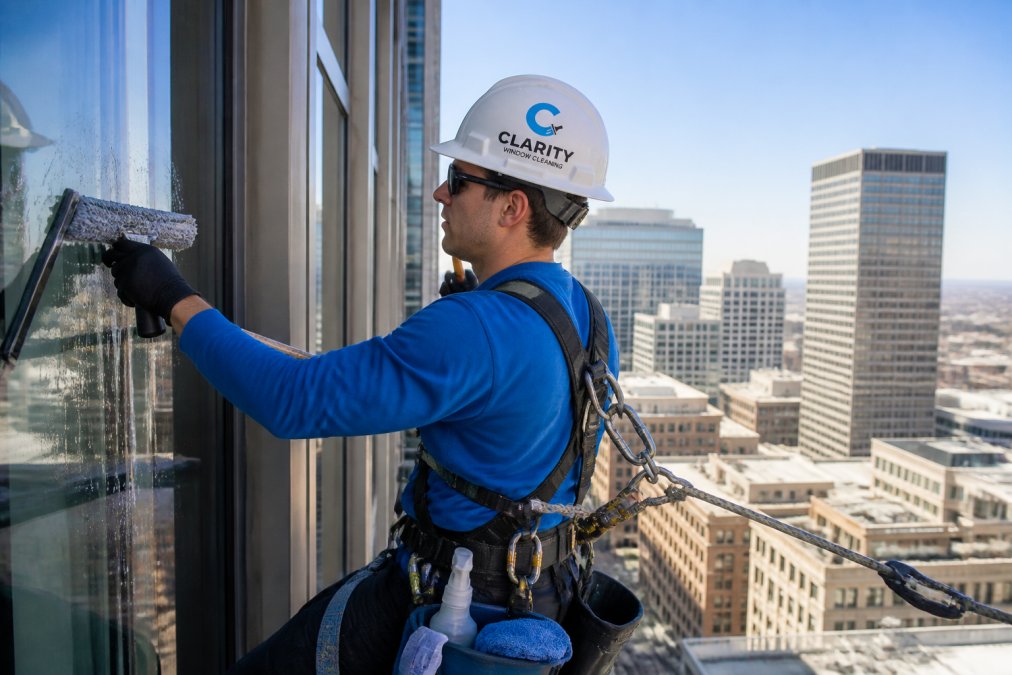
OSHA safety compliance for window cleaners is where insurance and operations meet. The Occupational Safety and Health Administration sets fall protection and equipment standards for workers at height, and a clean safety record keeps premiums and claims low. Insurers look at how you work, not what you promise.
- Written site-specific safety plan for each building
- Documented fall protection and harness inspection logs
- Ladder safety and anchor point verification
- Chemical handling and dilution records
- Incident reporting and near-miss tracking
Certificate of Insurance for Property Managers
A certificate of insurance for property managers proves a cleaning contractor carries the coverage your contract requires. It lists policy types, limits, and effective dates, and names additional insureds when required. Without it, you have no proof the crew is protected.
| Document | What It Proves | Who Needs It | Renewal Frequency |
|---|---|---|---|
| Certificate of insurance | Active coverage and limits | Property manager | Annually or per contract |
| Additional insured endorsement | Owner named on policy | Building owner | At policy renewal |
| Workers' comp proof | Employee injury coverage | Facilities director | Annually |
| Safety plan | OSHA-aligned procedures | Site manager | Per project |
- Confirm the certificate lists general liability, workers' comp, and auto
- Verify effective dates cover the full contract term
- Check that additional insured wording matches the lease
- Set a calendar reminder 30 days before expiration
High-Rise vs. Residential Risk Profiles
High-rise and residential window cleaning carry very different risk profiles, and insurers price them accordingly. High-rise work involves rope access or suspended platforms, greater fall exposure, and more expensive property below. Residential work is lower to the ground but involves delicate surfaces, landscaping, and homeowners on site.
What Does Window Cleaning Insurance Actually Cover?
Window cleaning insurance covers third-party injury and property damage, employee injuries, vehicle accidents, and equipment in transit, depending on the bundle. But knowing coverage types is only half the picture. The other half is what happens in the hours after an incident, because on-site steps often determine whether a claim is paid or denied.
Third-Party Claims and Completed Operations
Third-party claims cover injuries or damage to people and property outside your business. Completed operations extends that protection after the job finishes. If a window seal fails or a pane cracks weeks later and the client claims the work caused it, completed operations responds.
Equipment-Specific Coverage and Pure-Water Systems
Pure-water systems, water-fed poles, carbon fiber poles, filtration units, and pressure washing equipment are specialized assets that generic property policies often undervalue. Equipment-specific coverage, frequently written as inland marine, protects them against damage, theft, and breakdown. For providers using pure-water systems to reach upper floors without ladders, that equipment is the core of the operation.
What Happens After an Incident: A Claims Process Walkthrough
This is the step most crews get wrong, and where coverage is won or lost. When an incident occurs, a dropped tool, a scratched pane, a slip on a wet lobby floor, a fall, the first hour matters more than the policy language.
- Secure the scene and stop work. Prevent further injury or damage. Do not resume the job until the area is safe.
- Render aid and call for medical help if anyone is hurt. Document the time and who responded.
- Notify the property manager or facilities manager immediately. Do not wait for the next business day. Commercial contracts usually require prompt notice, and a delay can complicate the claim.
- Photograph everything. The scene, the damage, the equipment involved, the conditions (wet floor, missing signage, anchor point, ladder placement). Photos taken at the scene carry far more weight than descriptions written later.
- Collect witness information. Names, roles, and contact details for anyone who saw the incident.
- Do not admit fault or discuss coverage. Statements made on site can be used in a claim. Report facts, not conclusions.
- Preserve the equipment and any damaged property. Do not repair, discard, or replace anything until the insurer has been notified.
- Report the claim to your insurer promptly. Provide the incident report, photos, witness details, and the contract for the job.
- Cooperate with the adjuster. Provide requested documentation and access. Withholding information is one of the fastest ways to have a claim denied.
Most denials in this trade trace back to late reporting, missing documentation, or work performed outside the operations described on the policy. If a crew takes on pressure washing, post-construction cleanup, or rope access without updating the policy, those jobs may not be covered, even if the crew is otherwise fully insured.
How Much Does Window Cleaning Insurance Cost?
Window cleaning insurance cost is not a single number, and any provider quoting one before asking about your operation is guessing. What separates a well-priced policy from an expensive one is how it is structured against the work you actually do, for commercial and high-rise crews, structure matters more than sticker price.
- Annual revenue and payroll, general liability is often rated per $1,000 of revenue, while workers' compensation is rated per $100 of payroll. Higher payroll in a high-risk class moves the workers' comp number more than anything else.
- Number of employees and vehicles, each additional crew member adds workers' comp exposure, and each service vehicle adds a commercial auto premium.
- Coverage limits and deductibles, raising a general liability limit from $1M to $2M per occurrence is usually a modest increase; raising it to $5M typically requires an umbrella or excess policy. A higher deductible lowers premium but shifts more of each claim onto your balance sheet.
- Claims history and safety documentation, a clean loss run plus documented fall protection training, harness inspection logs, and site-specific safety plans can move you into a better tier at renewal.
- Work mix, a provider doing both high-rise and residential work is priced on the higher-risk portion of the book, not the average.
Set your coverage limits to your largest contract requirement, not your lowest premium. The savings from underinsuring are real until the first claim, and then they are gone.
Conclusion
Getting coverage right is one of the least glamorous parts of running a window cleaning business, and one of the most important. Providers who document safety practices, carry the right limits, and hand over clean certificates are the ones facilities managers keep on speed dial.
Frequently Asked Questions
Do window cleaners need public liability insurance?
Yes. Public liability insurance, often called general liability, protects window cleaning companies from third-party claims of bodily injury or property damage. If a cleaner accidentally cracks a client's window or a passerby is injured by falling equipment, this coverage handles legal defense costs and settlement payouts. Most commercial contracts require proof of this insurance before work begins.
How does insurance protect property managers when hiring window cleaners?
When property managers hire an insured window cleaning company, the liability for accidents shifts to the contractor's policy. If a cleaner is injured on site or damages the building, the property manager is protected from financial loss. Always request a certificate of insurance before work starts to confirm active coverage.
What are the OSHA requirements for window cleaning insurance and safety?
OSHA requires employers to provide a workplace free from serious hazards. For window cleaners, this means fall protection, ladder safety training, and proper equipment maintenance. While OSHA does not mandate insurance, carrying workers' compensation and general liability insurance demonstrates compliance and protects your business from lawsuits following a workplace incident.
Does general liability insurance cover property damage during window cleaning?
General liability insurance typically covers accidental property damage caused during window cleaning, such as scratched glass, broken frames, or water damage to interiors. However, policy exclusions may apply for intentional acts or faulty workmanship. Review your policy carefully and document pre-existing damage before starting any job to avoid disputes.