 listicle
Vetting OSHA-Compliant Window Cleaning for 20-Story Towers
Table of Contents
- Why OSHA Compliance Matters for High-Rise Window Cleaning
- Verify OSHA Fall Protection and Anchor Point Certification
- Review Commercial Window Cleaning Safety Checklist Requirements
- Assess High-Rise Window Cleaning Insurance Requirements
- Request a Written Window Cleaning Site-Specific Safety Plan
- Verify Technician Training and Safety Certification
- Demand Documented Safety Protocols and Post-Incident Reporting
- Inspect Equipment Maintenance Logs and Safety Audit Records
Last Updated: August 28, 2026
Vetting OSHA-Compliant Window Cleaning for 20-Story Towers
Facilities managers and property managers know the stakes. A single accident on a high-rise window cleaning job means injuries, regulatory fines, insurance claims, legal liability, and damage to your building's safety record. The difference between hiring a contractor who cuts corners and one who operates by the book can cost you six figures.
This guide from Clarity Window Cleaning covers the exact vetting process you need to protect your building, your tenants, and your bottom line. We work directly with facilities managers and property managers to understand what actually matters when evaluating OSHA-compliant window cleaning services. Below, we'll walk you through every checkpoint, from anchor point certification to liability transfer language, so you hire with confidence.
Quick Reference: What to Verify
- OSHA Fall Protection Compliance, Anchor points, certified inspections, competent person designation
- Insurance and Liability, Minimum coverage amounts, liability transfer in subcontracting agreements
- Safety Documentation, Written site-specific safety plans, equipment maintenance logs, post-incident reporting procedures
- Technician Credentials, Training certifications, IWCA standards, safety audit records
Why OSHA Compliance Matters for High-Rise Window Cleaning
Window cleaning on a 20-story office tower is a high-hazard operation governed by federal safety regulations. OSHA fall protection standards (29 CFR 1910.27) establish mandatory requirements for any work at heights above 6 feet, and high-rise window cleaning triggers the strictest oversight (osha.gov).
Liability doesn't stop with the contractor. If you hire a non-compliant service and someone gets hurt, your building can face citations, fines, and civil liability. OSHA holds building owners accountable for maintaining safe conditions on their premises. That's why vetting is a legal and operational necessity.
A single incident disrupts operations, damages tenant confidence, and creates documentation nightmares for your insurance company. Facilities managers who work with OSHA-compliant providers know the work is done safely and documented properly.
Clarity Window Cleaning provides free estimates for all window cleaning needs and can walk you through our OSHA-compliant processes so you understand exactly what proper vetting looks like in practice.
Verify OSHA Fall Protection and Anchor Point Certification
OSHA fall protection requires every worker suspended at height to be protected by guardrails, safety net systems, or personal fall arrest systems. For high-rise window cleaning, that means anchor points, the structural elements where safety lines attach.
Check for Competent Person Designation
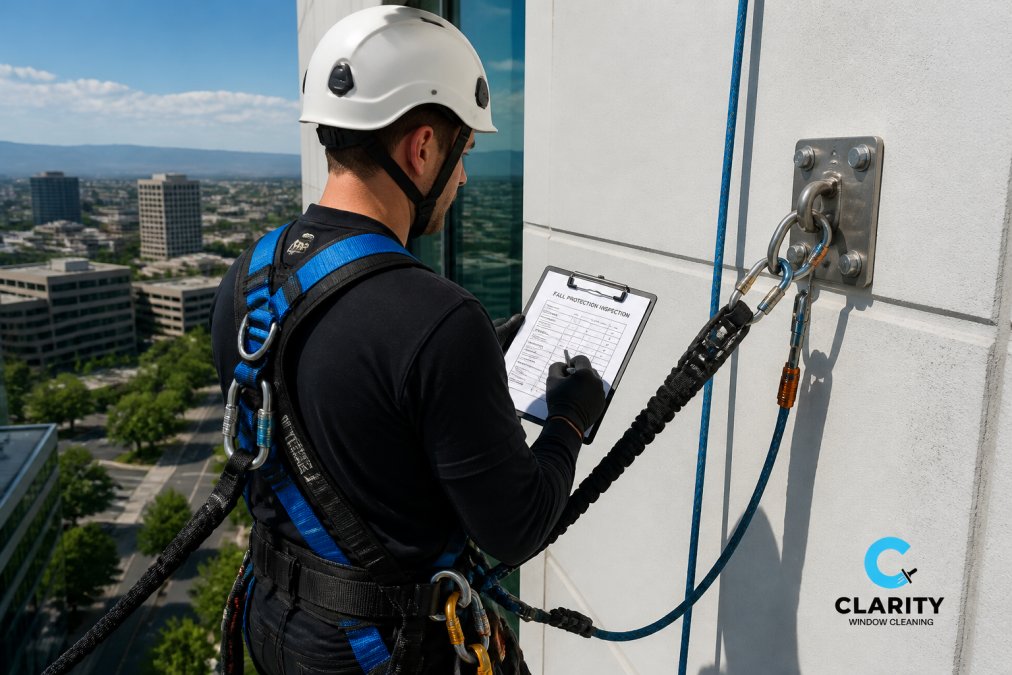
Ask the contractor directly: "Do you have a designated competent person on site?" This is required by OSHA. A competent person is trained and authorized to identify fall hazards, inspect equipment, and stop work if conditions become unsafe (osha.gov). They're your first line of defense against unsafe practices.
The contractor should provide documentation showing who holds this designation and what training they've completed. This person should be on-site during the entire job.
Confirm Anchor Point Load Testing Documentation
Every anchor point used for fall protection must be tested to verify it can safely support the load. ANSI/IWCA I-14.1 standards specify that anchor points must support a minimum load of 5,000 pounds per worker (or 3 times the maximum intended load, whichever is greater) (peer-reviewed research).
Request written documentation showing:
- The date of the most recent anchor point inspection
- Load testing results with specific PSI or force measurements
- The name and credentials of the person who performed the test
- Any repairs or reinforcements made since the last test
If the contractor can't produce this documentation, don't proceed.
Review Commercial Window Cleaning Safety Checklist Requirements
A professional contractor should have a detailed safety checklist specific to your building. This identifies hazards on YOUR property and outlines how the contractor will address them.
The checklist should cover:
- Building access points, How workers enter and exit, elevator access, roof access procedures
- Weather conditions, Wind speed limits, rain protocols, temperature restrictions
- Electrical hazards, Distance from power lines, grounding procedures
- Structural hazards, Weak facade points, loose materials, decorative elements
- Tenant notifications, How and when tenants will be informed, operational disruptions
- Emergency procedures, Rescue protocols, first aid station location, emergency contacts
The contractor should walk through this checklist with you before work begins. A generic document without building-specific details is a red flag.
Assess High-Rise Window Cleaning Insurance Requirements
Insurance is non-negotiable. Verify that the contractor carries adequate coverage and that your building is properly protected.
Minimum insurance requirements for high-rise window cleaning:
- General Liability, Minimum $1 million per occurrence, $2 million aggregate
- Workers' Compensation, Statutory limits for your state
- Umbrella/Excess Liability, Additional $1-2 million coverage for high-rise work
- Equipment Insurance, Coverage for ropes, harnesses, and specialized equipment
Request a Certificate of Insurance (COI) that lists your building as an "additional insured." This protects you if the contractor's insurance denies a claim.
Liability Transfer in Subcontracting Agreements
If the contractor subcontracts part of the work, liability can get murky. Make sure the primary contractor's agreement explicitly requires subcontractors to carry the same insurance minimums and to name your building as an additional insured.
The contract language should state: "Contractor shall require all subcontractors to maintain insurance coverage meeting or exceeding the requirements of this agreement and to provide proof of coverage prior to work commencement."
If the contractor refuses this language or works with subcontractors who won't provide proof of insurance, walk away.
Request a Written Window Cleaning Site-Specific Safety Plan
A site-specific safety plan (SSSP) is a written document that outlines how the contractor will perform the work safely on YOUR building. It's customized to your property's unique hazards and conditions.
The SSSP should include:
- Scope of work, Exactly what areas will be cleaned, frequency, timeline
- Hazard analysis, Specific hazards identified on your building
- Fall protection systems, Type of system, anchor points, inspection procedures
- Personal protective equipment, Harnesses, helmets, footwear, inspection frequency
- Rescue procedures, How injured workers will be evacuated, emergency contacts
- Weather protocols, Wind speed limits, rain procedures, temperature restrictions
- Training documentation, Proof that all workers have received training on the SSSP
Request this document before work begins. A reputable contractor will have it prepared and ready to discuss.
Verify Technician Training and Safety Certification
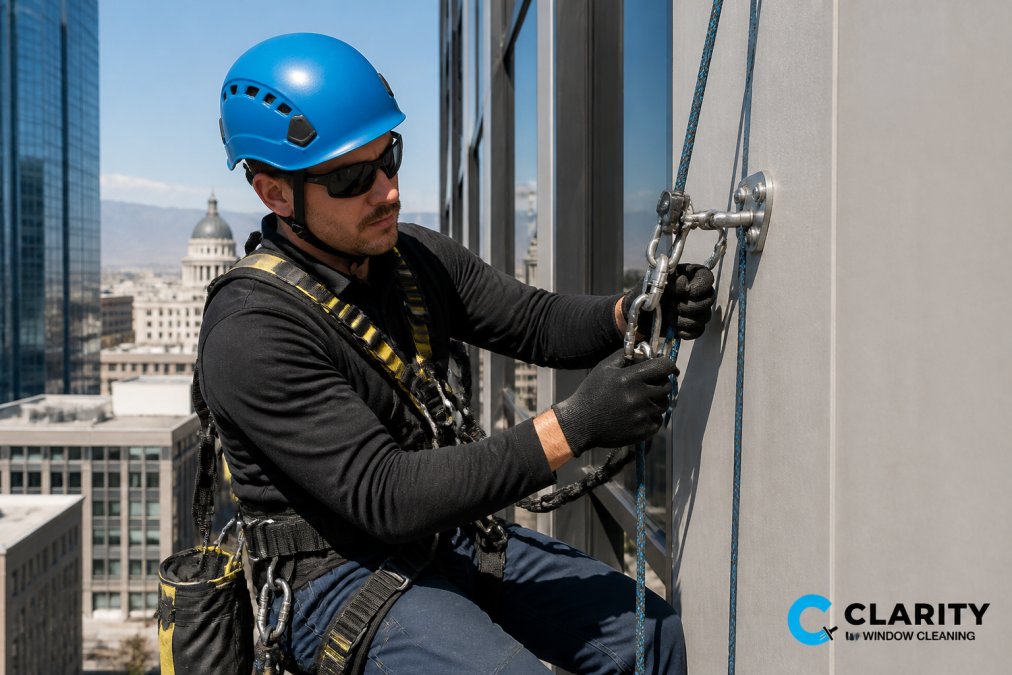
Every technician on-site should have documented training in fall protection, rope rescue, and high-rise work procedures.
Ask the contractor for:
- IWCA Certification, The International Window Cleaning Association offers training and certification for window cleaners
- OSHA Training Cards, Proof of OSHA 10-Hour or 30-Hour training in fall protection
- Rope Rescue Certification, If the job involves rope descent systems, technicians should have rescue training
- First Aid/CPR, Current certification showing workers can respond to emergencies
- Training Records, Documentation showing when training was completed and when renewals are due
Certifications should be verifiable through the issuing organization's database or physical certificates.
Demand Documented Safety Protocols and Post-Incident Reporting
Safety protocols should cover:
- Daily pre-work briefings, How the team reviews the day's work plan and safety procedures
- Equipment inspection procedures, How ropes, harnesses, and anchor points are inspected before each use
- Near-miss reporting, How workers report hazards or close calls
- Incident response, Immediate actions if someone is injured, including first aid and emergency services
- Post-incident investigation, How the contractor will analyze what went wrong and prevent recurrence
Request a template of the contractor's incident report form before work begins. Make sure it includes:
- Date, time, and location of incident
- Names and roles of people involved
- Detailed description of what happened
- Injuries sustained
- Immediate actions taken
- Photos or diagrams of the scene
- Witness statements
- Root cause analysis
- Corrective actions to prevent recurrence
Inspect Equipment Maintenance Logs and Safety Audit Records
The contractor's equipment is only safe if properly maintained. Request maintenance logs showing when ropes, harnesses, anchors, and other equipment were last inspected and serviced.
Equipment to verify:
- Ropes and lifelines, Inspection dates, condition assessments, replacement schedules
- Harnesses and lanyards, Inspection records, signs of wear or damage, replacement dates
- Anchor points, Load testing results, inspection dates, any repairs or reinforcements
- Personal protective equipment, Helmet inspection, glove replacement, footwear condition
- Rescue equipment, If rope rescue is part of the plan, verify rescue kits are inspected and current
A professional contractor will have organized maintenance records. If the contractor can't produce these logs, that's a serious concern.
Also request records of any safety audits the contractor has conducted. Many reputable contractors hire third-party safety auditors to review their practices annually.
Create Your Vetting Checklist
| Verification Item | What to Look For | Red Flags |
|---|---|---|
| OSHA Compliance | Competent person designation, written documentation | Can't name the competent person or provide proof of training |
| Anchor Point Testing | Load testing documentation with dates and results | No documentation or testing older than 2 years |
| Insurance Coverage | COI showing $1M+ general liability, your building as additional insured | Can't provide COI or coverage amounts below minimums |
| Site-Specific Safety Plan | Customized SSSP for your building before work begins | Generic template without building-specific hazards |
| Technician Certifications | IWCA certification, OSHA training, current first aid/CPR | No verifiable certifications or expired training |
| Equipment Maintenance | Documented inspection logs for ropes, harnesses, anchors | No maintenance records or equipment older than safe limits |
| Safety Protocols | Written incident response and post-incident reporting procedures | No documented procedures or unwilling to provide incident report template |
| Subcontractor Requirements | Primary contractor requires subcontractors to carry same insurance | No contractual language protecting your building |
Key Takeaways
Vetting an OSHA-compliant window cleaning service for a 20-story tower comes down to documentation and accountability. You're bringing a high-risk operation onto your property, and you need proof that every worker, every piece of equipment, and every procedure meets federal safety standards.
Contractors worth hiring will welcome this scrutiny. They'll have documentation ready, explain their safety systems in detail, and customize their approach for your building's specific needs. If a contractor resists your questions or can't produce documentation, keep looking.
Clarity Window Cleaning provides free estimates for all window cleaning needs and can walk you through our OSHA-compliant processes, safety certifications, and documentation so you see exactly what proper vetting looks like. We work directly with facilities managers and property managers to ensure every job meets federal standards and protects your building.
Frequently Asked Questions
What specific OSHA standards apply to high-rise window cleaning?
OSHA 1910.27 governs fall protection for employees working at heights. High-rise window cleaning must comply with fall arrest systems, personal protective equipment requirements, and anchor point load testing. Services should demonstrate competent person designation, documented hazard assessments, and site-specific safety plans. Ask contractors to reference their compliance framework explicitly.
How do I verify a window cleaning company's OSHA-compliant certification?
Request proof of IWCA (International Window Cleaning Association) certification or equivalent safety credentials. Verify that technicians hold current fall protection training documentation and that the company maintains records of anchor point load testing. Ask for references from other 20-story or taller building clients. Confirm liability insurance limits and workers' compensation coverage directly with their insurer.
What documentation should an OSHA-compliant window cleaning service provide?
Demand a written site-specific safety plan tailored to your building's layout and hazards. Request equipment maintenance logs, safety inspection protocols, training records for all technicians, anchor point load testing certificates, and post-incident reporting procedures. Clarity provides free estimates and detailed safety documentation for every high-rise window cleaning project to ensure you have complete compliance records for your board and insurance.
What are the risks of hiring non-compliant window cleaning services?
Non-compliant contractors expose your facility to worker injuries, OSHA citations, liability claims, and potential building owner responsibility for inadequate safety oversight. If an accident occurs, your building's insurance may deny claims if the contractor lacked proper certifications. You could face regulatory fines and reputational damage. Hiring OSHA-compliant services transfers liability properly and protects your operation.
This article was written using GrandRanker
Frequently Asked Questions
What specific OSHA standards apply to high-rise window cleaning?
OSHA 1910.27 governs fall protection for employees working at heights. High-rise window cleaning must comply with fall arrest systems, personal protective equipment requirements, and anchor point load testing. Services should demonstrate competent person designation, documented hazard assessments, and site-specific safety plans. Ask contractors to reference their compliance framework explicitly.
How do I verify a window cleaning company's OSHA-compliant certification?
Request proof of IWCA (International Window Cleaning Association) certification or equivalent safety credentials. Verify that technicians hold current fall protection training documentation and that the company maintains records of anchor point load testing. Ask for references from other 20-story or taller building clients. Confirm liability insurance limits and workers' compensation coverage directly with their insurer.
What documentation should an OSHA-compliant window cleaning service provide?
Demand a written site-specific safety plan tailored to your building's layout and hazards. Request equipment maintenance logs, safety inspection protocols, training records for all technicians, anchor point load testing certificates, and post-incident reporting procedures. Clarity provides free estimates and detailed safety documentation for every high-rise window cleaning project to ensure you have complete compliance records for your board and insurance.
What are the risks of hiring non-compliant window cleaning services?
Non-compliant contractors expose your facility to worker injuries, OSHA citations, liability claims, and potential building owner responsibility for inadequate safety oversight. If an accident occurs, your building's insurance may deny claims if the contractor lacked proper certifications. You could face regulatory fines and reputational damage. Hiring OSHA-compliant services transfers liability properly and protects your operation.