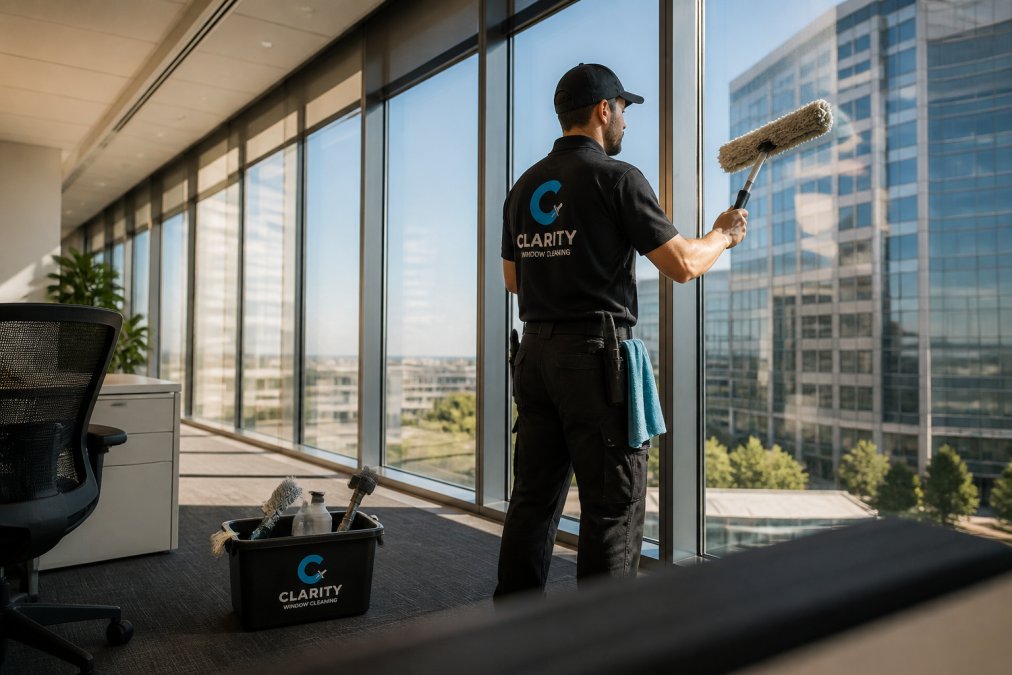
 how-to
Non-Disruptive Window Cleaning for Offices: A Guide
Table of Contents
- Why Non-Disruptive Window Cleaning Matters for Office Operations
- Commercial Window Cleaning Best Practices for Minimal Disruption
- Scheduling Strategies That Protect Workplace Productivity
- OSHA Window Cleaning Safety Requirements for Commercial Properties
- How to Hire a Commercial Window Cleaner for Your Office
- Pre-Cleaning Preparation Checklist for Offices
- Maintaining Streak-Free Glass and Building Aesthetics
- Conclusion
Last Updated: August 21, 2026
Why Non-Disruptive Window Cleaning Matters for Office Operations
Clean windows are essential for commercial properties, but the cleaning process shouldn't disrupt tenant workflows or create safety hazards. Non-disruptive window cleaning has become a critical service differentiator for property and facilities managers who understand that building aesthetics and occupant experience are inseparable.
At Clarity Window Cleaning, we work directly with facilities managers and property managers to deliver professional results that happen in the background, maintain your building's appearance, and leave no trace of disruption behind. This guide covers the strategies, safety protocols, and hiring considerations that separate non-disruptive commercial window cleaning from standard service.
Commercial Window Cleaning Best Practices for Minimal Disruption
Professional commercial window cleaning best practices prioritize operational continuity alongside quality results. Water-fed pole systems, microfiber technology, and streak-free finishing methods deliver results faster, quieter, and with minimal visual obstruction during business hours.
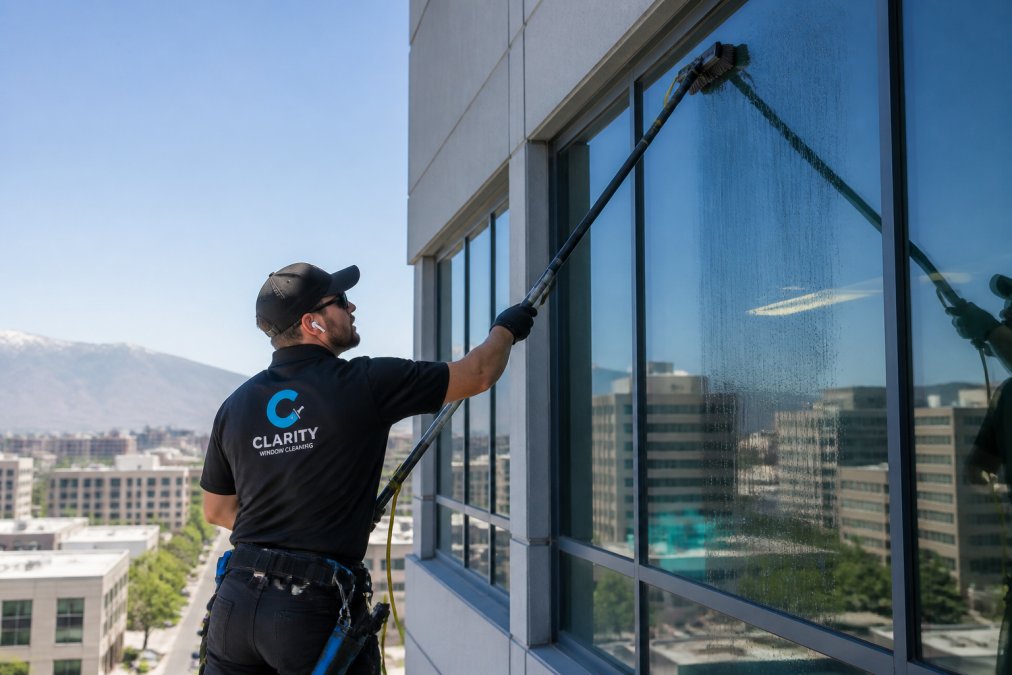
Water-Fed Pole Systems and Microfiber Technology
Water-fed pole systems use lightweight, telescoping poles (typically extending 25-50 feet) fitted with microfiber brush heads and water delivery mechanisms. The operator controls water flow and pressure from ground level, eliminating the need for scaffolding, lifts, or building access that would disrupt interior operations.
Microfiber technology amplifies efficiency. Microfiber bristles capture and hold water more effectively than traditional materials, reducing passes per window. A water-fed pole system can clean the exterior of a 15-story office building without requiring interior access or tenant notification.
Streak-Free Finishing Techniques
Streak-free glass is a professional standard that separates commercial-grade cleaning from residential work. Professional streak prevention uses three integrated techniques: deionized water rinses, squeegee technique, and quality control inspection.
Deionized water removes mineral content that causes streaking (peer-reviewed research). Tap water contains dissolved minerals that leave visible residue as water evaporates. Deionized systems strip these minerals, so the final rinse leaves no trace, particularly critical in commercial settings where glass integrity impacts tenant perception and building value.
Squeegee technique uses consistent pressure, overlapping passes, and edge management to eliminate water pooling and drip patterns. Professional teams train extensively on squeegee angles, blade condition, and pressure modulation. Quality control inspection happens before the crew leaves your property, verifying that all windows meet streak-free standards.
Scheduling Strategies That Protect Workplace Productivity
Strategic scheduling transforms cleaning from a workplace interruption into a background maintenance task that tenants barely notice.
After-Hours Service Options
After-hours cleaning is the gold standard for non-disruptive service in occupied office buildings. Evening, early-morning, or weekend scheduling eliminates conflict between cleaning operations and tenant work. Professional window cleaning companies equipped for after-hours work bring additional lighting systems, coordinate with building security, and follow strict protocols to avoid triggering alarms or creating safety hazards.
After-hours service requires advance planning. Your cleaning contractor needs building access protocols, security coordination, and clear communication about occupied and accessible areas. Clarity provides free estimates for all window cleaning needs, including detailed after-hours logistics so you understand exactly how the service will work before committing.
Phased Cleaning Across Multiple Zones
For large commercial properties, phased cleaning divides the building into zones and schedules each zone on a rotating basis. A 28-story office tower might be divided into four zones, with each zone cleaned on a different day. This approach maintains building aesthetics while spreading visual and operational impact across multiple weeks.
Phased scheduling works particularly well for properties with high-rise window cleaning needs. Rope access teams or lift systems can focus on one zone at a time, reducing equipment footprint and visual obstruction for any single tenant group. Consistency is key, predictable patterns allow tenants and facilities teams to adjust without friction.
OSHA Window Cleaning Safety Requirements for Commercial Properties
Commercial window cleaning operates under strict occupational safety standards. The Occupational Safety and Health Administration (OSHA) establishes fall protection requirements, equipment standards, and site-specific safety protocols that professional cleaning companies must follow.
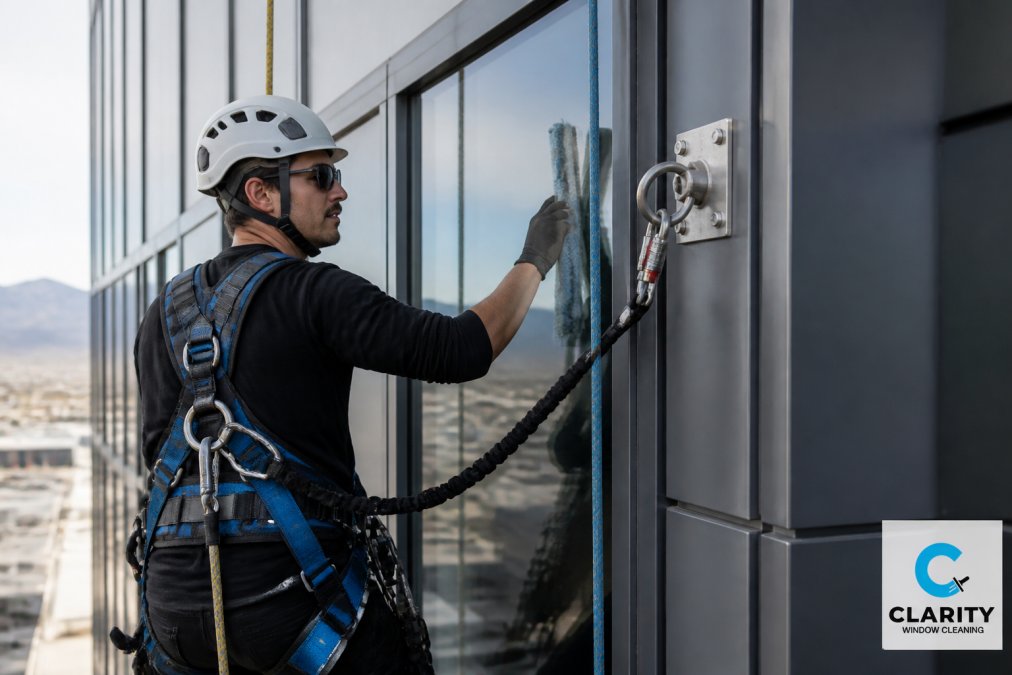
Safety Harness and Fall Protection Standards
OSHA regulations require fall protection systems for any work at heights exceeding 6 feet (osha.gov). Professional window cleaners use redundant fall protection, primary harness systems plus backup lines, ensuring that equipment failure never creates an uncontrolled fall scenario.
Safety harness systems must be inspected regularly and replaced according to manufacturer specifications. A harness that has arrested a fall must be retired, even if it appears undamaged. Professional teams maintain detailed equipment logs documenting inspection dates, service history, and replacement cycles.
Anchor points require structural assessment. A professional cleaning contractor evaluates your building's facade, roof structure, and window frames to identify safe anchor locations that can support fall arrest forces. Improper anchor point selection is a critical failure mode that professional teams identify and correct before work begins.
Site-Specific Safety Plans and Documentation
Professional commercial window cleaning requires a site-specific safety plan tailored to your building's unique characteristics. This plan documents hazards, identifies safe work procedures, specifies equipment requirements, and establishes emergency protocols.
Site-specific safety plans are non-negotiable for high-rise window cleaning. A 28-story office tower has wind exposure, electrical hazards, and adjacent building considerations that a ground-level complex doesn't face. Professional teams develop these plans before work begins and share them with your facilities team for coordination and approval.
Documentation creates accountability and legal protection. When a professional team completes window cleaning with a documented safety plan, site inspection records, and equipment certification logs, you have verifiable evidence that the work met OSHA standards. Clarity provides free estimates for all window cleaning needs, and that process includes detailed safety plan review.
How to Hire a Commercial Window Cleaner for Your Office
Selecting the right commercial window cleaning contractor requires evaluating technical qualifications, safety credentials, and experience with your specific building type. The lowest price quote rarely delivers the non-disruptive, professional results that protect your building's value and tenant relationships.
Evaluating Certifications and Insurance
Professional window cleaning certifications verify that technicians have completed formal training in safety protocols, equipment operation, and industry standards. Insurance requirements are non-negotiable. Your contractor must carry workers' compensation insurance, general liability insurance (minimum $1-2 million coverage), and property damage coverage (osha.gov). Request certificates of insurance and verify coverage limits directly with the insurance carrier.
Bonding protects you against contractor non-performance or property damage. A bonded contractor has posted a financial guarantee that they'll complete work as agreed. Bonding is particularly important for high-rise window cleaning where equipment failure or incomplete work creates visible, ongoing problems.
Assessing Experience with High-Rise and Complex Buildings
High-rise window cleaning requires specialized equipment, safety protocols, and logistical planning that differs fundamentally from ground-level work. Ask specific questions about high-rise experience: How many buildings over 10 stories have they cleaned? What rope access certifications do their technicians hold? Have they worked with your building's specific facade type?
Request references and contact them directly. Ask about scheduling reliability, quality consistency, safety incident history, and whether the contractor accommodated non-disruptive scheduling needs. References from facilities managers at comparable properties provide the most valuable insight.
Clarity has extensive experience with high-rise window cleaning across the commercial sector. Our team works directly with facilities managers and property managers who need non-disruptive service for complex buildings. We provide free estimates for all window cleaning needs, including detailed project planning and reference information.
Pre-Cleaning Preparation Checklist for Offices
Professional window cleaning produces better results when your facilities team completes preparation steps before the crew arrives.
Pre-Cleaning Preparation Checklist:
- Notify all tenants of cleaning date, time window, and any building access requirements
- Clear window sills and ledges of plants, decorative items, or equipment
- Ensure building access is available (unlocked doors, elevator access, stairwell access)
- Identify any special hazards (electrical equipment, HVAC units, antennas) near windows
- Confirm that weather conditions are suitable (no high winds, precipitation, or extreme temperatures)
- Provide contact information for on-site coordination during cleaning
- Remove any obstacles that might impede equipment placement or movement
Interior window access requires tenant coordination. If your cleaning plan includes interior glass, confirm that tenants will allow access or that cleaning happens during after-hours windows when spaces are empty. Weather coordination prevents rescheduling and ensures quality results. Professional contractors typically have weather protocols in their estimates.
Maintaining Streak-Free Glass and Building Aesthetics
Post-cleaning maintenance extends the interval between professional cleaning cycles and preserves your building facade's professional appearance. Interior glass maintenance with microfiber cloths and deionized water prevents dust accumulation and interior streaking. Monthly interior maintenance takes minimal time but dramatically extends visible cleanliness between professional exterior cleaning cycles.
Professional cleaning frequency typically ranges from quarterly to semi-annually for office buildings, depending on environmental exposure and tenant expectations. High-traffic areas near building entries may require more frequent cleaning than upper floors. Your contractor should recommend a maintenance schedule based on your building's specific characteristics.
Documentation of cleaning cycles helps justify maintenance budgets and demonstrates diligent building care. Facilities managers who maintain cleaning records can show building owners, boards, and tenants that professional maintenance is occurring on schedule.
Maintaining a professional building appearance while protecting operational continuity requires strategic planning and the right contractor. Non-disruptive window cleaning for offices isn't about cutting corners, it's about applying professional techniques, safety protocols, and scheduling discipline to deliver results that serve both your building and your tenants.
Clarity provides free estimates for all window cleaning needs, and our team specializes in high-rise window cleaning and commercial properties where non-disruptive service is essential. We work directly with facilities managers and property managers to maintain the professional appearance your building deserves.
Frequently Asked Questions
How can office window cleaning be performed without disturbing employees?
Non-disruptive window cleaning uses water-fed pole systems and microfiber technology that operate quietly and allow work to continue uninterrupted. After-hours scheduling, phased zone-by-zone cleaning, and strategic timing during low-traffic periods minimize impact on workplace productivity. Professional cleaners coordinate with facilities managers to identify optimal windows for cleaning while keeping interior views and operations clear.
What should I look for when hiring a commercial window cleaner?
Verify that technicians hold commercial window cleaning certifications and carry full insurance and bonding. Request documentation of OSHA compliance, safety protocols, and site-specific safety plans. Ask about experience with high-rise buildings and multi-tenant complexes similar to yours. Confirm they provide detailed post-service reporting and can accommodate your scheduling needs. Clarity provides free estimates for all window cleaning needs so you can assess fit before committing.
What equipment do professional cleaners use for quiet, non-disruptive window washing?
Professional teams use water-fed pole systems, deionized water solutions, microfiber technology, and squeegees designed to minimize noise and disruption. These tools allow exterior cleaning without blocking interior views or requiring access from inside occupied spaces. Professional-grade equipment ensures streak-free results while maintaining operational efficiency throughout your facility.
How often should commercial office windows be cleaned?
Frequency depends on building location, weather exposure, and tenant expectations. Most commercial properties benefit from routine maintenance to maintain glass integrity and building aesthetics. High-traffic areas and ground-level windows may need more frequent cleaning. Facilities managers should establish a service schedule with their cleaning partner based on site assessment and operational needs.
This article was written using GrandRanker
Frequently Asked Questions
How can office window cleaning be performed without disturbing employees?
Non-disruptive window cleaning uses water-fed pole systems and microfiber technology that operate quietly and allow work to continue uninterrupted. After-hours scheduling, phased zone-by-zone cleaning, and strategic timing during low-traffic periods minimize impact on workplace productivity. Professional cleaners coordinate with facilities managers to identify optimal windows for cleaning while keeping interior views and operations clear.
What should I look for when hiring a commercial window cleaner?
Verify that technicians hold commercial window cleaning certifications and carry full insurance and bonding. Request documentation of OSHA compliance, safety protocols, and site-specific safety plans. Ask about experience with high-rise buildings and multi-tenant complexes similar to yours. Confirm they provide detailed post-service reporting and can accommodate your scheduling needs. Clarity provides free estimates for all window cleaning needs so you can assess fit before committing.
What equipment do professional cleaners use for quiet, non-disruptive window washing?
Professional teams use water-fed pole systems, deionized water solutions, microfiber technology, and squeegees designed to minimize noise and disruption. These tools allow exterior cleaning without blocking interior views or requiring access from inside occupied spaces. Professional-grade equipment ensures streak-free results while maintaining operational efficiency throughout your facility.
How often should commercial office windows be cleaned?
Frequency depends on building location, weather exposure, and tenant expectations. Most commercial properties benefit from routine maintenance to maintain glass integrity and building aesthetics. High-traffic areas and ground-level windows may need more frequent cleaning. Facilities managers should establish a service schedule with their cleaning partner based on site assessment and operational needs.