 how-to
How to Clean Hard-to-Reach Windows Safely: Pro Guide
Table of Contents
- What You'll Need: Tools for Hard-to-Reach Windows
- Commercial Window Cleaning Equipment for High-Reach Jobs
- OSHA Window Cleaning Safety Standards You Must Follow
- Step-by-Step: How to Clean Hard-to-Reach Windows Safely
- Troubleshooting Streaks and Hard Water Stains
- Professional Window Cleaning Maintenance Reporting
- Common Mistakes to Avoid When Cleaning High Windows
- Conclusion
- Frequently Asked Questions
Last Updated: September 15, 2026
What You'll Need: Tools for Hard-to-Reach Windows
Cleaning hard-to-reach windows safely starts with the right equipment, not bravery. At Clarity Window Cleaning, our certified technicians treat every high-rise job as an equipment problem first and a cleaning problem second, because the tools you choose determine whether the work is safe.
Here's the core kit for reaching glass above ground level:
- Telescoping pole with a locking collar, so the sections hold under load
- Water-fed pole with a deionized water feed for exterior glass
- Window scrubber and squeegee heads that fit the pole thread
- Microfiber cloths for interior glass and detailing edges
- Safety harness and anchor point rated for fall arrest
- Extension pole adapters for angled or recessed panes
Most facilities managers already own a squeegee and a ladder. The gap is almost always in the pole system and the fall protection, and that's exactly where accidents happen.
Commercial Window Cleaning Equipment for High-Reach Jobs
Commercial window cleaning equipment for high-reach jobs splits into two families: pole systems that work from the ground, and access systems that put a person next to the glass. Choosing between them is a building decision, not a preference, and it usually comes down to three variables: reach, glass type, and how often the work recurs.
Ground-based systems keep feet on the pavement:
- Water-fed poles with deionized water reach several stories from grade
- Telescoping poles handle mid-level glass and interior atriums
- Scrubber and squeegee heads swap onto the same pole thread
Access systems place a technician at the pane:
- Rope access with a rated harness and roof anchors
- Suspended platforms for full facade work
- Ladder alternatives for low-rise and podium levels
The OSHA guidance on walking-working surfaces and fall protection treats any surface above the standard threshold as a fall hazard, which is why ground-based pole work is the default for anything a pole can reach safely.
| Method | Best For | Key Equipment | Main Limitation |
|---|---|---|---|
| Water-fed pole | Exterior glass, mid-rise | Deionized water, telescoping pole | Reach caps out |
| Rope access | High-rise facades | Harness, roof anchors, rope | Requires certified crew |
| Suspended platform | Full-building exteriors | Platform, tie-back system | Setup time and cost |
| Telescoping pole | Interiors, low exteriors | Extension pole, microfiber | Limited height |
Buy or Rent? A Decision Framework for Facilities Managers
Most facilities managers face the same fork: buy the gear for a one-time or occasional cleaning, or rent it for the job and hand it back. The answer depends on frequency, not on the sticker price alone.
- One-time or annual cleaning: renting a water-fed pole system or a suspended platform setup usually makes more sense than buying, because storage, inspection, and recertification costs continue after the job ends.
- Quarterly or monthly cleaning: purchasing a pole system pays for itself over a recurring schedule, and it lets your crew train on the same equipment every visit.
- High-rise facades: rope access and suspended platforms are almost always rented or provided by a certified contractor, because the certification, inspection, and insurance burden is not something a single building should carry.
A common pattern is that buildings under five stories buy their own pole systems and rent access equipment for the rare full-facade job, while taller buildings outsource the entire access layer to a certified crew. There is no universal right answer, but there is a wrong one: buying equipment you will use once and then store for a year.
Glass Type Compatibility: What Your Equipment Can and Cannot Touch
Not every pole head, pad, or cleaning solution is safe on every pane. Matching equipment to glass type prevents permanent damage that no cleaning method can undo.
- Tinted glass: avoid abrasive pads and strong alkaline solutions, which can dull or discolor the film. Use a soft scrubber and a pH-neutral cleaner.
- Low-E (low-emissivity) glass: the coating is delicate. Never use a razor blade, steel wool, or aggressive scrubber on the coated surface, and test any new cleaner in a corner first.
- Stained or decorative glass: use only soft microfiber and mild detergent. Abrasives and acids etch the surface permanently.
- Tempered and laminated glass: generally tolerant of standard pole cleaning, but edges and chips are weak points, so keep the scrubber off damaged areas.
For a 28-story tower with tenants who notice every disruption, the method matters as much as the result. Clarity Window Cleaning builds site-specific safety plans around each building's access points and glass types, so the crew works around your operating hours instead of through them. We also provide free estimates for all window cleaning needs, which gives facilities managers a documented starting point before committing to a schedule.
OSHA Window Cleaning Safety Standards You Must Follow
OSHA window cleaning safety standards are not optional paperwork. They are the difference between a routine maintenance day and a serious incident. The rules that govern this work come from OSHA's general industry standards for walking-working surfaces and fall protection, plus the scaffolding and ladder requirements that apply to specific access methods.
What this means in practice:
- Fall protection is required above the trigger height, with a harness and a rated anchor
- Ladder safety rules limit ladder use for tasks where a pole or platform is safer
- Fall prevention relies on guardrails, covers, and controlled access zones
- Training must be documented for every worker using the equipment
The OSHA standards for ladders and fall protection in general industry spell out the anchor strength, inspection, and training requirements that a compliant crew follows on every job.
Step-by-Step: How to Clean Hard-to-Reach Windows Safely
The safe sequence for hard-to-reach windows is: assess the glass, secure the work zone, choose the access method, clean from the top down, and inspect before you leave. Skipping the assessment step is where most DIY attempts go wrong.
Exterior Windows: Water-Fed Poles and Squeegee Technique
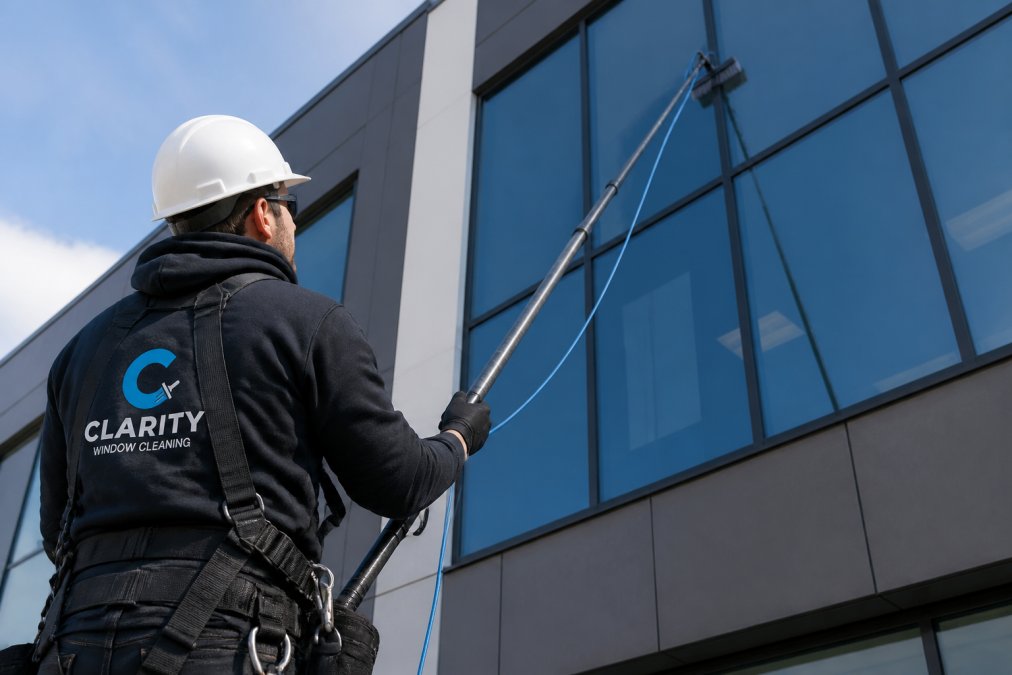
Water-fed pole work starts with deionized water, because pure water dries without spotting. Extend the telescoping pole, wet the glass with the scrubber head, then rinse from the top down and let the water sheet off. For lower exterior panes you can reach directly, use a squeegee with overlapping strokes and wipe the blade between passes so you don't drag dirt back across the glass surface.
Interior Windows: Telescoping Poles and Microfiber Cloths
Interior glass above atrium level is usually reached with a telescoping pole and a microfiber cloth, not a ladder. Spray a mild cleaning solution, agitate with the scrubber, then dry with a clean microfiber pad on the pole head. Detail the edges last, since that's where streaks show first under interior lighting.
Troubleshooting Streaks and Hard Water Stains
Streaks and hard water stains have different causes, so they need different fixes. Most people treat both the same way and make the problem worse. The fastest way to solve either is to diagnose the symptom before reaching for a product.
Diagnosing the Symptom
- Streaks that reappear in the same pattern: the squeegee blade or microfiber pad is contaminated, or the cleaning solution is drying before you wipe.
- Streaks that look like a film: the glass was cleaned in direct sun, or the rinse water was not pure enough.
- White, chalky spots that do not wipe off: mineral deposits, not dirt.
Fixing Streaks
Streaks usually come from one of three things:
Removing Hard Water Stains
Interior vs. Exterior: Different Problems, Different Fixes
Professional Window Cleaning Maintenance Reporting
A useful report includes:
Common Mistakes to Avoid When Cleaning High Windows
Watch for these:
Conclusion
Frequently Asked Questions
How do you clean windows you can't reach without a ladder?
For windows above ground level, use a telescoping pole with a water-fed brush or squeegee attachment. Water-fed poles up to 40 feet let you clean from the ground using deionized water, which dries spot-free without wiping. For higher windows, rope access or suspended platforms are required. Never lean out of a window or stand on furniture to reach glass. If you cannot reach safely from the ground, call a professional window cleaning service like Clarity, which provides free estimates for high-reach jobs.
What safety equipment is required for cleaning high windows?
OSHA requires fall protection for any work at 4 feet or higher in general industry. This includes a full-body harness, lanyard, and anchor point rated for 5,000 pounds. For rope access, you need a backup fall-arrest system and a suspended platform with guardrails. Ladder use is limited to light-duty tasks under 20 feet with proper angle and footing. Commercial window cleaning crews must also have site-specific safety plans. Clarity's certified technicians follow OSHA window cleaning safety standards on every job.
How often should commercial windows be professionally cleaned?
Most commercial properties need professional window cleaning two to four times per year, depending on location and weather. Buildings near highways or construction sites may require monthly service to prevent hard water stains and debris buildup. Facilities managers should schedule cleanings seasonally and document each service for insurance and board reporting. Clarity Window Cleaning offers customized schedules for high-rise and commercial properties, with free estimates to match your building's needs.
Can you clean high windows without a ladder?
Yes. Telescoping poles and water-fed pole systems let you clean windows up to 40 feet from the ground. These tools use deionized water and a scrubbing head to remove dirt, then rinse without streaks. For windows above 40 feet, rope access or suspended platforms are necessary. Ladders are only safe for low windows with stable footing. If your building has hard-to-reach windows, Clarity Window Cleaning provides free estimates for high-rise and commercial window cleaning.