 ultimate-guide
High-Rise Window Cleaning Liability: A Risk Management Guide
Table of Contents
- The Primary Liability Risks in High-Rise Window Cleaning
- OSHA Window Cleaning Safety Requirements and Compliance
- Commercial Window Cleaning Insurance Coverage Essentials
- Building Owner vs. Contractor Liability: Who Bears the Risk
- Creating a Window Cleaning Risk Assessment Checklist
- Subcontractor Liability Management and Agreements
- Technological Risk Mitigation for High-Rise Operations
- Conclusion
Last Updated: August 25, 2026
The Primary Liability Risks in High-Rise Window Cleaning
High-rise window cleaning liability encompasses legal and financial exposure contractors and building owners face when maintaining exterior surfaces on tall structures. A single incident on a 20-story office tower can expose both parties to six-figure liability claims, regulatory fines, and operational disruption.
At Clarity Window Cleaning, we understand how quickly a preventable accident can become a crisis affecting insurance premiums, tenant confidence, and facility reputation. Understanding these risks means knowing what to control, what to document, and what to transfer through proper contracting and insurance. Standard commercial liability insurance often doesn't cover all high-rise window cleaning scenarios, especially equipment failure, glass damage, or third-party injury claims.
Fall Protection and Worker Safety
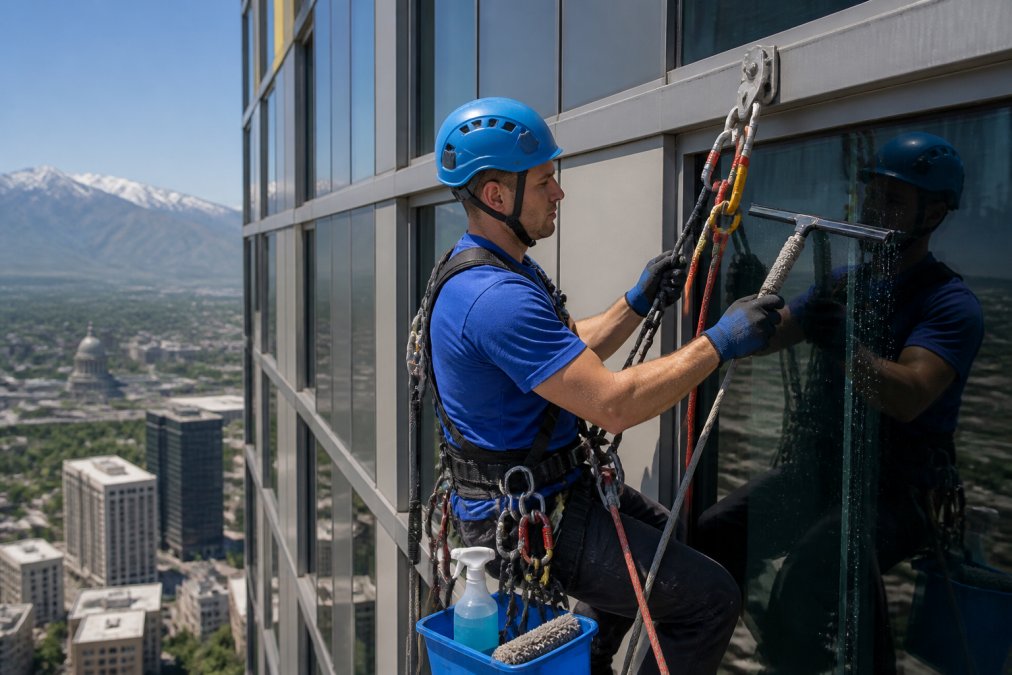
Fall protection is the foundation of any high-rise window cleaning operation. Workers suspended hundreds of feet above ground depend entirely on engineered systems: harnesses, anchor points, ropes, and backup systems. Component failure creates catastrophic consequences.
The primary risk is the gap between what a contractor says they'll do and what they actually do on the job. A harness rated for 5,000 pounds means nothing if it's been dropped, stored in direct sunlight for years, or never inspected. Anchor points that look solid might be corroded or improperly installed. Facilities managers must verify fall protection systems before work begins by requesting recent inspection certifications, examining equipment in person, and understanding the contractor's maintenance schedule.
Equipment Failure and Maintenance Liability
Equipment failure creates dual liability exposure: immediate injury to workers and secondary property damage from dropped tools or malfunctioning systems. Who bears liability depends on the contract. If the contractor owns and maintains equipment, they typically carry liability. If the building owner provides equipment or fails to disclose maintenance issues, liability shifts to the property side.
Clarity provides free estimates for all window cleaning needs and includes detailed equipment inspections as part of pre-service planning, protecting both contractor and building owner by identifying risks before they become incidents.
Property Damage and Glass Breakage
High-rise window cleaning liability often includes damage to the building itself. Cleaning chemicals can etch or discolor certain glass types or frames. Pressure washing can force water into seals, causing interior leaks. Glass breakage deserves specific attention, older buildings may have single-pane windows or tempered glass with hidden stress fractures that a contractor's tool or vibration can trigger. Property damage liability coverage must match the building's actual replacement costs.
OSHA Window Cleaning Safety Requirements and Compliance
OSHA regulations set the baseline for safe high-rise window cleaning operations. These are federal requirements with enforcement teeth. Violations result in citations, fines, and potentially criminal liability if an incident occurs and investigation reveals willful non-compliance.
Fall Protection Standards and Anchor Points
OSHA's fall protection standard (229 CFR 1926.500) requires that workers on surfaces with unprotected sides or edges more than 6 feet above a lower level be protected from falling (osha.gov). For high-rise window cleaning, this means 100% compliance with fall arrest systems.
Anchor points must support at least 5,000 pounds of force per attached worker, or be designed and certified by a professional engineer as part of a complete system (osha.gov). Many building structures lack permanent anchor points suitable for window cleaning. Contractors must install temporary anchor points, requiring engineering review and proper installation. Installing temporary anchor points without proper engineering creates massive liability.
Facilities managers should request anchor point engineering certifications, installation inspection reports, load testing documentation, and maintenance schedules.
Documentation and Regulatory Violations
OSHA requires contractors to maintain detailed records of fall protection systems, inspections, training, and incidents. Documentation is your liability shield. If an incident occurs and OSHA investigates, the first question is: "What documentation do you have?"
A contractor without documented safety training, equipment inspection records, or incident reports is admitting non-compliance. Building owners who hire such contractors share in that liability. OSHA violations become discovery evidence for plaintiff attorneys in injury lawsuits, demonstrating negligence.
Commercial Window Cleaning Insurance Coverage Essentials
Insurance is the financial backstop for high-rise window cleaning liability. The right coverage protects both contractors and building owners. Gaps in coverage leave both parties exposed to catastrophic losses.
General Liability vs. Professional Liability
General liability insurance covers bodily injury, property damage, and personal injury claims arising from contractor operations. If a worker falls and injures a building tenant, general liability covers medical costs and lost wages (up to policy limits). General liability typically carries coverage limits of $1 million to $2 million per occurrence (iii.org). For high-rise operations, $1 million is the minimum acceptable standard. Some building owners require $2 million for properties over 15 stories.
Professional liability insurance (errors and omissions) covers claims of negligence in performing the service. If improper cleaning technique damages window seals or causes interior water damage, professional liability covers repair or replacement costs. General liability typically does NOT cover this scenario.
Workers' Compensation and Third-Party Coverage
Workers' compensation insurance covers medical costs and lost wages for contractor employees injured on the job. This is mandatory in all 50 states for contractors with employees.
If a contractor is injured on your property and lacks workers' compensation insurance, the injured worker may sue the building owner directly. Require the contractor to carry workers' compensation for all workers (employees and subcontractors), and require proof of coverage before work begins. Clarity provides free estimates for all window cleaning needs and includes workers' compensation verification as part of pre-service documentation.
Building Owner vs. Contractor Liability: Who Bears the Risk
Liability doesn't fall neatly into contractor-only or owner-only categories. Both parties typically share some exposure. The contract determines who bears what risk based on who controls each activity.
Contractual Indemnification Clauses
Indemnification clauses shift liability from one party to another. A typical clause states: "The contractor agrees to indemnify and hold harmless the building owner from all claims arising from the contractor's negligence or breach of this agreement."
In practice, indemnification clauses are complex and often unenforceable if written poorly. Courts in many states won't enforce clauses attempting to indemnify one party against claims arising from the other party's own negligence. Mutual indemnification clauses protect both parties: the contractor indemnifies the owner for contractor negligence, and the owner indemnifies the contractor for owner negligence. Building owners should have a lawyer review indemnification language before signing.
Duty of Care and Site Inspection Responsibilities
Both parties have a duty of care to prevent foreseeable harm. For contractors, this means proper training, equipment maintenance, and safety procedures. For building owners, this means disclosing known hazards and maintaining building systems in safe condition.
A building owner's duty of care includes conducting a pre-service site inspection with the contractor to document structural condition of anchor points and access areas, condition of existing windows and frames, known hazards, building system locations that could be affected by cleaning, and weather exposure. This inspection creates a written baseline protecting both parties.
Clarity provides free estimates for all window cleaning needs and includes comprehensive site inspection as part of our proposal process, protecting both parties and ensuring the contractor understands actual conditions.
Creating a Window Cleaning Risk Assessment Checklist
A risk assessment checklist translates liability theory into practical action. It's a working document guiding pre-service planning, identifying specific hazards, and creating accountability.
Pre-Service Inspection and Safety Planning
A pre-service inspection checklist should include structural assessment (Are anchor points suitable? Do they require temporary installation?), equipment verification (Has all fall protection equipment been inspected and certified? Are backup systems in place?), building condition (Are windows and frames in good condition? Are there known hazards?), insurance verification (Does the contractor carry general liability and workers' compensation? Are coverage limits adequate?), access and scheduling (Can the contractor access the building safely? Are there tenant occupancy restrictions?), and communication (Has the contractor identified a site supervisor? Are emergency procedures clear?).
This checklist becomes part of the contract. Both parties sign off, confirming they understand the scope of work and hazards involved.
Post-Incident Documentation and Crisis Management
When incidents occur, documentation becomes critical. Immediate steps include ensuring all workers are safe, securing the scene and preserving evidence, photographing the scene from multiple angles, obtaining witness contact information, and notifying your insurance company immediately.
Within 24 hours: file an incident report with OSHA if required, notify your insurance broker, and preserve all documentation. Within one week: conduct formal investigation, document findings and corrective actions, and review insurance coverage and claim procedures.
Building owners should have a crisis management plan in place before an incident occurs, identifying key contacts and notification procedures.
Subcontractor Liability Management and Agreements
Many window cleaning contractors use subcontractors for specialized work. Each subcontractor adds a layer of liability exposure. The building owner's exposure depends on how the contractor manages subcontractors.
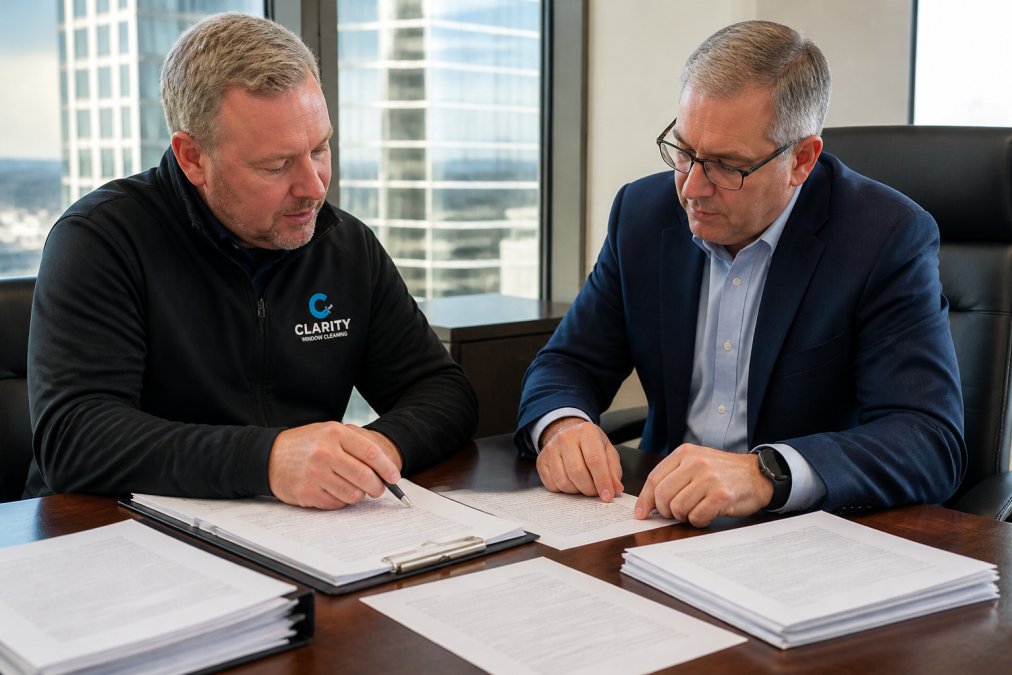
A subcontractor liability management agreement should require the contractor to verify that all subcontractors carry appropriate insurance, require subcontractors to name the building owner as additional insured, conduct background checks and safety training verification, maintain a list of approved subcontractors with current insurance certificates, and enforce safety standards with regular inspections.
The building owner should request and review subcontractor insurance certificates before work begins. A subcontractor agreement should also address indemnification, creating a chain of liability: the subcontractor is responsible to the contractor, and the contractor is responsible to the building owner.
Technological Risk Mitigation for High-Rise Operations
Technology increasingly reduces risk in high-rise window cleaning. Drone inspections assess window condition and structural integrity without putting workers at height, reducing fall risk and providing detailed photographic documentation. Equipment sensors monitor rope tension, harness stress, and worker positioning, creating real-time safety data. Data systems centralize safety records: equipment inspection dates, worker training certification, incident reports, and insurance verification.
Building owners should ask whether their contractor uses technology to mitigate risk. Technology adoption demonstrates sophistication and risk awareness while creating better documentation that protects both parties if an incident occurs.
High-rise window cleaning liability is manageable when both contractors and building owners approach it systematically. The foundation is understanding what risks exist, documenting how you're controlling those risks, and maintaining insurance coverage matching your actual exposure.
Clarity Window Cleaning specializes in high-rise and commercial window cleaning for facilities managers and property managers who need OSHA-compliant service with detailed documentation and full insurance protection. We conduct comprehensive pre-service inspections, maintain detailed safety records, and provide post-service reporting for board meetings and insurance verification. Clarity provides free estimates for all window cleaning needs, contact us to discuss your building's specific liability profile and how our documented, insured approach protects your facility and your team.
Frequently Asked Questions
What are the main liability risks for property managers during high-rise window cleaning?
Property managers face several critical liability exposures: worker fall injuries, equipment failure, property damage, and glass breakage. High-rise window cleaning liability also extends to third-party injuries if debris falls or equipment malfunctions. The most significant risk involves inadequate fall protection systems and non-compliance with OSHA standards. Facilities managers must verify that contractors maintain proper safety protocols, workers' compensation coverage, and general liability insurance with sufficient limits. Understanding contractual indemnification clauses protects your facility from absorbing contractor negligence.
How does OSHA compliance impact liability for high-rise building owners?
OSHA compliance directly reduces your legal exposure and potential fines. Building owners have a duty of care to ensure contractors follow OSHA fall protection standards, including proper anchor points, safety harnesses, and rope access protocols. Failure to verify compliance can result in regulatory violations and increased liability if an accident occurs. Document all safety inspections and contractor certifications. Non-compliant operations expose your facility to OSHA citations, worker injury lawsuits, and third-party claims. Clarity provides free estimates and works with facilities managers to ensure all operations meet OSHA requirements.
What insurance coverage is essential for high-rise window cleaning contractors?
Contractors must carry general liability insurance (minimum $1 million coverage recommended), professional liability coverage, and workers' compensation insurance. High-rise operations require additional umbrella or excess liability coverage due to elevated risk exposure. Verify that contractors name your facility as an additional insured on their policies. Request proof of current coverage before work begins. Insurance should cover equipment failure, property damage, workplace injury, and third-party liability. Gaps in coverage create uninsured exposure for your facility if an accident occurs during high-rise operations.
Who is legally responsible if a window cleaning accident occurs on a commercial property?
Liability depends on the contractual relationship and cause of injury. If the contractor was negligent or failed to follow safety protocols, they typically bear primary liability through their insurance. However, building owners can share liability if they failed to inspect conditions, verify contractor qualifications, or enforce safety standards. Indemnification clauses in contracts shift certain risks to the contractor, but they do not eliminate owner responsibility for site safety. Courts examine whether the property owner exercised reasonable duty of care. Clear contracts, documented safety inspections, and contractor verification reduce your exposure significantly.
This article was written using GrandRanker