 ultimate-guide
High Rise Building Window Maintenance: 2026 Guide
Table of Contents
- Why High Rise Window Maintenance Is a Safety Issue, Not Just a Looks Issue
- OSHA Window Cleaning Standards: The Rules That Govern Your Building
- High Rise Window Cleaning Safety Equipment: What a Qualified Crew Uses
- Commercial Window Cleaning Frequency: Matching Schedules to Your Facade
- How to Vet a High Rise Window Maintenance Contractor
- Beyond Basic Washing: Glass Oxidation, Post-Construction, and Sustainability
- Build a Maintenance Schedule That Protects Your Building Envelope
- Frequently Asked Questions
Last Updated: September 7, 2026
High rise building window maintenance is about protecting people, assets, and liability, not just keeping glass presentable. For facilities managers and property managers, every cleaning cycle involves work at significant heights, which carries inherent risk that must be managed through strict protocols and professional execution. This guide from Clarity Window Cleaning outlines the safety standards, equipment, and scheduling practices that define responsible high rise building window maintenance, giving you the framework to protect your building envelope and everyone who works on it.
A common misconception is that any window washing crew can handle a 20-story curtain wall. The reality is that high rise work demands specialized training, certified equipment, and documented safety procedures that align with federal regulations. Before you approve any contractor, you need to understand what compliance actually looks like on site and in the paperwork. Below, we break down the regulations, the gear, and the vetting process so you can make informed decisions.
Why High Rise Window Maintenance Is a Safety Issue, Not Just a Looks Issue
The primary reason to prioritize high rise window maintenance is the prevention of glass degradation and the mitigation of safety risks. Unmaintained windows develop hard water stains and glass oxidation that can weaken the structural integrity of the pane over time, turning a cosmetic issue into a costly replacement. More critically, a building with dirty or damaged glass obscures visibility for occupants and can hide developing seal failures that threaten the building envelope.
Beyond the glass itself, the act of cleaning introduces risk. Every pass with a squeegee involves work-at-height, and a lapse in procedure can lead to serious injury or property damage. This is why professional crews treat each job as a site-specific operation, not a routine chore. The goal is preventative maintenance: catching small issues like failing caulk or corroded anchors before they escalate into emergencies that disrupt tenants and strain your maintenance budget.
OSHA Window Cleaning Standards: The Rules That Govern Your Building
OSHA window cleaning standards are the baseline for any legitimate high rise operation, and they are not optional. The Occupational Safety and Health Administration (OSHA) sets strict requirements for fall protection, equipment inspection, and worker training that apply to all suspended work on building facades. According to OSHA's guidelines on powered platforms and work-at-height, employers must provide fall protection systems, including safety harnesses and anchorage points, for any worker on a suspended scaffold.
Compliance goes beyond simply handing a worker a harness. The standard requires that all equipment, from swing stages to bosun chairs, undergoes regular safety inspection by a qualified person, and that technicians hold relevant OSHA certification. For you as a building owner, this means you should never accept a verbal assurance of compliance. You need to see the documentation: training records, inspection logs, and the site-specific safety plan that outlines how the crew will handle your building's unique configuration. A crew that treats OSHA standards as a checklist rather than a culture is a liability risk you cannot afford.
High Rise Window Cleaning Safety Equipment: What a Qualified Crew Uses
Professional high rise window cleaning relies on a few distinct access methods, each suited to different building geometries and scopes of work. A qualified crew will select the right system based on the facade type, height, and accessibility, and they will always prioritize the safest method over the fastest one.
Suspended Scaffolding and Swing Stages
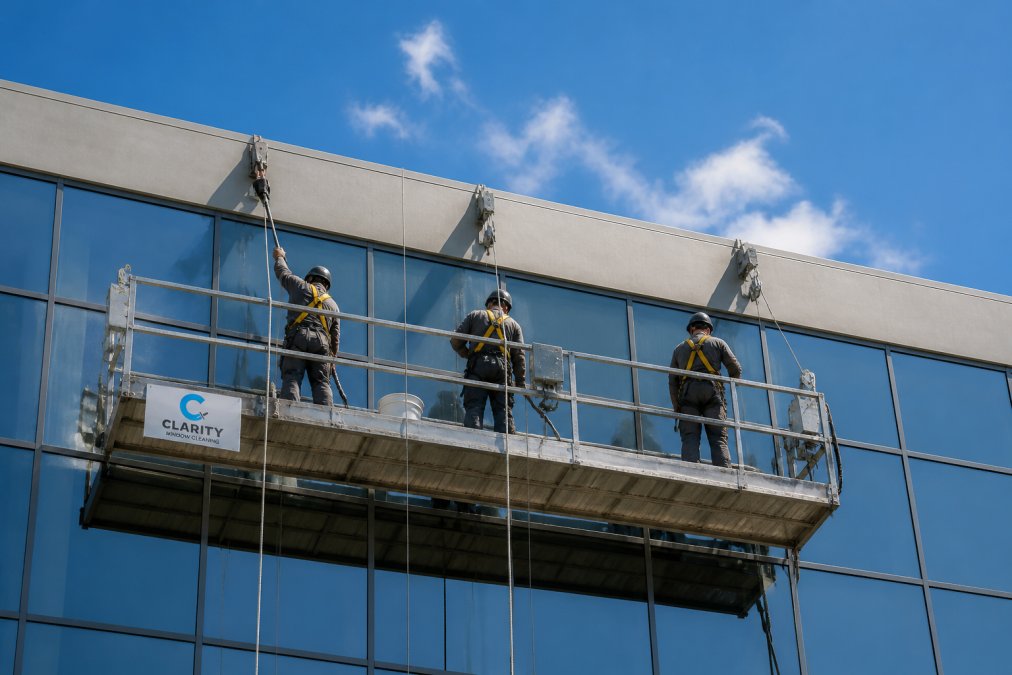
Swing stages, also known as suspended scaffolding, are the most common method for cleaning large expanses of curtain wall. These powered platforms hang from the roof via cables and allow technicians to work steadily across the facade. This method requires a secure roof anchorage system and a clear drop zone below to protect pedestrians. A qualified crew will set up barricades and signage to manage the area, ensuring that the operation does not disrupt your building's occupants or the public right-of-way.
Rope Descent Systems and Bosun Chairs
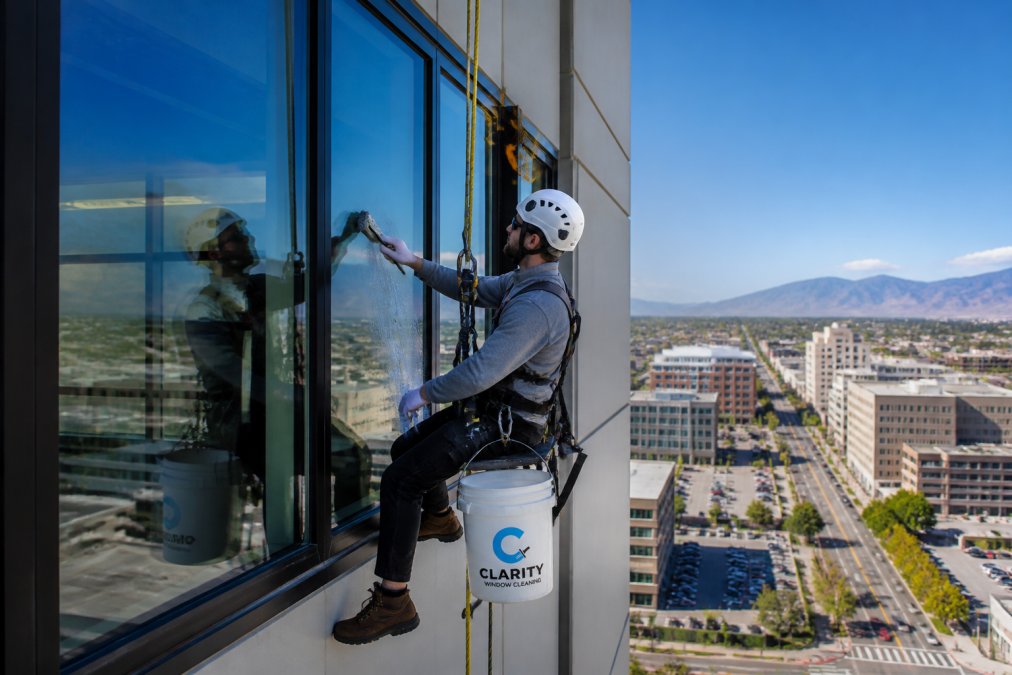
For buildings with complex architecture or limited roof access, rope access techniques using bosun chairs offer a more flexible solution. This method involves technicians descending on ropes with a seat and a separate safety line, giving them precision control around corners and architectural features. Rope access demands a high level of technician training and physical fitness, as the worker relies entirely on their rigging skills and the integrity of their anchorage points. While it is a highly effective method, it is not a shortcut; it is a specialized skill that requires continuous practice and certification.
Water-Fed Poles and Deionized Water Systems
Ground-based or balcony-based cleaning using water-fed poles is a growing trend for lower-rise sections and for routine maintenance between full-scale washes. These systems use telescoping poles with a brush head that delivers deionized water, which strips minerals and allows the glass to dry streak-free without the need for a squeegee. This method is excellent for safety because it keeps technicians on a stable surface, but it has limitations on very tall structures where pole reach becomes impractical. Deionized water systems are also a more sustainable choice, as they often use less chemical detergent than traditional methods.
Commercial Window Cleaning Frequency: Matching Schedules to Your Facade
The right commercial window cleaning frequency depends on your building's location, exposure, and the expectations of your tenants. A common benchmark is bi-annual maintenance for office towers in urban environments, but this is a starting point, not a one-size-fits-all rule. Buildings near construction sites, major roadways, or in areas with high pollen or bird activity may require quarterly cleaning to maintain a consistent appearance.
Consider the visual impact on your tenants and your property's image. A glass facade that is cleaned only twice a year will look acceptable for a few weeks after service, but will gradually accumulate a film of dirt and oxidation that dulls the building's appearance. For premium office space, a quarterly schedule keeps the property looking sharp and signals to tenants that the management is attentive. Clarity Window Cleaning offers customized service schedules that align with your operational needs, allowing you to avoid disruption during peak business hours or during sensitive tenant events.
How to Vet a High Rise Window Maintenance Contractor
Choosing a contractor for high rise building window maintenance is a decision that carries significant risk, so your vetting process must be rigorous. You are not just hiring someone to clean glass; you are hiring a partner to manage a safety-critical operation on your asset. This requires a review of their credentials, their equipment, and their approach to your specific building. Beyond the basics of insurance and safety plans, a truly professional partner will be transparent about the legal and operational frameworks that govern their work.
Verifying OSHA Compliance and Insurance Documents
Your first step is to request proof of OSHA compliance and comprehensive liability insurance. Do not accept a certificate of insurance that is expired or that shows inadequate coverage limits. The contractor should be able to provide a certificate naming your building as an additional insured, which protects you in the event of a claim. Also, ask about their workers' compensation coverage. If a technician is injured on your property and the contractor lacks proper coverage, the liability can fall back on you as the property owner. A reputable company will provide these documents without hesitation.
The Fine Print: What Your Service Level Agreement (SLA) Must Cover
A common oversight for property managers is treating the contract as a formality. In high rise work, the Service Level Agreement (SLA) is your primary risk management tool. It must go beyond a scope of work and price. Look for these specific clauses to protect your asset and define clear expectations:
- Indemnification and Hold Harmless: The contract should clearly state that the contractor indemnifies you against claims arising from their work, including negligence, property damage, and third-party injury. Ensure this clause is mutual but favors the party not at fault.
- Additional Insured Status: As mentioned, you must be named as an additional insured on their general liability policy. This is non-negotiable. Ask for the actual endorsement, not just a promise.
- Jobsite Safety and Compliance: The SLA should explicitly require the contractor to adhere to all applicable OSHA standards, maintain a site-specific safety plan, and provide proof of ongoing training for their technicians.
- Weather and Disruption Clauses: Define what happens in the event of inclement weather that halts work. Will you be charged for a partial day? What is the protocol for rescheduling? A clear clause prevents billing disputes.
- Performance and Quality Standards: Define what constitutes a 'clean' window. Is it free of streaks, spots, and film? Include a post-service inspection process where you or your facilities manager can sign off on the work before payment is released.
- Confidentiality and Security: For commercial buildings, technicians will have access to sensitive areas. The SLA should include a confidentiality clause and a protocol for background checks on all personnel.
What a Site-Specific Safety Plan Should Include
A site-specific safety plan is the contractor's roadmap for handling your building's unique challenges. This document should outline the access methods to be used, the location of anchorage points, the plan for managing the ground area, and the procedures for weather emergencies like high winds or lightning. The plan must be developed before work begins and reviewed with the crew on site. If a contractor shows up without a plan or tries to improvise on the day of the job, that is a major red flag. Clarity Window Cleaning provides site-specific safety plans and documentation for every project, ensuring that all risks are identified and mitigated before a single squeegee touches the glass.
Integrating with Your Building Management System (BMS)
A forward-thinking contractor will ask about your building management system (BMS). Window maintenance doesn't happen in a vacuum; it affects HVAC pressure, security access, and tenant comfort. A professional partner will coordinate with your facilities team to schedule work during planned HVAC shutdowns or low-occupancy periods. They should also be able to provide digital reports that can be logged into your maintenance management software, creating a clear audit trail of service history, inspections, and upcoming maintenance needs. This integration transforms window cleaning from a discrete task into a data point within your overall building operations strategy, improving efficiency and accountability.
Beyond Basic Washing: Glass Oxidation, Post-Construction, and Sustainability
Standard washing removes dirt, but it does not address embedded contaminants. Glass oxidation, which appears as a cloudy, etched film on the surface, often requires specialized treatment to restore clarity. Similarly, post-construction window cleaning is a distinct discipline that involves removing paint overspray, adhesive residue, and mortar splatter without scratching the glass. General contractors and construction managers should seek a team with specific experience in this area to avoid costly damage to new installations.
Sustainability is another factor that is gaining importance for property managers. Many facilities are looking to reduce their environmental footprint, and window cleaning is no exception. Eco-friendly cleaning agents and deionized water systems minimize chemical runoff into local waterways. When vetting a contractor, ask about their environmental practices. A commitment to sustainable methods can align with your building's green certification goals, such as LEED, and demonstrates a forward-thinking approach to building envelope maintenance.
Build a Maintenance Schedule That Protects Your Building Envelope
Effective high rise building window maintenance is a year-round commitment, not a single event. The best approach is to establish a preventative maintenance calendar that accounts for seasonal changes and your building's specific needs. A typical plan might include a thorough cleaning and inspection in the spring to remove winter grime and salt residue, followed by a lighter maintenance pass in the fall to prepare for the winter months.
| Maintenance Task | Recommended Frequency | Primary Benefit |
|---|---|---|
| Full exterior wash and inspection | Bi-annual or Quarterly | Removes oxidation, prevents seal failure |
| Spot cleaning of high-traffic entryways | Monthly | Maintains first-impression appearance |
| Post-construction restoration | One-time after project completion | Removes debris and coating residue safely |
| Sealant and caulk inspection | Annual | Prevents water intrusion and envelope damage |
Integrating window cleaning with your building management system (BMS) can also yield benefits. By coordinating cleaning schedules with HVAC shutdowns or other maintenance activities, you can minimize disruption and ensure that technicians have safe access to all areas of the facade. This level of coordination is where a professional partner like Clarity Window Cleaning adds tangible value, working directly with facilities managers to align service with operational rhythms.
High rise building window maintenance demands more than a bucket and a squeegee. It requires a commitment to safety, a deep understanding of the equipment, and a proactive approach to preserving your building envelope. Clarity Window Cleaning provides free estimates for all window cleaning needs, specializing in commercial and high rise work for facilities and property managers. Our certified technicians deliver OSHA-compliant service with site-specific safety plans, detailed post-service reporting, and fully insured coverage, giving you peace of mind and a pristine view. Get started with Clarity Window Cleaning and protect your building with a maintenance partner you can trust.
Frequently Asked Questions
What are the OSHA requirements for high rise window cleaning?
OSHA requires a site-specific safety plan, certified fall protection equipment, and proper training for all personnel. This includes regular safety inspections of suspended scaffolding, anchorage points, and personal fall arrest systems. Contractors must document their compliance procedures and provide proof of insurance. Facility managers should request these documents and verify that the crew's OSHA certification is current before work begins.
How often should high rise windows be professionally cleaned?
Most commercial properties need professional window cleaning quarterly, or at minimum bi-annually. The right frequency depends on your location, weather patterns, and building usage. Buildings near construction sites or busy roadways may need monthly service. Facilities managers should balance tenant expectations for clear glass against budget constraints, but deferred maintenance leads to glass oxidation and hard water stains that cost more to remediate later.
What safety equipment is required for high rise window maintenance?
A compliant crew uses a combination of suspended scaffolding, swing stages, or rope descent systems with bosun chairs, depending on the building's architecture. Every technician needs a safety harness with a lanyard connected to certified anchorage points, plus proper training in work-at-height procedures. Deionized water-fed pole systems allow ground-level cleaning for lower floors, reducing the amount of time crews spend suspended.
How do facilities managers vet high rise window cleaning contractors?
Ask for proof of OSHA compliance, liability insurance, and worker's compensation coverage. Request a site-specific safety plan that addresses your building's unique access points and anchorage locations. Verify that technicians have completed certified training programs. Check references from buildings similar to yours and ask about their experience with your specific facade type. A reputable contractor provides detailed documentation and welcomes your questions about their safety record.
What is the difference between rope descent systems and suspended scaffolding?
Rope descent systems, also called bosun chairs, give technicians more flexibility to reach complex architectural features and are faster to set up. Suspended scaffolding, or swing stages, provides a more stable work platform and allows crews to carry heavier equipment. The best choice depends on your building's height, facade design, and the scope of work. A qualified contractor assesses your structure and selects the method that balances safety, efficiency, and cost.
Can high rise windows be cleaned without disrupting building occupants?
Yes. Professional crews schedule work around business hours and use methods that minimize disruption. Water-fed pole systems clean from the ground, eliminating the need for exterior access on lower floors. For upper floors, crews coordinate with your facilities team to position equipment away from occupied areas. A good contractor provides a detailed schedule in advance and works quietly so tenants continue their operations without interruption.
How do I handle post-construction window cleaning for a new high rise?
Post-construction cleaning requires specialized techniques to remove cement splatter, paint overspray, and adhesive residue without scratching the glass. Standard cleaning methods often fail on these materials. Contractors with post-construction experience use specific solutions and scraping tools designed for each type of debris. Schedule this service before the building is fully occupied, and ask the contractor to document the process for your warranty records.
What causes streaking after professional window cleaning?
Streaking usually results from using tap water, which leaves mineral deposits as it dries. Professional crews use deionized water, which absorbs dissolved minerals and dries without residue. Another cause is cleaning glass that is too hot from direct sun, causing the solution to evaporate before the squeegee passes. A skilled technician adjusts their technique for weather conditions and uses the right tools to deliver a streak-free finish.