 ultimate-guide
Commercial Window Cleaning Maintenance Reporting Guide
Table of Contents
- Why Commercial Window Cleaning Reporting Matters for Facilities Managers
- What a Commercial Window Cleaning Checklist Should Cover
- OSHA Window Cleaning Compliance: What Must Be Documented
- Building a Window Cleaning Maintenance Schedule That Works
- Standardized Reporting Templates and Digital Tools
- Liability, Insurance, and Compliance Documentation
- How to Evaluate a Commercial Window Cleaning Provider's Reporting
- Conclusion
Last Updated: August 15, 2026
Why Commercial Window Cleaning Reporting Matters for Facilities Managers
Commercial window cleaning maintenance reporting is the documented record of every service visit, inspection finding, safety check, and post-service outcome tied to your building's glass assets. At Clarity Window Cleaning, we work directly with facilities managers and property managers and know that most reporting gaps aren't caused by negligence, they're caused by providers who treat the job as done the moment the squeegee comes off the glass.
Without structured documentation, you're managing a critical maintenance function on memory and goodwill. Neither holds up when your board asks for maintenance records, your insurer requests service logs, or a tenant files a complaint about streaking on a floor-to-ceiling window.
Below, we break down exactly what a reporting framework for commercial window cleaning should include, how to build a maintenance schedule that holds, and what separates a provider who documents properly from one who doesn't.
Accountability and Operational Transparency
Accountability in facility management is the difference between a defensible maintenance record and a liability gap. Every commercial window cleaning service visit should generate a paper trail: who was on site, what equipment was used, which areas were serviced, and what conditions were noted before and after.
Operational transparency means your service provider shares that documentation with you proactively, in a format you can file, forward, and reference. Many facilities managers only discover their provider's reporting is inadequate when they need records in a hurry.
Protecting Asset Value and Tenant Satisfaction
Neglected exterior glass degrades faster than most building owners expect. Mineral deposits, construction residue, and environmental buildup etch into glass over time, reducing clarity and eventually requiring costly restoration or replacement. Documented, scheduled maintenance creates a record that demonstrates proactive asset stewardship.
Tenant satisfaction is directly tied to building appearance. Clean, streak-free windows signal a well-managed property and influence prospective lessees during building tours.
What a Commercial Window Cleaning Checklist Should Cover
A commercial window cleaning checklist is a structured pre- and post-service document that confirms every critical task has been completed, every safety protocol followed, and every area of the building addressed. A good checklist is your quality assurance mechanism.
Most providers hand off a basic invoice. A professional framework delivers a completed checklist alongside it.
Pre-Service Site Inspection Items
Before any crew begins work, a thorough site inspection should confirm:
- Access points: Which floors, facades, and entry routes are cleared for the service date
- Anchor points and rigging: Condition and load certification of all roof anchors, davit arms, and suspended scaffold systems
- Hazard identification: Presence of HVAC units, signage, window-mounted equipment, or obstructions on the building exterior
- Window condition: Pre-existing damage, cracks, failed seals, or window film that requires special handling
- Tenant notification status: Confirmation that affected floors or suites have been notified per your service level agreement
- Weather conditions: Wind speed and precipitation checks, particularly critical for high-rise window cleaning above 10 stories
This pre-service documentation protects both parties. If a crack is discovered mid-service and wasn't logged beforehand, the liability question becomes complicated fast.
Post-Service Documentation Requirements
Post-service documentation closes the loop and should include:
- Confirmation of all areas serviced, mapped to the building's floor plan or facade diagram
- Notes on any areas skipped due to access restrictions or safety conditions, with a follow-up plan
- Photographic evidence of completed work on key elevations
- Record of cleaning solutions used, particularly relevant for buildings pursuing green cleaning standards
- Technician sign-off with license and certification numbers
- Supervisor quality review confirmation
This documentation feeds directly into your maintenance logs, supports your service level agreement compliance tracking, and gives you the evidence base you need for insurance verification and board reporting.
OSHA Window Cleaning Compliance: What Must Be Documented
OSHA compliance documentation for window cleaning is non-negotiable for any building above ground level, and especially critical for high-rise window cleaning operations.
According to OSHA's Walking-Working Surfaces standard (29 CFR 1910.28), employers and building owners have defined responsibilities when contractors perform work at height on their property. Your provider's compliance affects your facility's liability exposure.
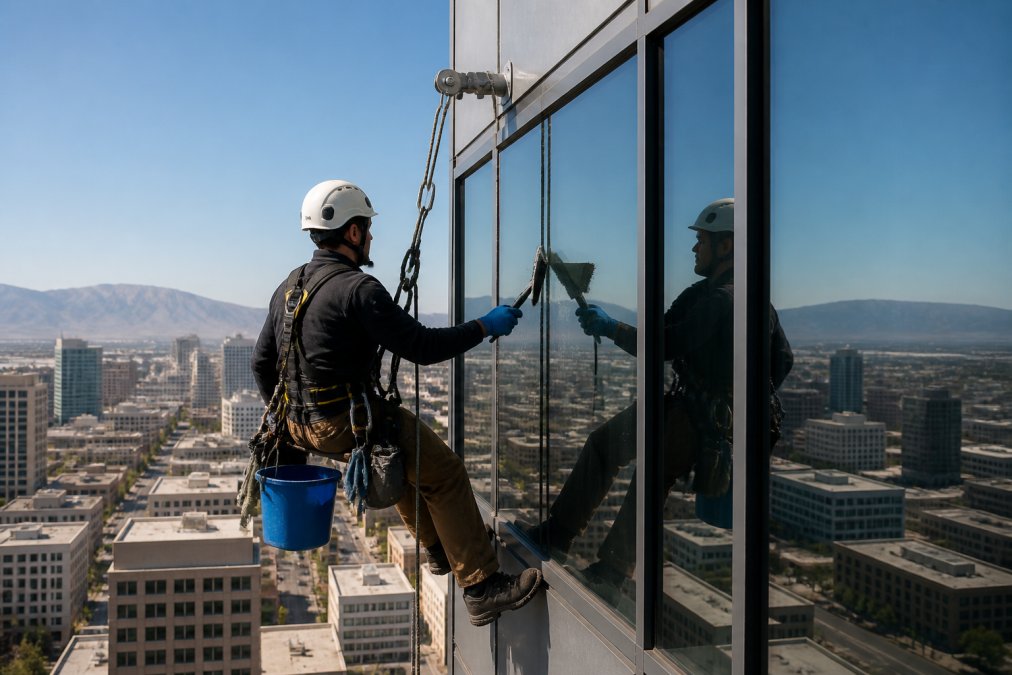
Required Safety Records for High-Rise Window Cleaning
For any high-rise window cleaning engagement, your provider should deliver:
- Site-specific safety plan: A written plan covering fall protection systems, emergency procedures, and equipment inspection protocols for your specific building
- Anchor point certification: Documented proof that all roof anchors and rigging points have been load-tested and certified by a qualified engineer
- Equipment inspection logs: Pre-use inspection records for all suspended platforms, bosun's chairs, rope descent systems, and personal protective equipment
- Technician training records: Proof that every crew member has completed OSHA-required fall protection training and any building-specific safety orientation
- Incident and near-miss reports: Any safety event should be documented and shared with the facility manager
- Insurance certificates: Current general liability and workers' compensation certificates, naming your property as an additional insured where required
The ANSI/IWCA I-14.1 Window Cleaning Safety Standard provides the industry's baseline framework for safe window cleaning operations. A provider who can't reference it by name is worth scrutinizing.
Building a Window Cleaning Maintenance Schedule That Works
A window cleaning maintenance schedule is a proactive calendar that aligns service frequency with building type, occupancy patterns, and environmental conditions. The goal is to prevent reactive cleaning and replace it with planned preventative maintenance that protects glass assets year-round.
Frequency by Building Type and High-Traffic Areas
Service frequency depends on your building's exposure, use, and tenant expectations.
| Building Type | Recommended Frequency | Key Considerations |
|---|---|---|
| High-rise office tower | Monthly to quarterly | High visibility, tenant expectations, wind-driven debris |
| Retail shopping center | Monthly | Storefront glass, high foot traffic, customer-facing appearance |
| Healthcare facility | Monthly to bi-monthly | Infection control standards, interior glass care requirements |
| Industrial complex | Quarterly to semi-annual | Heavier soiling, custom access scheduling to avoid disruption |
| Multi-tenant residential | Quarterly | Resident satisfaction, seasonal buildup, post-construction cleanup |
| Post-construction | As-needed (immediate) | Construction residue, overspray, protective film removal |
High-traffic areas within any building, lobbies, atriums, elevator banks with glass walls, warrant more frequent attention than upper-floor offices. These spaces create first impressions and directly reflect on building management.
Standardized Reporting Templates and Digital Tools
The biggest gap in most commercial window cleaning programs isn't the cleaning itself, it's the reporting infrastructure. Standardized reporting templates create consistency across every service visit, making it easy to compare results, identify recurring issues, and demonstrate compliance over time.

A standardized template should include fixed fields for service date, building address, technician names and certifications, areas serviced, cleaning methods and solutions used, pre-service conditions noted, post-service quality confirmation, and any deferred items with a follow-up timeline. When every report uses the same structure, your maintenance logs become genuinely useful.
Integrating Reports with Facility Management Software
Most modern facility management platforms support data import from service providers. The practical question is whether your window cleaning provider can deliver reports in a format your system accepts.
At minimum, look for providers who can deliver:
- PDF service reports with consistent field structure for easy filing
- Digital sign-off confirmation with time-stamped technician acknowledgment
- Photo documentation attached to each service record
- Exportable data for integration with your facility maintenance KPIs
The best providers treat reporting as a core deliverable, not an afterthought. When managing a high-rise office tower with dozens of service contractors, operational transparency from each vendor is what makes the whole system work.
Sustainability and Green Cleaning Metrics Worth Tracking
Green cleaning metrics are increasingly relevant for commercial properties pursuing LEED certification, ESG reporting requirements, or tenant sustainability commitments. For window cleaning, the metrics worth capturing include:
- Water consumption per service visit: Pure water systems use significantly less water than traditional methods and eliminate the need for chemical detergents
- Cleaning solution composition: Documentation of whether solutions are biodegradable and free of phosphates or VOCs
- Waste disposal records: How rinse water and any chemical waste are managed on site
- Carbon footprint of service logistics: Route efficiency and vehicle type for crews servicing your property
According to the U.S. Green Building Council's LEED Operations and Maintenance framework, cleaning product and protocol documentation is a component of several LEED O+M credits. Having that documentation ready from your service provider saves significant effort at certification time.
Liability, Insurance, and Compliance Documentation
Every commercial window cleaning provider working on your property should supply the following before any work begins:
- Certificate of insurance: General liability coverage and workers' compensation, with your property named as an additional insured. Request updated certificates annually.
- Bonding documentation: Confirmation that the provider is bonded, which protects your property in cases of damage or theft.
- OSHA compliance records: Evidence of fall protection training, equipment certifications, and site-specific safety plans.
- Contractor vetting documentation: For properties with formal contractor approval processes, ensure your window cleaning provider has completed your vendor qualification requirements.
Risk mitigation means closing the documentation loop before the work starts, not scrambling for paperwork after an incident. A provider who hesitates to supply any of these documents is telling you something important about how they operate.
The BOMA International's facility management best practices guidelines recommend maintaining a complete vendor compliance file for every active service contractor, reviewed and updated annually.
How to Evaluate a Commercial Window Cleaning Provider's Reporting
Most providers can clean glass. Fewer can demonstrate a professional reporting framework that meets the standards facilities managers actually need.
Ask for a sample service report before you sign anything. A provider confident in their documentation process will share one immediately. If they can't produce a sample or describe a consistent reporting format, that's your answer.
Verify insurance and certification independently. Request the actual certificate of insurance and confirm the coverage amounts are adequate for your building's risk profile.
Evaluate their site-specific safety planning process. For high-rise window cleaning, ask how they develop the site-specific safety plan for your building. Generic answers suggest generic plans.
Check their communication protocols. How do they notify you before a service visit? How quickly do they report a deferred area or a safety concern discovered on site?
Ask about their quality assurance process. Who reviews completed work before the crew leaves? Is there a supervisor sign-off requirement?
Clarity Window Cleaning provides free estimates for all commercial window cleaning needs. Certified technicians, OSHA-compliant practices, site-specific safety plans, and detailed post-service reporting are the baseline for any provider working on a commercial or high-rise property.
Conclusion
Managing a commercial property's window cleaning program without a structured reporting framework is a liability waiting to surface. The documentation gap affects asset value, tenant satisfaction, safety compliance, and your ability to demonstrate due diligence to insurers and boards.
Clarity Window Cleaning works directly with facilities managers and property managers to deliver OSHA-compliant commercial window cleaning with the detailed reporting, site-specific safety planning, and scheduling flexibility that high-rise and multi-tenant properties require. Request a free estimate and see what professional, fully documented window cleaning service looks like in practice.
Frequently Asked Questions
What should be included in a commercial window cleaning maintenance report?
A thorough maintenance report should include the date and time of service, areas cleaned (interior, exterior, high-rise zones), technician names and certifications, equipment used, any damage or defects observed, before-and-after photo documentation, and supervisor sign-off. For high-rise commercial window cleaning, the report should also note anchor points used, weather conditions, and any site-specific safety deviations. This documentation supports board reporting, insurance verification, and long-term facility asset management.
How often should facilities managers schedule commercial window cleaning?
Service frequency depends on building type, location, and tenant expectations. Most high-rise office towers benefit from quarterly exterior cleaning at minimum, with monthly interior glass care in high-traffic lobbies and common areas. Retail centers and healthcare facilities often require more frequent scheduled service. A written window cleaning maintenance schedule tied to your service level agreement keeps cleaning consistent, supports preventative maintenance goals, and gives you a documented record for compliance and budgeting purposes.
Why is documentation important for high-rise window cleaning?
Documentation protects both the building owner and the contractor. For high-rise window cleaning, OSHA standards under 29 CFR 1910 and 1926 require records of fall protection systems, equipment inspections, and site-specific safety plans. Proper maintenance logs demonstrate due diligence if an incident occurs, support insurance claims, and satisfy contractor vetting requirements. Facilities managers who maintain thorough records also have a clearer picture of service history, which helps when renegotiating service agreements or addressing tenant complaints.
What safety compliance standards should be documented in window cleaning reports?
Reports should reference OSHA 29 CFR 1910.28 and 1926.502 for fall protection, along with ANSI/IWCA I-14.1 for window cleaning safety. Documentation should confirm that all technicians hold current certifications, that equipment passed pre-use inspection, that site-specific safety plans were followed, and that the contractor carries general liability and workers' compensation insurance. Facilities managers should request certificates of insurance before each service visit and retain them as part of their compliance documentation.
This article was written using GrandRanker
Frequently Asked Questions
What should be included in a commercial window cleaning maintenance report?
A thorough maintenance report should include the date and time of service, areas cleaned (interior, exterior, high-rise zones), technician names and certifications, equipment used, any damage or defects observed, before-and-after photo documentation, and supervisor sign-off. For high-rise commercial window cleaning, the report should also note anchor points used, weather conditions, and any site-specific safety deviations. This documentation supports board reporting, insurance verification, and long-term facility asset management.
How often should facilities managers schedule commercial window cleaning?
Service frequency depends on building type, location, and tenant expectations. Most high-rise office towers benefit from quarterly exterior cleaning at minimum, with monthly interior glass care in high-traffic lobbies and common areas. Retail centers and healthcare facilities often require more frequent scheduled service. A written window cleaning maintenance schedule tied to your service level agreement keeps cleaning consistent, supports preventative maintenance goals, and gives you a documented record for compliance and budgeting purposes.
Why is documentation important for high-rise window cleaning?
Documentation protects both the building owner and the contractor. For high-rise window cleaning, OSHA standards under 29 CFR 1910 and 1926 require records of fall protection systems, equipment inspections, and site-specific safety plans. Proper maintenance logs demonstrate due diligence if an incident occurs, support insurance claims, and satisfy contractor vetting requirements. Facilities managers who maintain thorough records also have a clearer picture of service history, which helps when renegotiating service agreements or addressing tenant complaints.
What safety compliance standards should be documented in window cleaning reports?
Reports should reference OSHA 29 CFR 1910.28 and 1926.502 for fall protection, along with ANSI/IWCA I-14.1 for window cleaning safety. Documentation should confirm that all technicians hold current certifications, that equipment passed pre-use inspection, that site-specific safety plans were followed, and that the contractor carries general liability and workers' compensation insurance. Facilities managers should request certificates of insurance before each service visit and retain them as part of their compliance documentation.